When HMS Prince of Wales arrived in Singapore in June 2025, Britain’s Indo-Pacific engagement acquired a conspicuous physical form. Yet a carrier alongside a quay cannot explain what its host wants from the relationship. Southeast Asian governments seek security, investment and room to make their own choices; they do not necessarily understand a visiting fleet as an invitation to join a geopolitical camp. Britain’s challenge is to make its presence useful within that pursuit of autonomy. The events surrounding ASEAN’s regional outlook, AUKUS, trade accession and Myanmar suggest a mixed record: London has widened its institutional access and supplied additional partnerships, while encountering clear limits on its ability to shape either regional alignment or the conduct of coercive actors.
June 2019: ASEAN defines the question
ASEAN’s Outlook on the Indo-Pacific, adopted in June 2019, presented an inclusive framework centred on dialogue, cooperation and the organisation’s own convening role. Its principles included sovereignty, non-intervention and respect for international law, including the UN Convention on the Law of the Sea. The document was an intervention in how the region should be understood: an interconnected space for cooperation, rather than an arena whose future must be organised entirely around major-power rivalry. [1]
This was neither a declaration that power politics had disappeared nor a single national strategy shared by every member. A collective text establishes what governments can endorse together. Their security relationships, economic structures and domestic priorities remain different. Its diplomatic value lies partly in providing common language that members can use when resisting arrangements they regard as too exclusive or demanding.
An English School interpretation takes those practices seriously. ASEAN helps sustain a regional international society in which states recognise rules of coexistence despite profound differences in political systems and material strength. Consultation and sovereign equality are therefore more than decorative language. They protect the claim of smaller states to participate in defining order, rather than merely receiving it from stronger powers.
The limitation is equally important. A preference for non-intervention can preserve working relations while making it harder to confront violence within a member state. Consensus can prevent domination by one participant and also inhibit a timely collective response. Britain needs to engage this tension as a political reality. Praising ASEAN centrality in general, then bypassing regional concerns whenever they complicate a British initiative, would make the endorsement difficult to credit.
August 2021: Britain gains a place in the conversation
Britain became an ASEAN dialogue partner in August 2021, the first new country to receive that status in twenty-five years. The British government placed the decision within the Indo-Pacific tilt announced in its Integrated Review. The institutional change was concrete: London gained a recognised relationship with ASEAN as a separate partner following its departure from the European Union. It did not acquire membership of ASEAN or the right to direct the organisation’s agenda. [2]
On 4 August 2022, the partners adopted a plan of action for 2022–26. Its provisions covered political consultation, maritime cooperation, economic integration, education and other fields. The text supported ASEAN’s Outlook while acknowledging Britain’s tilt, bringing two differently motivated projects into a common programme. It also set out regular mechanisms through which officials could develop and review cooperation. [3]
This was a diplomatic success because access became structured rather than dependent on occasional visits. Repeated contact can improve knowledge of regional preferences, expose problems before they become crises and connect proposals to officials capable of implementing them. But a plan containing many areas for possible cooperation should not be read as proof that all those activities were funded or completed.
For Britain, usefulness is the most plausible route from access to influence. Maritime expertise, educational partnerships and financial services can address priorities that governments already hold. Their value does not depend on persuading the region to adopt Britain’s entire strategic interpretation. Indeed, a relationship may become more durable when participation offers practical benefits without requiring agreement on every question involving China or the United States.
A region with several strategic perspectives
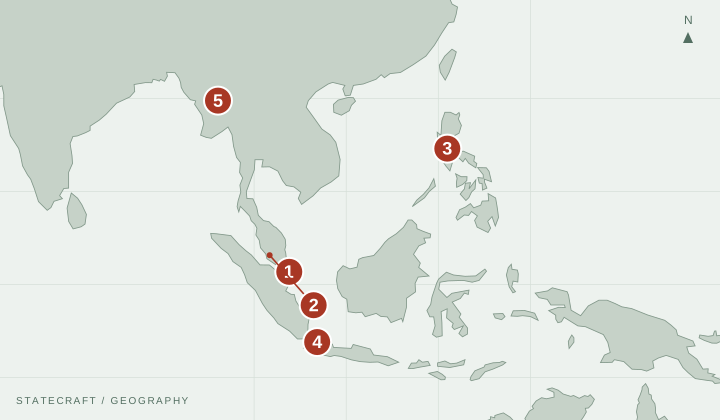
- Singapore
A British dialogue partner and member of the Five Power Defence Arrangements.
- Kuala Lumpur
Malaysia: defence cooperation with Britain alongside concerns about AUKUS.
- Manila
The Philippines: a South China Sea claimant and US treaty ally.
- Jakarta
ASEAN’s secretariat is based in Indonesia; centrality means preserving regional agency.
- Naypyidaw
Myanmar’s crisis exposes the limits of regional consultation.
September 2021: AUKUS meets different regional judgements
Only weeks after the dialogue partnership, Britain, Australia and the United States announced AUKUS on 15 September 2021. Its initial submarine project aimed to help Australia acquire nuclear-powered boats; the British announcement explicitly distinguished nuclear propulsion from nuclear armament. It also described a technologically demanding undertaking extending over decades. The announcement committed the partners to a programme, rather than delivering an immediate new Australian submarine force. [4]
Malaysia’s foreign ministry responded on 19 September with concern that AUKUS could intensify a regional arms race. Its statement emphasised non-proliferation and existing regional legal arrangements. This was a declared Malaysian assessment of risk. It should neither be attributed to ASEAN as a whole nor dismissed as proof that Malaysia opposed every form of British defence engagement. [5]
Singapore’s response was differently framed. Following a telephone call with Australia’s prime minister on 16 September, its government said that Lee Hsien Loong hoped AUKUS would contribute to regional peace and stability and complement the existing architecture. That was a conditional expression of hope, not an unlimited endorsement of every future activity under the partnership. The contrast with Malaysia demonstrates why a single category of regional approval or opposition is misleading. [6]
The dispute involved competing accounts of order. The AUKUS partners presented stronger capability and cooperation as a contribution to stability. Concerned regional governments asked whether the same development might deepen rivalry or unsettle established assurances. Both accounts require attention to consequences. Deterrence may discourage coercion, while a measure intended to reassure some governments may increase the anxieties of others.
Britain’s appropriate response is sustained explanation and consultation, supported by credible non-proliferation arrangements and clarity about what the partnership does. Public diplomacy cannot eliminate a substantive disagreement, but it can prevent inaccurate assumptions from becoming the entire debate. Treating scepticism as disloyalty would defeat the purpose of an engagement strategy that claims to support regional autonomy.
From announcement to capability
The March 2023 AUKUS announcement selected a submarine design based on British work and envisaged construction in Britain and Australia. The published timetable placed the future British boats in the late 2030s. This gave Britain a significant industrial and strategic role, but it also placed the central capability well beyond the announcement itself. Design decisions, workforce development, infrastructure and sustained funding would determine whether the promised force became available. [7]
That distinction changes the assessment of diplomatic success. A partner can welcome the prospect of a more capable security relationship today while remaining uncertain about its delivery. Conversely, a government can worry about a future military balance before the underlying equipment exists. Analysts should therefore separate signalling effects from operational effects, and both from the industrial risks of a programme spanning several administrations.
Britain also has to reconcile different geographic commitments. A long-term Indo-Pacific partnership can support wider deterrence and industrial cooperation, but every personnel requirement, maintenance period and spending decision competes with other uses. It is insufficient to count the number of partnerships announced. The strategic question is whether Britain can sustain the contribution on which those relationships depend.
The implication for Southeast Asian autonomy is conditional. Additional capable partners may widen regional choices and reduce dependence on any single power. They may also ask for access or political support that narrows a host’s freedom of manoeuvre. The net effect turns on the terms of cooperation. British statecraft succeeds when partners can identify tangible benefits and retain an intelligible say over the obligations they accept.
An older partnership offers a different model
The Five Power Defence Arrangements provide a longer-established form of British engagement with Australia, Malaysia, New Zealand and Singapore. Britain’s account of Exercise Bersama Lima in 2023 described the arrangements as consultative and recorded joint activity involving its forces. Consultation in response to a threat should not be confused with an automatic NATO-style commitment to a particular military response. The arrangement’s value lies partly in a scope participants have been able to sustain. [8]
At their meeting on 31 May 2024, the five defence ministers reaffirmed the partnership and reviewed recent exercises, including Bersama Lima in October 2023 and Bersama Shield in April–May 2024. The joint statement linked this activity to trust and interoperability. These are the participants’ assessments, supported by evidence that exercises occurred; they do not independently establish how much conflict was deterred. [9]
Nevertheless, repeated training has a plausible practical mechanism. Forces learn procedures, communications and the limits of each other’s capabilities. Officials develop relationships that may make consultation easier during uncertainty. The benefits accumulate through routine activity and can survive differences over other strategic questions. Malaysia’s membership alongside its concerns about AUKUS is therefore entirely intelligible: governments evaluate particular arrangements rather than accept or reject an external power in the abstract.
For Britain, this is a lesson in diplomatic patience. An established, bounded contribution can earn confidence without requiring a fresh declaration of regional leadership. It also gives partners more opportunity to shape cooperation over time. The risk is complacency: longevity alone does not establish continuing relevance. Exercises and consultations must keep serving purposes that the participating states can defend domestically as well as to one another.
The South China Sea: support for rules has a precise scope
On 12 July 2023, Britain reaffirmed that the 2016 South China Sea arbitral decision was final and binding on the Philippines and China. Its statement also said that the UK did not take a position on competing sovereignty claims. These propositions are compatible. Britain could support the legal rules governing maritime entitlements and dispute settlement without deciding which state owned every disputed land feature. [10]
That precision matters because loose descriptions of defending a regional order can conceal very different commitments. A statement supporting an arbitral award is not a defence treaty with a claimant, nor a promise to enforce every legal conclusion through force. It is a diplomatic act that reinforces the legitimacy of adjudication and raises the reputational cost of disregarding it.
The English School perspective helps explain why that act can still matter. If material power alone determined lawful maritime rights, smaller states would face a much narrower range of choices. Public support for a legal framework contributes to a society in which claims require justification beyond capability. Yet law’s authority does not remove the practical imbalance between actors able to sustain a presence at sea.
Britain’s contribution should consequently be assessed as part of a wider set of measures: legal consistency, maritime cooperation, diplomatic coordination and an appropriately explained naval presence. The objective is to support peaceful dispute management and the freedom of regional states to pursue lawful activities. A conspicuous operation that increases tension without a clear connection to those purposes would offer a weaker account of success than a quieter improvement in regional capacity.
December 2024: trade creates another kind of option
The Comprehensive and Progressive Agreement for Trans-Pacific Partnership entered into force between Britain and an initial group of ratifying members on 15 December 2024. These included Brunei, Malaysia, Singapore and Vietnam. For Britain and Malaysia, it established their first free-trade agreement. The change created new legal opportunities for trade, with actual benefits depending on firms using the agreement and meeting its requirements. It did not demonstrate an immediate increase in national income on the date of entry. [11]
The strategic relevance extends beyond export promotion. A wider choice of markets, suppliers and investment relationships can help governments manage dependence. Trade cooperation also gives the British relationship substance outside defence. That is particularly valuable where partners wish to avoid having every external engagement interpreted as a decision about military alignment.
However, membership of a trade agreement is not evidence that participants share a common position on China. Nor does a new agreement eliminate the commercial importance of geography or existing supply chains. Britain should avoid presenting economic cooperation as a covert loyalty test. Doing so would make a mechanism intended to widen options appear to narrow them.
The appropriate material tests are specific: preference use, reduced administrative obstacles, new commercial relationships and the distribution of gains. Aggregate forecasts can help frame expectations, but should remain forecasts until supported by outcomes. Diplomatic success is easier to establish at this stage: Britain joined an operating regional institution whose members accepted its accession. The size and resilience of the economic gains require a longer record.
What a forced choice reveals—and obscures
The ISEAS–Yusof Ishak Institute’s 2024 State of Southeast Asia survey illustrates the difficulty of compressing regional preferences into a single alignment. When respondents were asked to choose between China and the United States, the weighted regional result was 50.5 per cent for China and 49.5 per cent for the United States. Country results varied sharply. These were findings from a survey of selected regional stakeholders, not a representative ballot of Southeast Asia’s population or an official ASEAN policy. [12]
The question is useful precisely when its limitation is kept visible. It records how respondents answer a forced choice. It does not show that their governments want to be forced to choose, or that a preference in one domain determines choices in all others. A state may seek economic engagement with China, security cooperation with the United States and institutional partnerships with Europe at the same time.
For Britain, the inference is to ask better questions. What vulnerability does a partner want to reduce? Which forms of cooperation can its government sustain? What would make a British offer burdensome rather than helpful? These questions direct attention to local agency and the terms of a relationship instead of assuming that influence means moving a country from one camp to another.
Strategic autonomy is also uneven within states. Businesses, officials and communities may experience the same agreement differently. A policy that diversifies national options can expose a particular industry to new competition or impose costs on a coastal community. British engagement becomes more convincing when its account of mutual benefit is open to those differences, rather than relying only on agreement between national executives.
A forced choice conceals the differences
ISEAS 2024 survey · Preferred alignment if ASEAN had to choose
Values shown as China / United States. Each bar totals 100%.
Myanmar: when coexistence fails to protect people
Myanmar reveals the severe limits of a regional order built around consultation. ASEAN’s November 2022 review recorded little progress in implementing the Five-Point Consensus agreed in April 2021 and called for compliance by Myanmar’s armed forces. The review supplied the organisation’s own evidence that maintaining a common diplomatic framework had not secured the intended response. Its continuing commitment to engagement should be judged alongside that admission. [13]
Britain helped bring the issue into the Security Council. Resolution 2669, adopted on 21 December 2022, demanded an end to violence and urged the release of arbitrarily detained prisoners. Britain’s explanation described weeks of consultation with Council members, ASEAN states and regional partners. The result was a substantive diplomatic text achieved through a coalition wider than Britain’s closest allies, but it did not establish a comprehensive enforcement mechanism. [14]
On 29 October 2024, Britain announced sanctions against six entities involved in supplying aviation fuel or restricted goods, including aircraft parts, to Myanmar’s military. The measures were announced alongside action by the EU and Canada. Their intended mechanism was material: make access to resources used by the military more difficult. The existence of designations demonstrates a restriction imposed, rather than establishing the degree to which supply was actually interrupted. [15]
ASEAN’s own review of 9 October 2024 expressed concern about escalating conflict and the humanitarian situation, denouncing violence against civilians and public facilities. This record prevents a comfortable conclusion that repeated diplomacy had delivered civilian security. It also underlines why Myanmar’s people cannot be treated merely as an object of competition between external powers. Their safety and political agency are central to judging the regional order’s legitimacy. [16]
The British response combined regional consultation, UN action and selective economic pressure. That combination was defensible, but its limits must remain explicit. Sanctions can be evaded and diplomatic demands resisted. A policy supporting ASEAN should therefore ask how regional engagement serves affected people, and how humanitarian assistance and inclusive political contact can reach beyond formal exchanges with governments. Respect for regional ownership must not become a reason to stop examining failure.
June 2025: Britain’s presence faces a practical test
The arrival of HMS Prince of Wales in Singapore on 23 June 2025 brought the argument back to visible British capability. The Royal Navy recorded the carrier group’s Southeast Asian visits as part of Operation Highmast. This establishes that Britain deployed a significant force and used the visit for engagement. It does not establish that every regional government interpreted the deployment favourably or that the visit itself changed a contested actor’s behaviour. [17]
The strongest case for the deployment is that presence can support training, demonstrate the ability to operate with partners and give diplomatic commitments practical substance. The opportunity cost is that ships, personnel and support capacity are finite. Its value therefore depends on what the engagement enables and whether that contribution can be sustained alongside Britain’s other responsibilities.
The comparison between the carrier visit and the dialogue partnership is instructive. One demonstrates the ability to arrive with substantial assets; the other provides a channel for learning what partners actually need. A coherent policy connects them. Officials should be able to explain how the deployment advances agreed cooperation, what practical work continues after the ships leave and what partners regard as its value. Without that connection, the visibility of a visit can exceed the durability of the relationship it is intended to strengthen.
Taken together, the cases show British progress in access and partnership, with more qualified evidence of wider strategic transformation. Dialogue status, trade accession and repeated exercises are identifiable achievements. They widen the instruments available to Britain and its partners. Myanmar and contested maritime conduct show the much harder problem of converting those instruments into restraint.
An English School judgement favours a British role that strengthens a regional society in which smaller states have meaningful choices. That requires lawful conduct, reliable contributions and respect for disagreement. Britain will not earn durable influence by asking Southeast Asia to disappear inside a story about two great powers. It is more likely to earn it by helping regional governments and people preserve the space in which their own priorities can be pursued.
Presence arrives before influence

Sources & notes
- ASEAN — Outlook on the Indo-Pacific, June 2019 ↗Back to the essay ↑
- UK government — ASEAN dialogue-partner status, August 2021 ↗Back to the essay ↑
- ASEAN — Plan of action with the United Kingdom, 4 August 2022 ↗Back to the essay ↑
- Boris Johnson — Announcement of AUKUS, 15 September 2021 ↗Back to the essay ↑
- Malaysian Ministry of Foreign Affairs — Response to AUKUS, 19 September 2021 ↗Back to the essay ↑
- Singapore Ministry of Foreign Affairs — Prime ministers’ telephone call, 16 September 2021 ↗Back to the essay ↑
- UK government — AUKUS design and intended timetable, 13 March 2023 ↗Back to the essay ↑
- UK government — Bersama Lima and the consultative FPDA, 2023 ↗Back to the essay ↑
- Five Power Defence Arrangements — Joint ministerial statement, 31 May 2024 ↗Back to the essay ↑
- UK government — South China Sea legal position, 12 July 2023 ↗Back to the essay ↑
- UK government — CPTPP entry into force, 15 December 2024 ↗Back to the essay ↑
- ISEAS–Yusof Ishak Institute — The State of Southeast Asia 2024 survey report ↗Back to the essay ↑
- ASEAN — Review of the Five-Point Consensus, 11 November 2022 ↗Back to the essay ↑
- UK Mission to the UN — Explanation of Resolution 2669, 21 December 2022 ↗Back to the essay ↑
- UK government — Coordinated Myanmar sanctions, 29 October 2024 ↗Back to the essay ↑
- ASEAN — Myanmar review, 9 October 2024 ↗Back to the essay ↑
- Royal Navy — Carrier arrival in Singapore, 23 June 2025 ↗Back to the essay ↑
This is an analytical essay, grounded in the dated developments and official positions above. Interpretations and illustrative scenarios are distinguished from reported events. Drafted with AI assistance. Maps and evidence graphics: Statecraft. Documentary photographs are dated and credited individually. Read our editorial approach.