A household energy payment and an air-defence commitment to Ukraine appear to belong to different political conversations. One concerns the cost of keeping a home warm; the other, the cost of helping a state defend itself. In a country exposed to international energy prices and committed to European security, however, each raises a common question: how much room does Britain have to respond when events beyond its borders become more expensive? The Budget delivered on 28 October makes that connection unusually visible. Its energy measures address the domestic consequences of disruption abroad. Its defence commitments seek to strengthen the means of responding to insecurity. Its financial backing for Ukraine attempts to sustain a partner under attack. Reading these choices together reveals a foreign policy whose practical limits are partly determined at home. The central issue is strategic freedom: the ability to maintain essential commitments, absorb disruption and choose between courses of action without being forced into abrupt retreat. This freedom does not require Britain to produce everything itself or act without allies. It requires a clearer understanding of which dependencies it can manage, which it needs to reduce, and which obligations it can sustain. The English School of international relations supplies a useful lens. States compete for power while also sustaining a society organised around sovereignty, diplomacy and international law. The question is how Britain finances its own security while supporting that wider order. This approach examines tensions between order and justice without assuming that national interests and shared responsibilities always coincide. [1].
How an external shock narrows choices
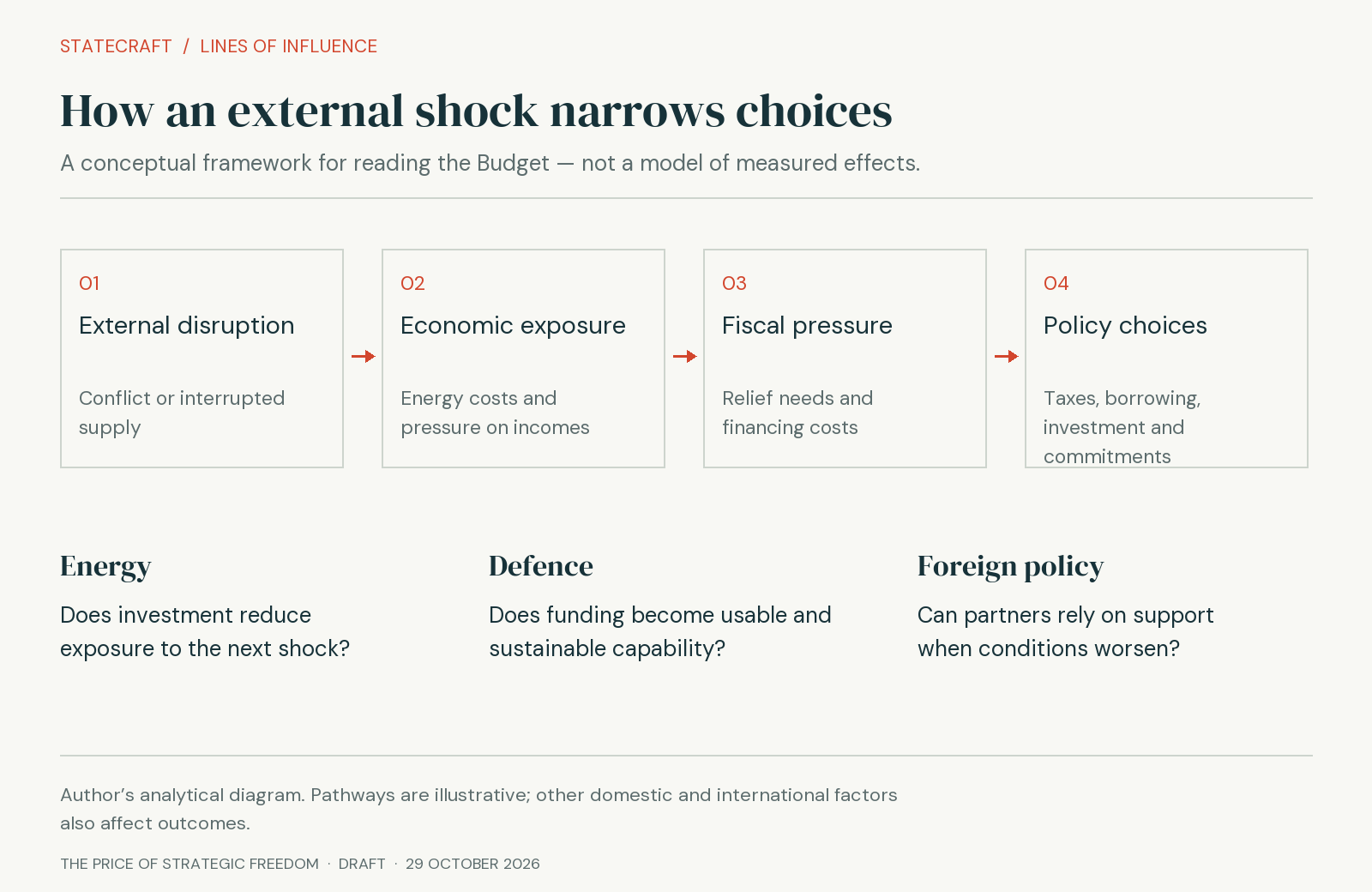
When an energy shock becomes a fiscal constraint
The Office for Budget Responsibility’s October outlook identifies higher energy prices and interest rates as important pressures on the economy and public finances. Its central forecast puts the current-budget surplus at £15 billion in 2029–30 and estimates a 56 per cent probability of meeting the corresponding fiscal mandate. Those are forecasts, not money held separately for emergencies. The OBR also notes that energy-market prices had moved further after the assumptions underlying its forecast were set. [2].
The strategic relevance lies in the mechanism. When energy becomes more expensive, households have less to spend elsewhere and businesses face higher operating costs. A government may then face demands for assistance at the same time as other spending commitments become harder to finance. A foreign crisis can narrow domestic choices without an adversary directly targeting British territory.
This does not mean every movement in borrowing costs is caused by war, or that every domestic economic weakness originates overseas. It means external exposure can amplify existing constraints. The cost of an international commitment includes the possibility of sustaining it while the economy is under pressure for other reasons.
Fiscal rules organise these choices and can restrain commitments without durable funding. But weapons programmes, electricity networks and alliance obligations extend beyond a forecast horizon. Meeting a rule at one date does not establish that every commitment remains affordable thereafter.
The appropriate question is therefore how the government plans for adverse conditions. Would a prolonged energy shock require a reduction in defence procurement? Would it lead to further borrowing, higher taxes or changes elsewhere? A credible strategy should identify the choices and contingencies, even when it cannot predict which will be necessary.
Room for manoeuvre is valuable precisely because forecasts can be wrong. The test is whether Britain retains workable alternatives when a central assumption fails.
Jackdaw and the competing responsibilities of energy security
The Budget proposes a £100 payment from January 2027 for households in council tax bands A–D in England, with funding for devolved governments, and extends the electricity VAT cut to July 2027. It also proposes a Cost Control Framework at the 2027 Spending Review and abandons the planned gas levy for hydrogen funding. These measures operate on different timescales. [3].
The Chancellor also confirmed in his speech that Jackdaw had been approved the previous week. The regulator granted development and production consent on 21 October, after the Energy Secretary’s agreement. This concerns an already licensed North Sea gas field, rather than a new exploration licence. Consent allows the project to proceed; it does not establish that production has begun. [4]; [5].
The government presented the decision as support for energy security and jobs, alongside a transition towards lower-carbon energy. It expected supply as early as the end of October; that remained an expectation at this draft’s evidence cutoff. Its announcement also records that the assessment had to consider emissions from burning the extracted gas following the Finch judgment. [6].
Domestic production can contribute to physical supply without insulating consumers from international prices. Ofgem describes the close relationship between British gas and electricity wholesale prices and international gas markets. The location of a field therefore cannot, by itself, establish the size of any household saving. [7].
Jackdaw exposes an English School tension between sovereign discretion and common responsibilities. A government must consider domestic supply and livelihoods, while climate effects cross borders. English School scholarship on environmental stewardship examines how ecological responsibility has become part of international society alongside sovereignty and markets. This lens does not settle whether Jackdaw should proceed; it asks how Britain justifies the decision against both sets of obligations. [8].
The practical test is whether additional production forms part of a credible transition, with demand, emissions and replacement infrastructure considered together. The National Wealth Fund says £2 billion is allocated for an Energy Wealth Fund within its additional capitalisation. That is finance to deploy, not operating infrastructure. [9].
Relief helps households withstand present costs; resilient infrastructure changes future exposure. Jackdaw adds a further question: how should a state manage continuing fossil-fuel dependence while meeting its responsibilities beyond its borders?
Offshore production and strategic dependence

Financing the plan is one stage of building a force
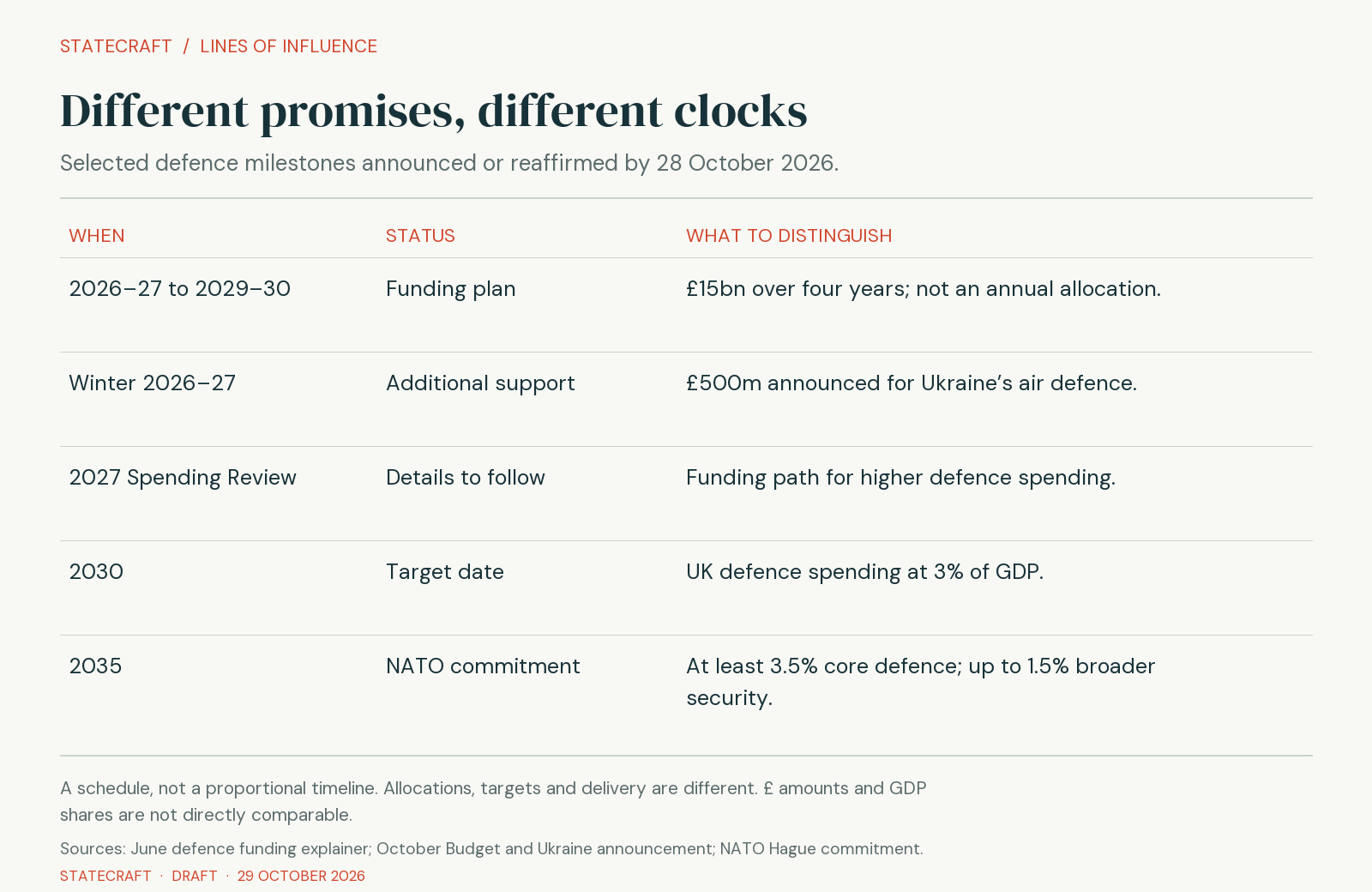
Defence presents a comparable problem of time and translation. The June funding explainer set out a £15 billion Defence Investment Plan across 2026–27 to 2029–30, including £4.7 billion still to be funded at this Budget. That makes it misleading to treat the entire £15 billion as a wholly new annual allocation announced in October. [10].
The Treasury now says that gap is funded through reprioritisation of capital budgets. It also sets a target date of 2030 for defence spending to reach 3 per cent of GDP, while leaving the detailed path to the 2027 Spending Review. Closing a funding gap and establishing a fully specified future spending settlement are distinct achievements. [11].
Reprioritisation is a real choice, with an opportunity cost. Investment transferred to defence is unavailable for its previous purpose unless replaced. The strategic assessment should consider both sides: the military capability gained and the effects of the displaced investment. Without departmental detail and delivery evidence, it would be premature to conclude either that these transfers are harmless or that they necessarily damage national resilience.
There is also a distinction between affordability and effectiveness. An affordable programme can arrive late, perform poorly or lack the people and maintenance needed to use it. Conversely, an apparently expensive support contract may protect the availability of equipment already purchased. The headline acquisition is only part of the capability.
Historical scrutiny gives reason to examine assumptions carefully. In December 2023, the National Audit Office identified a £16.9 billion affordability gap in the 2023–2033 Equipment Plan. That was an assessment of an earlier plan, not a current estimate of the October 2026 position. Its relevance is methodological: a spending ambition requires consistent cost forecasts and explicit choices about what can actually be delivered. [12].
For the new settlement, the useful questions are operational. What additional readiness will result? Which production bottlenecks will be removed? How will stockpiles, personnel, infrastructure and maintenance support the equipment ordered? What happens if costs rise faster than expected?
Publishing answers would strengthen the government’s argument for investment. It would also make scrutiny more demanding. A percentage of GDP can demonstrate political priority, but it cannot establish that a force is ready for a particular task.
Different promises, different clocks
Private finance does not remove public responsibility
The new Innovative Defence Financing Taskforce is charged with identifying opportunities for private and international investment, supporting procurement reform and helping smaller companies access finance. Its terms include potential public-private partnerships where they offer value for money, and it is due to run until the next Spending Review. [16].
Investment can help firms expand production or develop technology before revenue from a large contract arrives. This may be particularly useful where a promising supplier faces a gap between demonstrating an idea and producing it at scale. A government seeking more capability should examine whether its contracting practices themselves make that gap unnecessarily difficult to cross.
However, finance and funding remain different. An investor supplies capital in expectation of a return. Someone must ultimately pay for the equipment, service or commercial revenue that makes that return possible. A financial structure can distribute risk and change the timing of payments; it cannot make the underlying resource cost disappear.
For defence, allocation of control is as consequential as allocation of financial risk. Contracts should establish access in an emergency, responsibilities for maintenance and how continuity will be protected if a supplier fails or changes ownership. A service that appears economical in ordinary conditions may be strategically costly if availability becomes uncertain during a crisis.
Private participation may expand capacity, while attractive near-term accounting can conceal future obligations. Ownership alone does not settle the question of performance.
The standard should be concrete: additional capability, whole-life affordability, enforceable access and a transparent explanation of who bears losses. Parliament needs enough information to scrutinise the resulting obligations, even where operational or commercial details require protection.
This is another form of dependence. The state may rely on a financier, manufacturer or service provider to deliver a public purpose. The task is to make that relationship serve the security requirement over time.
Ukraine: distinguish the instruments from the headline
The Treasury’s Ukraine package combines several instruments. It includes £500 million of additional military support for air defence this winter, up to £5.5 billion of World Bank guarantees, a £500 million contribution intended to mobilise £1.5 billion through an international crisis facility, and £3 billion of additional UK Export Finance capacity. The headline therefore cannot be read as an equivalent immediate transfer of cash or equipment. [17].
This distinction is essential to judging substance fairly. A guarantee may enable financing that would otherwise be unavailable, while exposing the guarantor to a possible future cost. Export-finance capacity creates scope for supported transactions, but its existence alone does not prove that orders have been agreed or goods delivered. A grant and a credit limit do different work.
The appropriate scrutiny follows the instrument. For guarantees, examine the financing enabled, conditions and exposure. For export support, examine signed transactions, delivery and repayment arrangements. For military assistance, examine what arrives, when it can be used and whether support can be maintained. These are more informative tests than adding unlike instruments together and treating the result as a single measure of immediate effort.
There is also a distinction between the recipient’s survival and the donor’s influence. Sustaining public services or strengthening air defence may help Ukraine endure pressure. It does not automatically establish that Britain can determine diplomatic outcomes, that other partners will maintain support, or that Russia will change its calculations in the intended direction.
Ukraine’s presidency welcomed the announcement as timely assistance and a signal that the country would not be left alone. That is significant evidence of the recipient government’s assessment, while remaining a statement by a party seeking continued support. [18].
An English School reading makes the purpose more precise. Support for Ukraine can defend sovereign independence and the prohibition of territorial conquest, while also sustaining the European balance of power. These justifications overlap without being identical. A pluralist concern for coexistence directs attention to restraint and escalation; a solidarist concern for shared responsibilities asks what protection is owed to people exposed to aggression. Neither concern supplies an automatic policy prescription. [19].
The resulting test is whether Britain can support an attacked state, preserve diplomatic possibilities and explain the limits of its commitments. Announcing solidarity cannot resolve those tensions; sustained delivery and diplomatic judgement must do the work.
The next test is coherence
These measures invite a broader question: do the instruments reinforce one another? Reliable energy supports industry; industry sustains defence; durable public consent supports commitments abroad. An English School assessment adds legitimacy: does Britain apply its account of sovereignty, restraint and shared responsibility consistently enough for other states to trust it?
Foreign policy also extends beyond military spending. The Budget states that the fiscal tests for returning official development assistance to 0.7 per cent of gross national income are not forecast to be met within this Parliament. That preserves a conditional aspiration without establishing a funded return date. [3].
This does not prove that diplomacy or development will be ineffective. It does mean an assessment of British influence should consider the full mix of instruments and their opportunity costs. A government may judge one commitment more urgent than another; it should explain what the resulting balance enables and what it leaves harder to do.
Three tests will make the argument assessable after Budget day. The first is reduced exposure: whether energy reforms lessen the consequences of another external price shock. The second is usable capacity: whether funded programmes produce reliable military and industrial capabilities. The third is sustained cooperation: whether financial backing and institutional agreements become support that partners can plan around.
Published baselines and intermediate milestones would make these tests meaningful. Contracts signed, connections completed, capacity commissioned and assistance delivered establish different things; each needs its own evidence.
The October Budget brings the domestic foundations of foreign policy into view. Its most important contribution may be to make the relationship harder to ignore. It does not yet establish that Britain has acquired the resilience or capabilities it seeks.
Strategic freedom is accumulated through dependable systems and commitments that survive difficult conditions. Britain’s next task is to show how the resources announced in this Budget will build them—and what choices it is prepared to make when the cost rises.
Sources & notes
- Barry Buzan, An Introduction to the English School of International Relations ↗Back to the essay ↑
- OBR, Economic and fiscal outlook, executive summary ↗Back to the essay ↑
- HM Treasury, Budget 2026, energy provisions ↗Back to the essay ↑
- Budget speech ↗Back to the essay ↑
- North Sea Transition Authority, Jackdaw consent ↗Back to the essay ↑
- Government announcement, 21 October, updated 23 October 2026 ↗Back to the essay ↑
- Ofgem, January 2026 infrastructure report ↗Back to the essay ↑
- Robert Falkner and Barry Buzan, environmental stewardship ↗Back to the essay ↑
- National Wealth Fund, Budget statement ↗Back to the essay ↑
- Ministry of Defence and HM Treasury, funding explainer, 30 June 2026 ↗Back to the essay ↑
- HM Treasury, Budget announcement ↗Back to the essay ↑
- NAO, The Equipment Plan 2023 to 2033 ↗Back to the essay ↑
- NATO, defence investment commitment ↗Back to the essay ↑
- Joint statement, 28 October 2026 ↗Back to the essay ↑
- Cornelia Navari, ed., International Society: The English School ↗Back to the essay ↑
- Taskforce terms of reference ↗Back to the essay ↑
- Treasury, Ukraine support announcement ↗Back to the essay ↑
- Office of the President of Ukraine, 28 October 2026 ↗Back to the essay ↑
- Jamie Gaskarth, responsibility and international society ↗Back to the essay ↑
This is an analytical essay, grounded in the dated developments and official positions above. Interpretations and illustrative scenarios are distinguished from reported events. Drafted with AI assistance. Maps and evidence graphics: Statecraft. Documentary photographs are dated and credited individually. Read our editorial approach.