In March 2021, a grounded container ship made a narrow stretch of Egyptian water a problem for businesses across the world. In 2022, a country supplying only a small fraction of Britain’s gas helped trigger an extraordinary British energy-price emergency. In early 2024, attacks near the Red Sea redirected vessels around Africa despite the presence of powerful navies. These episodes exposed three forms of dependence: on routes, on markets and on the political conditions that make commercial movement possible. Britain’s response combined military action, financial protection and efforts to diversify supplies. Its record shows useful capacity to manage disruption, alongside persistent limits on its ability to prevent it.
2021: one ship, a network of consequences
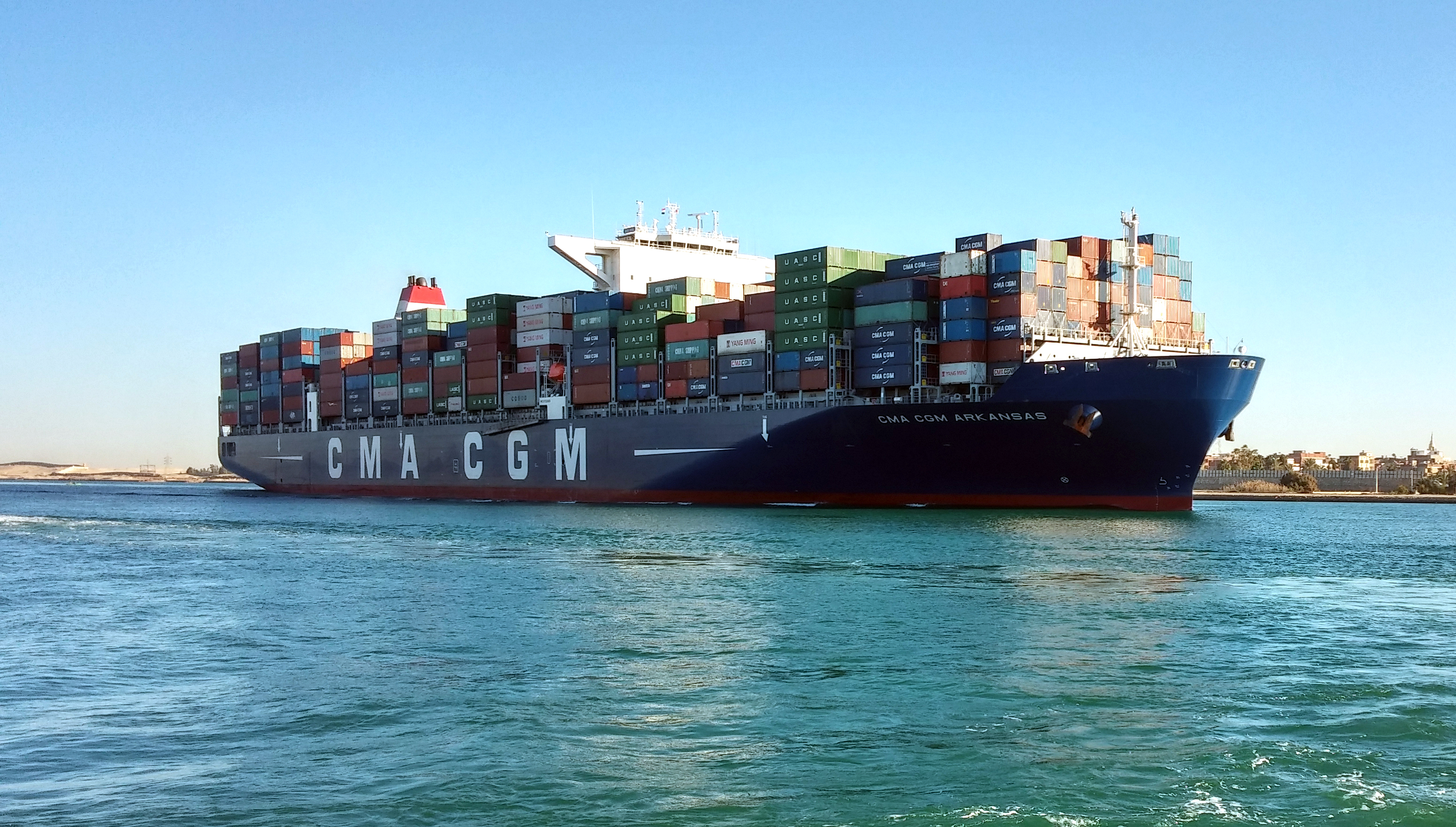
The Ever Given blockage interrupted Suez traffic for almost a week in March 2021. UN Trade and Development’s subsequent assessment placed the incident within a wider rise in freight rates, container shortages and logistical disruption during the pandemic.[1] The ship was a visible event, but the vulnerability was systemic: firms had organised deliveries around an efficient route and a schedule whose reliability they could not individually guarantee.
A blockage does not need to stop all trade to impose significant costs. A manufacturer may lack one component while holding every other input. A retailer may receive seasonal goods after the period in which they can be sold. Ships delayed on one voyage arrive late for the next, spreading disruption beyond the original route. The important unit of analysis is therefore the network and its timing, not simply the value of cargo physically held in a queue.
UNCTAD’s 2021 review described an uneven recovery in which congestion, equipment shortages and less reliable services restricted supply chains.[2] That account cautions against attributing every price increase to a single incident. Demand recovery, pandemic restrictions, shipping capacity and port performance interacted. For British policymakers, the lesson was not that every disruption required a new national production programme. It was that apparently private commercial efficiencies could create public vulnerabilities when many firms adopted similar assumptions.
The state cannot sensibly stockpile every imported product. It can identify goods whose absence would interrupt essential services, examine whether apparently different suppliers rely on the same route, and clarify responsibility for a prolonged interruption. Resilience begins with this knowledge. A government that knows only the country from which a finished product was invoiced may know little about the location of its decisive components or the infrastructure through which they must pass.
The scale of maritime trade helps explain why a local interruption can become a diplomatic concern. UNCTAD’s 2024 review states that more than eighty per cent of world merchandise trade by volume moves by sea.[3] This is a volume measure, not a claim that shipping accounts for the same share of economic value or British GDP. It nevertheless identifies a service on which a large part of the material economy depends.
A chokepoint in motion
2022: low direct exposure, high economic exposure
Britain’s energy shock demonstrated a second mechanism. In February 2022, the government reported that Russia had supplied less than four per cent of total UK gas in 2021, while emphasising that British prices were set in international markets.[4] The relevant dependence was therefore not just a bilateral pipeline relationship. Competition for alternative supplies could transmit a continental shortage to Britain even when the physical gas consumed here came from somewhere else.
This distinction matters for claims about energy independence. Producing more domestically can improve supply options and reduce some import requirements. It does not automatically disconnect consumers from internationally traded prices. Conversely, importing from several reliable partners can provide physical security without ensuring affordability during a global shortage. Supply continuity and price stability are related objectives, but a policy that improves one should not automatically be credited with achieving the other.
The British Energy Security Strategy of April 2022 proposed a longer-term expansion of domestic energy sources and a reduction in exposure to volatile fossil-fuel markets.[5] These measures operated on construction, investment and planning timescales. They could not by themselves settle the immediate question of how households and businesses would pay their bills. The gap between strategic ambition and present vulnerability therefore had to be bridged with fiscal intervention.
The National Audit Office’s November 2024 assessment estimated the cost of energy-bill support introduced in 2022 and 2023 at £44 billion. It judged the schemes successful in protecting the large majority of consumers, while identifying compromises in targeting and difficulties reaching some eligible groups.[6] This is a substantial material achievement. It is also evidence of the expense of absorbing a shock after it arrives. Public money limited the consequences of dependence; it did not abolish the underlying exposure.
The passages that connect the shocks
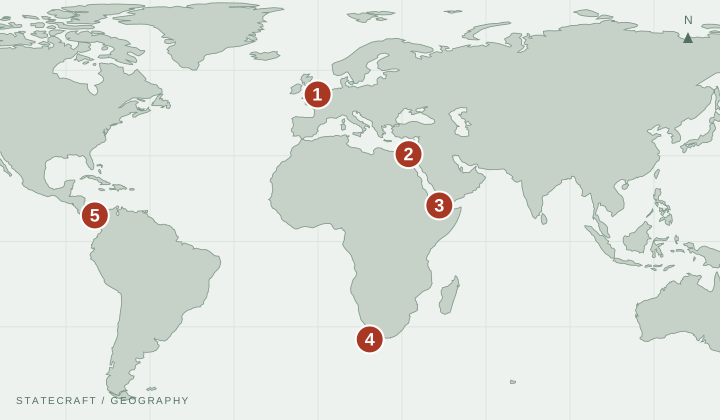
- Britain
An importing economy exposed to transport costs and international prices.
- Suez Canal
The shortcut between the Mediterranean and the Red Sea.
- Bab el-Mandeb
The southern gateway to the Red Sea, near the maritime attacks.
- Cape of Good Hope
The diversion around southern Africa lengthens voyages.
- Panama Canal
A separate chokepoint affected by drought restrictions.
2023–2024: security and climate disrupt the same system
The next crisis made maritime geography central again. Houthi attacks near the Red Sea led shipping companies to avoid the Suez route, while drought restricted Panama Canal traffic. IMF PortWatch estimates published in March 2024 put Suez trade volume in the first two months of that year fifty per cent below the same period in 2023, with trade around the Cape of Good Hope up seventy-four per cent. Panama transit trade fell by almost thirty-two per cent.[7]
These are estimates of transit trade over a specified period. They do not mean half of world trade disappeared, or that British imports fell by the same percentage. Much cargo was rerouted. The economic cost arose partly because the same shipment required more time, fuel and vessel capacity. A longer route can keep goods moving while making the whole system less efficient and more expensive to operate.
The simultaneous disruptions also challenge a narrowly military understanding of economic security. A navy may protect vessels against attack. It cannot manufacture rainfall for a canal or immediately expand port capacity along an alternative route. Climate adaptation, infrastructure maintenance and commercial coordination belong within the same account of resilience. Treating them as peripheral development concerns misses their relationship to the reliability of international commerce.
For Britain, the strategic attraction of maritime protection is clear: it serves national commercial interests while supplying a benefit available to other states. An English School reading sees freedom of navigation as one of the practices that makes international society function. Its defence can therefore be both self-interested and collectively useful. The difficulty is that agreement on the value of open shipping routes does not imply agreement on every military action proposed in their name.
Trade shifted around the disruption
Estimated change in transit trade volume · January–February 2024 versus the same months of 2023
Traffic contracted as Red Sea attacks disrupted the route.
Diversions increased trade passing around southern Africa.
Drought restrictions contributed to a separate disruption.
January 2024: Britain uses force
On 10 January 2024, the Security Council adopted resolution 2722 demanding an end to Houthi attacks on commercial shipping. The vote followed a major attack intercepted by British and American naval forces the previous day.[8] The resolution established a collective demand and a public record of condemnation. It should not be treated as a general authorisation for any subsequent strike ashore.
Britain joined American strikes against Houthi facilities on the night of 11 January, announcing the action on 12 January. The government described the purpose as degrading capabilities used to attack shipping and protecting navigation; Royal Navy participation in Operation Prosperity Guardian continued.[9] This was a concrete military response to an identified threat. Whether the strikes achieved the wider commercial objective is a separate empirical question.
The government’s published legal position relied on self-defence and argued that force was necessary and proportionate. Its January update referred to the attack on HMS Diamond and continuing attacks on shipping, and recorded notification to the Security Council under Article 51.[10] These statements establish the British justification. They are not an independent judicial finding that every factual premise or individual operation met the applicable legal tests.
The distinction between public justification and material outcome is essential. Destroying a facility can reduce an opponent’s immediate capacity. It may not change the political incentives behind the campaign or remove alternative means of attack. A shipping company evaluates the residual risk to crews, cargo and schedules, rather than the government’s description of a successful operation. A comparatively small probability of a catastrophic loss may be enough to keep it on a longer route.
Britain’s willingness to act nevertheless has diplomatic significance. It can reassure partners that shared maritime interests receive more than verbal support. It also creates responsibilities: explain the objective, coordinate with other states, assess civilian consequences and identify the conditions under which action should change. Deterrence cannot be inferred merely from resolve. If attacks continue, the government must distinguish preventing worse outcomes from achieving the original aim of restoring safe passage.
Working with allies without a single campaign
The European Union launched Operation Aspides on 19 February 2024 with a defensive mandate covering situational awareness, accompaniment and protection of vessels. Its framework differed from the British–American strikes on land.[11] This shows why references to an undifferentiated Western response can mislead. Governments could share a concern about navigation while adopting different operational boundaries and assessments of escalation.
Such variation can be useful if activities are coordinated and complementary. One group may provide escort and surveillance while another undertakes a different task. It becomes a weakness if participants issue inconsistent messages, leave gaps in responsibility or assume others will supply capabilities they have not promised. For Britain, cooperation meant more than persuading allies to endorse its own approach. It required understanding what they were prepared to do and building a workable arrangement around those limits.
There was also a broader legitimacy problem. The Houthis linked their campaign to the Gaza war, while Britain defended navigation as a rule applying regardless of the stated political cause.[12] That distinction is persuasive as a principle: commercial crews are not legitimate instruments for coercing unrelated governments. Diplomatically, however, legal argument cannot make the regional political context disappear. A durable response needed engagement with the wider conflict environment as well as protection at sea.
The material evidence remained sobering. UNCTAD’s 2025 review reported that Suez tonnage in early May 2025 was still around seventy per cent below its 2023 average.[13] That does not establish that British action had no protective effect; the counterfactual could have been worse. It does establish that normal commercial use had not been restored by that point. British statecraft generated defensive activity and demonstrated commitment, but had not secured the full economic outcome it sought.
2024: from emergency response to organised resilience
On 17 January 2024, Britain published its Critical Imports and Supply Chains Strategy. It proposed closer work with business, improved information about vulnerabilities and cooperation with international partners.[14] The timing linked a longer-standing concern to an immediate disruption. The strategic shift was from assuming firms would manage each problem separately towards recognising that some supply risks required public coordination.
The Critical Imports Council first met in April 2024, bringing together government, industry and academic expertise.[15] Creating an institution is a verifiable implementation step. It does not prove that medicines, components or other critical goods have become more secure. The institution’s value depends on the quality of information exchanged, the incentives for firms to disclose weaknesses, and whether identified risks lead to decisions rather than another catalogue of concerns.
Diversification also needs careful definition. Buying from a second exporter may offer little protection if both suppliers depend on the same refinery, subcomponent or shipping channel. Moving production to a politically friendly country may reduce exposure to deliberate coercion while retaining exposure to weather, congestion or common technology. A useful resilience policy follows the chain far enough to identify where substitution is genuinely possible and how long it would take.
The cost of alternatives should be explicit. Additional inventory ties up capital and can expire. Spare production capacity may remain underused in normal conditions. More suppliers can increase administrative and quality-control costs. These are the premiums paid for insurance against disruption. The state’s task is to decide where the social value of that insurance exceeds what individual firms are willing to purchase, and how the resulting costs should be distributed.
The strategy is strongest when it treats trade relationships as assets to improve, rather than vulnerabilities to eliminate. Diplomatic missions can help firms identify alternatives and understand local conditions. Agreements can make customs procedures more predictable. Partners can cooperate on emergency arrangements. None guarantees immunity from shocks, but each can shorten the period in which a disruption becomes a serious interruption of essential activity.
Whose security does a protected route serve?
The distribution of costs complicates a purely British balance sheet. UNCTAD’s 2024 analysis warned that prolonged freight-rate increases could raise consumer prices disproportionately in small island developing states and other vulnerable economies. Its estimates were conditional modelling, not a measurement of prices already caused by the Red Sea crisis.[16] The wider point is that governments have very different capacities to absorb the same maritime shock.
Britain could deploy naval forces and fund large domestic support programmes. A poorer importing state may face a higher food bill with little fiscal space, limited influence over shipping services and no means to protect a route itself. If Britain presents open navigation as a collective good, it should take these concerns seriously. Assistance with port resilience, customs capacity and access to finance can make that claim more credible than a narrative focused only on British commerce.
Rerouting around Africa illustrates the ambiguity. Additional calls or demand for services can create opportunities for some ports. Longer journeys, congestion and disrupted connections can impose costs on others. It would be misleading to describe the change as a general benefit to Africa, just as it would be misleading to treat every diverted vessel as lost trade. Effects depend on infrastructure, commercial contracts and the position of a port within the wider network.
An English School approach therefore asks who participates in defining the problem and sharing the burdens of the response. Powerful states may supply important security services, but that does not entitle them to assume universal consent to their priorities. Listening to affected importers and coastal states can improve policy as well as legitimacy. Their experience may reveal vulnerabilities invisible from the perspective of a naval headquarters or a major financial centre.
Climate policy is also maritime statecraft
The revised International Maritime Organization greenhouse-gas strategy adopted in 2023 set an ambition for international shipping to reach net zero by or around 2050. The British government’s response to the Climate Change Committee described its role in pressing for stronger ambition.[17] This is an official account of British participation, not a basis for attributing the negotiated outcome to London alone. Shipping regulation requires agreement among flag states, trading states and other participants with differing interests.
The connection to resilience is practical. Longer routes require more energy and can increase emissions; climate stresses can in turn damage the infrastructure on which routes depend. Decarbonisation and continuity of trade are therefore connected, even though measures advancing one objective can impose short-term costs on the other. A vessel owner cannot invest confidently in a fuel system without some expectation about future standards and the availability of that fuel in ports.
Britain’s useful contribution lies in helping make these expectations credible. Technical diplomacy can reduce the risk that incompatible rules fragment routes or strand investments. Cooperation on infrastructure and finance can help lower-income states meet new standards without losing connectivity. The material test is implementation across the system, rather than an ambitious target standing alone. An agreement that is formally universal but practically inaccessible can deepen inequalities it was supposed to manage.
This broadens the meaning of economic statecraft. It includes the use of force when justified, but also the patient construction of rules and capacities that make force less frequently necessary. British influence is strongest where its maritime, commercial and diplomatic expertise supports arrangements other states want to sustain. The objective should be a more reliable network, not an implausible promise that Britain can control every disturbance within it.
The limits of protection
The events from Suez to the Red Sea suggest a mixed but intelligible verdict. Britain helped cushion a severe energy-price shock, contributed to the protection of shipping and established machinery for examining critical imports. It did not disconnect domestic prices from world markets or restore normal Suez traffic by the point measured in the 2025 evidence. These are different levels of outcome and should be reported separately.
Evaluation should now follow several concrete questions. How quickly can an essential service replace a disrupted input? How much additional cost can households and firms bear? Which alternatives remain available if the preferred route closes? What information reaches ministers before a shortage becomes acute? The answers are more informative than a general ranking of national resilience, because they identify decisions that can actually change vulnerability.
These questions should also be asked before public support is promised. If a company expects the state to cover all disruption costs, it may have less reason to invest in alternatives. If the state leaves every risk with firms, essential services may remain exposed to failures whose consequences extend well beyond a single balance sheet. Good policy makes that boundary explicit and revises it in light of experience. Otherwise resilience can become either an unfunded instruction to business or an open-ended public liability.
Military and economic measures also need a shared timescale. Escorting a ship addresses an immediate threat. An alternative supplier may take months to qualify. Port improvements or a different energy system take years. A successful policy does not pretend these instruments are substitutes; it connects them so that emergency measures buy time for structural changes. It also specifies when temporary intervention should end, rather than allowing crisis arrangements to become permanent without reassessment.
The deepest lesson is that dependence is a condition to manage politically, not a defect that can be abolished economically. Britain’s prosperity rests on connections it cannot command alone. Its most credible statecraft combines selective national capacity with reciprocal arrangements that keep those connections usable. Success means preserving meaningful choices when a route, supplier or market fails—and sharing enough of the resulting security that others have reason to help preserve the system.
Sources & notes
- UNCTAD, Shipping during COVID-19: why container freight rates have surged, 23 April 2021. ↗Back to the essay ↑
- UNCTAD, Review of Maritime Transport 2021 findings, 18 November 2021. ↗Back to the essay ↑
- UNCTAD, Review of Maritime Transport 2024: scale of seaborne merchandise trade, measured by volume. ↗Back to the essay ↑
- UK government, Russia–Ukraine and UK energy factsheet, 25 February 2022. ↗Back to the essay ↑
- UK government, British Energy Security Strategy, 7 April 2022. ↗Back to the essay ↑
- National Audit Office, Energy bills support: an update, 14 November 2024. ↗Back to the essay ↑
- IMF, Red Sea Attacks Disrupt Global Trade, 7 March 2024. PortWatch transit estimates, January–February 2024. ↗Back to the essay ↑
- UN Security Council meeting coverage, resolution 2722, 10 January 2024. ↗Back to the essay ↑
- UK Prime Minister’s statement on strikes against Houthi military targets, 12 January 2024. ↗Back to the essay ↑
- UK government, updated summary of its legal position on Houthi strikes, 23 January 2024. ↗Back to the essay ↑
- Council of the EU, launch of EUNAVFOR Aspides, 19 February 2024. ↗Back to the essay ↑
- Rishi Sunak — Statement on the Red Sea and the Houthis’ stated rationale, 15 January 2024 ↗Back to the essay ↑
- UNCTAD, Review of Maritime Transport 2025, chapter II: Suez tonnage through early May 2025. ↗Back to the essay ↑
- Department for Business and Trade, Critical Imports and Supply Chains Strategy, January 2024. ↗Back to the essay ↑
- Department for Business and Trade, first Critical Imports Council meeting, 17 April 2024. ↗Back to the essay ↑
- UNCTAD, Suez and Panama Canal disruptions: conditional estimates of price effects, 2024. ↗Back to the essay ↑
- UK government response to the Climate Change Committee’s 2023 progress report: international shipping and the IMO strategy. ↗Back to the essay ↑
This is an analytical essay, grounded in the dated developments and official positions above. Interpretations and illustrative scenarios are distinguished from reported events. Drafted with AI assistance. Maps and evidence graphics: Statecraft. Documentary photographs are dated and credited individually. Read our editorial approach.