The race for artificial intelligence is often described as a contest between American and Chinese ingenuity. Follow the machinery behind that contest, however, and the map changes. Designs must become working chips; chips must be connected to memory; computing systems need electricity, cooling and reliable communications. Taiwan Semiconductor Manufacturing Company occupies a crucial position within this physical economy. Its importance raises a question extending well beyond technology: when others depend on what you produce, how much power does that give you over your own future?
The relationships inside an AI accelerator
The factory behind the promise
TSMC’s results released on 15 October provide a timely starting point. The company reported third-quarter revenue of US$46.72 billion, up 41.2 per cent from a year earlier. Manufacturing processes labelled seven nanometres and more advanced accounted for 79 per cent of wafer revenue. These figures describe TSMC’s business, not its share of the world’s chips, and do not mean that every advanced wafer becomes an AI processor. They nevertheless show the commercial scale of the production system around which governments are organising industrial strategy. [1]
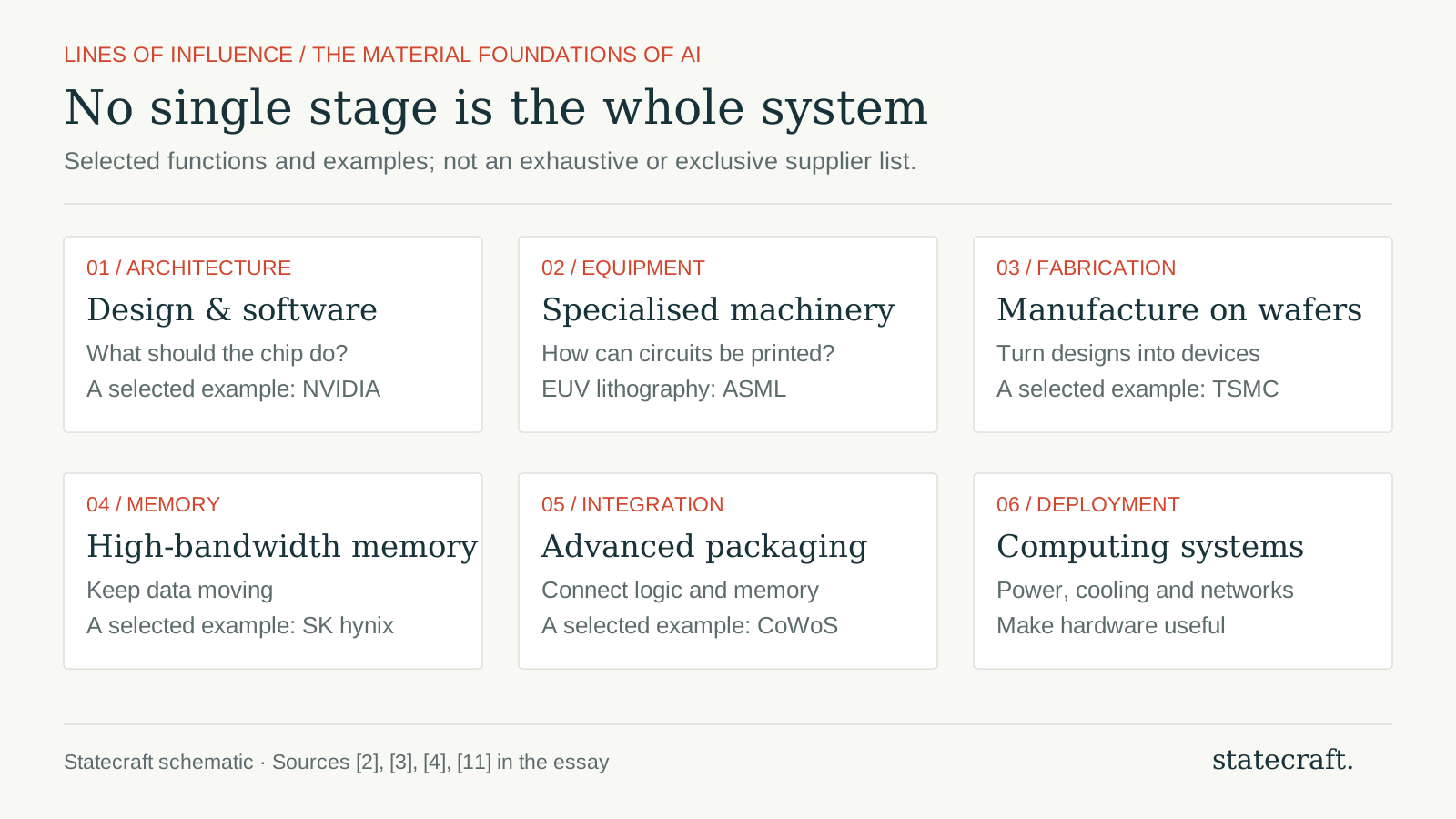
The distinction between designing and making matters. NVIDIA’s description of Blackwell Ultra identifies TSMC’s 4NP manufacturing process alongside a memory subsystem using HBM3E, or high-bandwidth memory. An American accelerator therefore embodies several kinds of expertise. The architecture, the manufacturing process, memory and software perform different jobs; strength in one does not automatically confer command over the others. Nor should a particular processor generation be mistaken for the whole, rapidly changing AI market. [2]
Packaging is another essential stage. TSMC’s CoWoS technology connects logic chips and high-bandwidth memory within advanced packages. This is more than a protective wrapper: the connections help determine whether components can exchange information at the required speed. A factory producing wafers cannot, by itself, provide a complete accelerator supply chain. Any claim about independence must ask which stages are available, in what quantities, and with whose continuing assistance. [3]
Even the machines that make chips embody international dependence. ASML’s extreme-ultraviolet lithography systems use highly specialised light-generation and optical technologies to print tiny circuit patterns. Their complexity makes the equipment supplier part of the strategic story alongside the foundry. A national flag outside a fabrication plant does not erase the relationships needed to equip, maintain and improve it. Technological sovereignty is therefore better understood as the ability to sustain essential activity under pressure than as a promise to manufacture everything alone. [4]
Taiwan’s influence, Taiwan’s choices
The resulting concentration gives Taiwan an unusual position. Access to its industrial capabilities creates reasons for foreign governments and companies to cultivate relationships, maintain contact and take disruption seriously. Commercial significance can open diplomatic doors that formal recognition alone leaves closed. But TSMC is a corporation, Taiwan is a political community, and their interests cannot simply be treated as identical. A profitable expansion abroad and the preservation of Taiwan’s security are different achievements.
Taiwan’s leadership presents these connections as a source of partnership. At a semiconductor forum on 1 September, President Lai Ching-te emphasised the island’s industrial cluster, the contribution of international cooperation and the trust attached to reliable supply. His account framed Taiwan as an active contributor to shared prosperity. It also illustrated an effort to convert manufacturing competence into a wider diplomatic asset. That is the government’s argument, rather than proof that industrial success necessarily delivers political protection. [5]
There are several possible mechanisms. Investment can create constituencies that favour stable relations. Research partnerships can make expertise harder to exclude from international discussion. Regular exchanges can keep practical cooperation alive where diplomatic language is constrained. Each can increase Taiwan’s room to manoeuvre. None, by itself, establishes how a partner would respond to a blockade, coercive pressure or war. An economic interest in preventing a crisis and a willingness to assume military risks are distinct commitments.
This is the central limitation of the familiar silicon-shield argument: the idea that Taiwan’s semiconductor importance helps deter an attack. Dependence may raise the expected costs of disruption and encourage restraint. It can also encourage customers to seek alternatives. Most importantly, political leaders may attach greater weight to territorial claims, credibility or domestic objectives than to commercial losses. The hypothesis deserves examination, but it cannot serve as a security guarantee or a timetable for predicting conflict.
Taiwan should consequently remain more than the setting for somebody else’s rivalry. Its people have interests in democratic choice, physical safety and economic opportunity that cannot be reduced to the uninterrupted delivery of chips. Asking how many processors the world would lose is useful for understanding exposure. Asking only that question would make the value of a society conditional on its usefulness to foreign customers. A serious account must consider both the industrial network and the political community sustaining it.
Washington: leadership through a network
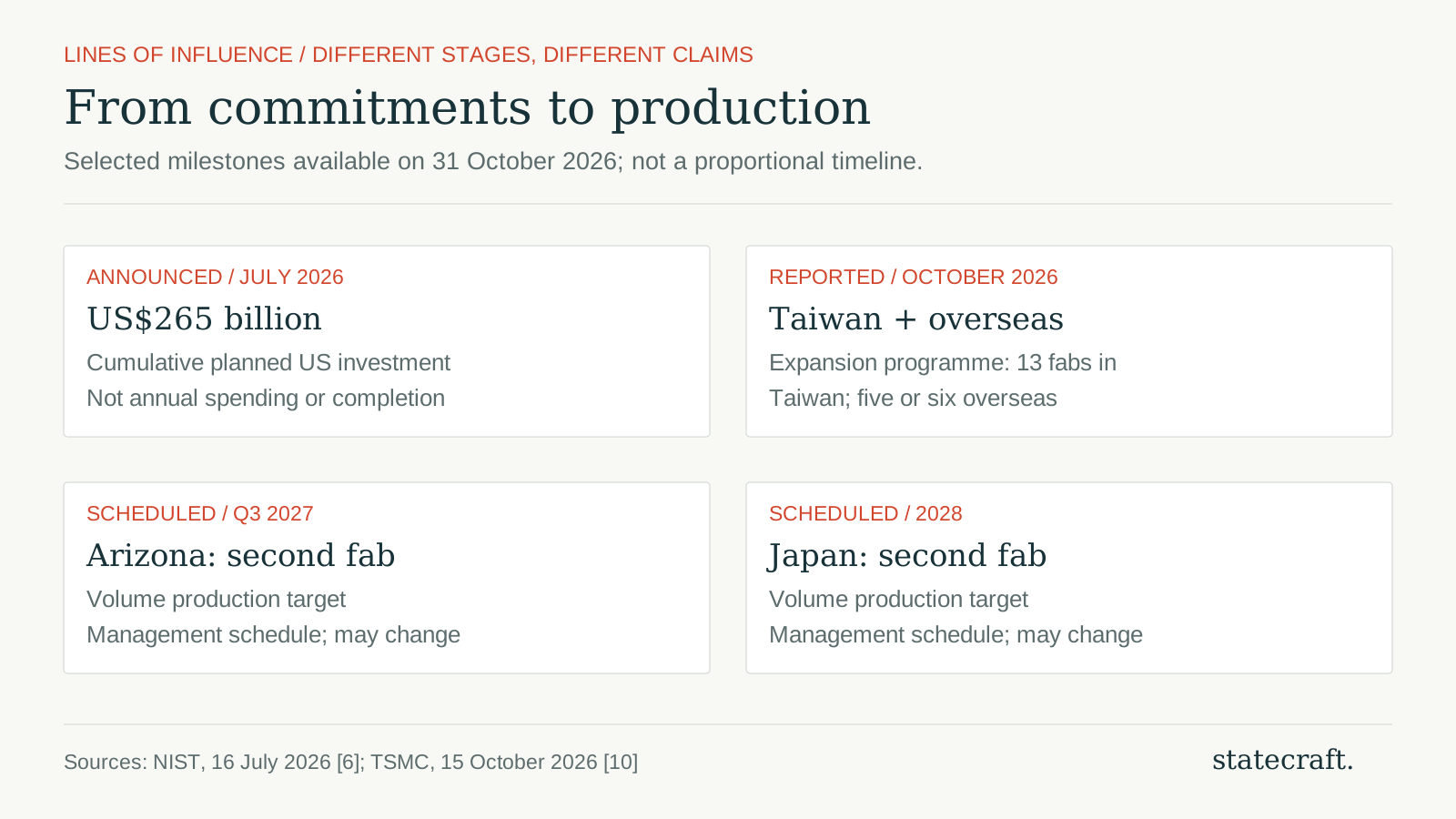
The United States approaches this network with substantial advantages in technology, customers and capital, while seeking more manufacturing at home. In July, the US National Institute of Standards and Technology reported another US$100 billion TSMC investment announcement, bringing the company’s total planned US investment to US$265 billion. The word planned is essential. A cumulative commitment describes an intended programme across years; it is neither a measure of completed factories nor an annual spending figure. [6]
The politics of these investments extends beyond factory output. A government can present domestic manufacturing as evidence that it is restoring control over a strategic industry. Customers may gain additional production options. TSMC can strengthen relationships in an important market. These objectives can reinforce one another without becoming identical. A commercially useful overseas site is not necessarily a complete national substitute for the Taiwanese production system, and a diplomatic announcement does not settle the economics of operating it.
Export controls reveal another form of influence: the power to set conditions on access. On 13 January, the US Bureau of Industry and Security announced case-by-case review for applications to export NVIDIA H200, AMD MI325X and similar chips to China, subject to security requirements. This dated decision should not be flattened into a claim that Washington either permits all advanced AI exports or prohibits every one. The relevant products, conditions and subsequent decisions matter. [7]
The analytical point is that dependence can be governed through permissions as well as prices. Where access requires a licence, commercial planning becomes partly contingent on political judgement. Restrictions may preserve advantages or reduce particular security risks. They may also strengthen incentives to build alternatives. The balance cannot be inferred simply from the existence of a rule: it requires evidence about access, substitution, enforcement and the time needed to adapt. Industrial influence is powerful partly because those adjustments are difficult, not because they are impossible.
One way to assess that influence is to distinguish an interruption from a permanent exclusion. A temporary delay can be managed with inventories or scheduling changes. An uncertain, prolonged restriction may alter the location of investment and the technologies a customer chooses. The political effect therefore depends partly on expectations. Suppliers can lose future business before they lose present technical leadership, while purchasers can remain dependent long after announcing their intention to diversify.
Beijing’s search for alternatives
China’s policy statements make the desire to reduce technological dependence explicit. The government’s account of the draft fifteenth Five-Year Plan, published in March, called for breakthroughs across integrated circuits and other core technologies. This establishes a declared priority for 2026–2030. It does not establish that every production obstacle has been overcome, or that domestic alternatives match foreign products in cost, scale, reliability and energy efficiency. Ambition and demonstrated capability belong in separate columns. [8]
There is nevertheless a strategic logic to substitution. A firm facing uncertain access may accept a more expensive or less efficient alternative if it expects that alternative to remain available. A government may support an industrial programme whose immediate commercial returns are weak because it values future freedom of action. Evaluating such programmes solely by this year’s performance can miss their political purpose. Treating their eventual success as inevitable makes the opposite error. Capabilities must be assessed as they develop.
The Taiwan question also predates the AI boom. Beijing’s 2022 white paper presents unification as a national objective and explicitly declines to renounce force. This is an official statement of the People’s Republic of China’s position, not a neutral adjudication of Taiwan’s future. Its relevance is that semiconductor incentives operate within a larger political dispute. Lowering the economic costs of confrontation would not explain the dispute’s origins; raising those costs would not, on its own, resolve it. [9]
For outside governments, these overlapping pressures complicate policy. They may want access to Chinese markets, secure technology supplies and stability across the Taiwan Strait at the same time. Measures that advance one objective can make another harder. Reducing exposure can be prudent without requiring a prediction of imminent war. Maintaining dialogue can be useful without implying agreement. The difficult task is to make these judgements explicit, rather than conceal trade-offs behind a general promise of resilience or an assumption that commerce will always prevail.
An announcement is not operating capacity
Diversification is not disappearance
TSMC’s October earnings discussion illustrates the distinction between diversification and departure. Management described thirteen leading-edge and advanced-packaging fabs being built in Taiwan over the coming years, alongside five or six overseas. It placed volume production at Arizona’s second fab in the third quarter of 2027 and at Japan’s second fab in 2028. These are management’s plans and schedules, subject to execution. They indicate continuing investment in Taiwan alongside an expanding international footprint. [10]
This matters for the claim that overseas factories are simply removing Taiwan’s strategic importance. Geography can change without capability becoming interchangeable. A site’s process technology, packaging connections, customers and stage of operation all affect what it can supply. Adding capacity abroad may reduce certain risks while leaving other dependencies in place. Counting factories alone misses these differences. Conversely, assuming Taiwan’s position can never change would turn an industrial achievement into a permanent geopolitical law. It is neither sensible to declare disappearance nor to assume permanence.
The wider region contains participants with capabilities of their own. South Korea’s SK hynix describes high-bandwidth memory as vertically connected memory chips designed to accelerate data processing. Its product-development announcements demonstrate why memory deserves attention alongside logic fabrication, without settling comparisons between competing suppliers. The network has several technically demanding stages. A shortage or interruption at one stage can constrain the value of capacity elsewhere. This makes cooperation between specialised producers an enduring feature of the industry, even as governments pursue greater control. [11]
Diversification also raises a distributive question. Who pays for the additional capacity, and who gains reliable access to it? Subsidies, infrastructure and training can create valuable capabilities, but they consume resources with alternative uses. Smaller economies cannot necessarily match the incentives offered by richer states. An international race to reduce dependence might therefore spread production while concentrating bargaining power among those able to finance it. Resilience for one purchaser need not mean equal security of supply for everyone else.
Different disruptions would also test different forms of resilience. A production accident at one site, a restriction on particular equipment and a prolonged regional conflict would not have identical consequences. A second factory might help with the first while remaining exposed to the same equipment rules or regional logistics. These are illustrative scenarios, not forecasts. They explain why a credible strategy should identify the disruption it is designed to withstand before claiming that additional capacity has solved the problem.
Britain’s route into the argument
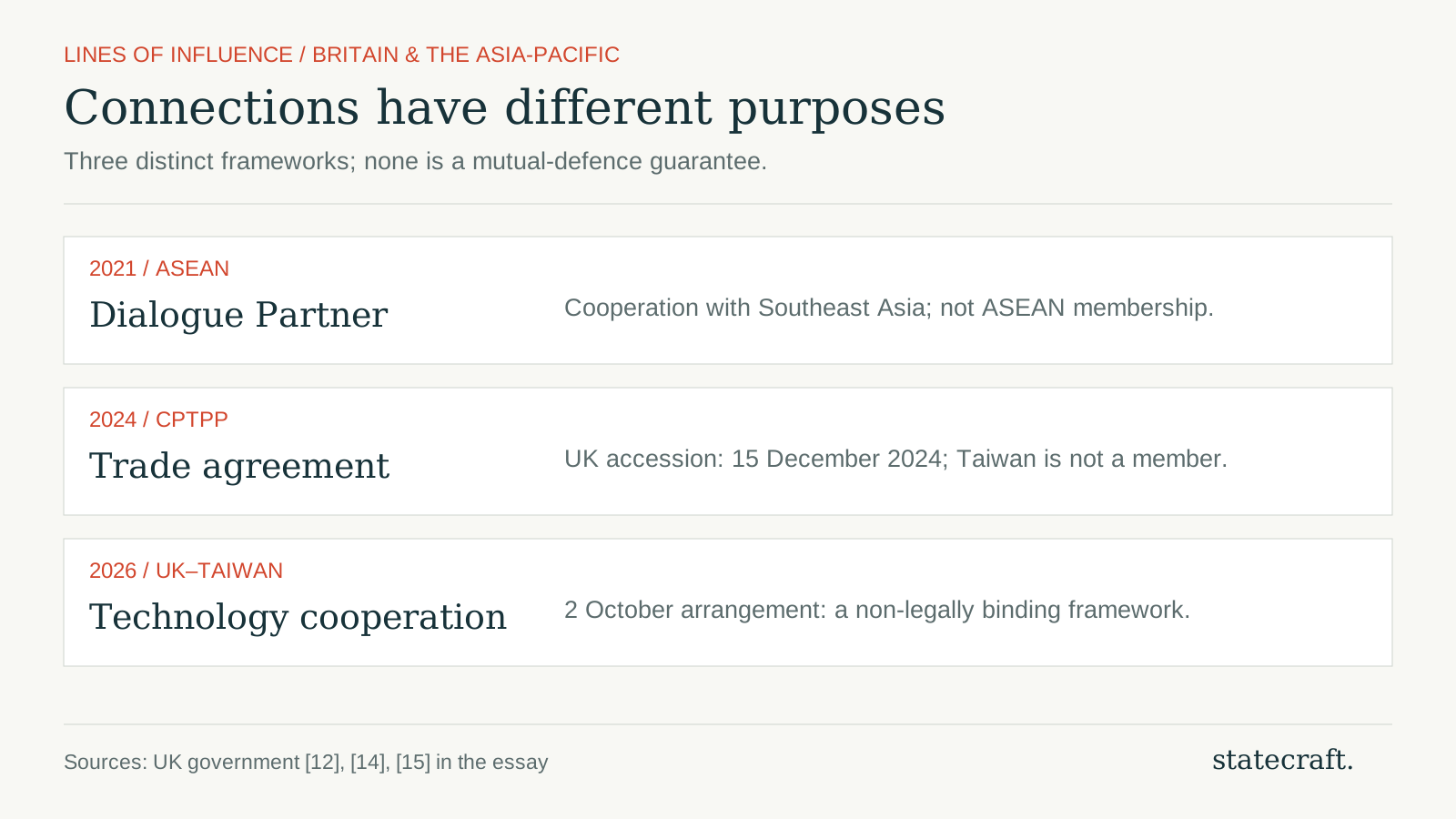
Britain’s connection is more concrete than a distant interest in American–Chinese competition. On 2 October, the UK and Taiwan announced a Science, Innovation and Technology Arrangement covering cooperation including semiconductors, telecommunications and AI standards. The official announcement describes it as a non-legally binding framework. It creates a basis for collaboration; it is not evidence that a new factory has opened, nor does it provide a mutual-defence undertaking. Its value will depend on the work that follows. [12]
For Britain, this suggests an approach grounded in useful contributions rather than comprehensive self-sufficiency. The UK AI Hardware Plan identifies Arm’s Cambridge origins and its role in the semiconductor ecosystem. Design expertise, research and the ability to connect specialist firms can matter internationally even where manufacturing is located elsewhere. But the presence of expertise in Britain should not be confused with government ownership or the ability to direct a company’s global decisions. Commercial success and national discretion are related, not equivalent. [13]
The ASEAN link needs equally careful wording. Britain became an ASEAN Dialogue Partner in 2021; it did not join ASEAN as a member. That relationship offers channels for cooperation with Southeast Asian governments on subjects including trade, science and technology. It should encourage attention to their priorities rather than treating the region as a convenient extension of a British strategy. Dialogue acquires substance when partners find the proposed work useful and retain choices about the relationships they pursue. [14]
Britain’s accession to the Comprehensive and Progressive Agreement for Trans-Pacific Partnership is a separate development. The UK joined CPTPP on 15 December 2024. The agreement includes Japan and several Southeast Asian economies, creating another framework for economic engagement. Taiwan is not among the twelve members listed in the government’s current guidance. Neither CPTPP membership nor ASEAN dialogue status constitutes a guarantee of semiconductor supply in a crisis. Trade institutions support relationships; they do not remove the need to understand production and political risk. [15]
The practical test for British policy is whether these relationships improve capability and understanding over time. Research partnerships need sustained funding and exchange. Businesses need to know where critical dependencies sit. Diplomacy needs enough regional knowledge to distinguish a partner’s priorities from London’s preferred language. This is a less dramatic account of influence than announcing a national champion or dispatching a high-profile visit. It may also be more durable: a country gains standing when it contributes something others continue to need and trust.
There is a domestic dimension too. Training engineers, sustaining research institutions and providing dependable infrastructure are conditions of being a useful international partner. Their diplomatic returns are difficult to advertise because they accumulate slowly and depend on decisions by others. Yet an agreement without the people and resources to implement it risks becoming an empty framework. Britain’s regional ambitions should therefore be judged partly against the capabilities it is willing to maintain at home.
Three relationships, three different purposes
International society under technological pressure
The English School of international relations helps connect these developments. Its central concern with international society asks how political communities sustain rules, institutions and practices amid competition. Applied here, it directs attention to the relationship between economic cooperation, diplomacy and restraint. The semiconductor network functions across jurisdictions whose governments disagree profoundly. Its existence shows that rivalry and organised cooperation can coexist. It does not prove that cooperation will survive every political shock, or that economic integration automatically produces a shared conception of justice.
Consider the competing understandings of order. Governments defending export restrictions may invoke security; firms may seek predictable market access; Taiwan may seek space for participation; Beijing may frame sovereignty through its territorial claim. These positions cannot be reconciled by calling each one a defence of the rules. The substantive questions concern which rules apply, who helps determine them, how disputes are managed and whether powerful actors accept restraints on their own conduct. A vocabulary of order becomes unpersuasive when it merely restates the preferences of its strongest advocates.
There are still practical areas in which diplomacy can matter. The June Australia–UK ministerial statement opposed unilateral changes to the Taiwan Strait status quo and encouraged dialogue over coercion or force. It also supported Taiwan’s meaningful participation in international organisations where statehood is not required, or as an observer or guest. Such language does not settle security outcomes. It identifies ways of defending peaceful interaction and practical participation without pretending that the underlying diplomatic disagreements have disappeared. [16]
An English School perspective also brings the tension between order and justice into view. Avoiding a major war is an overriding concern, but an arrangement that treated Taiwan’s people merely as an inconvenience to great-power stability would have a serious moral deficit. Equally, invoking their freedom without considering the consequences of escalation would be irresponsible. The task is to defend space for peaceful choice while reducing the risk that competing claims turn into catastrophic violence. Semiconductor policy must sit within that wider responsibility, rather than substitute for it.
This changes how success should be measured. More transactions do not necessarily mean greater political freedom, just as fewer foreign suppliers do not necessarily mean greater security. A useful assessment would examine whether partners can disagree without losing essential access, whether institutions keep channels open during disputes, and whether adjustments leave smaller participants with meaningful options. These standards are demanding because they require attention to behaviour over time. They cannot be satisfied by a memorandum, an investment total or a single diplomatic visit. But they offer a clearer account of international order than a simple division between connected friends and excluded rivals. They also leave room for revision: a relationship that once expanded choice can later become restrictive, while carefully designed cooperation can reduce a previously dangerous vulnerability. Lines of Influence should follow those changes rather than assume that any participant’s place in the network is fixed or naturally deserved.
The power to remain connected
For Lines of Influence, the lesson is a distinction between importance and command. TSMC’s position makes cooperation with Taiwan valuable. It also exposes Taiwan to the decisions of customers, suppliers and governments elsewhere. The same relationship can produce opportunity and vulnerability at once. To understand its political consequences, we must ask how difficult replacement would be, how quickly alternatives could emerge, and which actors can change the conditions of access. Dependence acquires political meaning through those relationships, not through a production statistic alone.
Three developments deserve continued attention: whether announced factories become productive capacity; whether alternative technologies deliver reliable performance at scale; and whether diplomatic partnerships expand Taiwan’s practical room for choice. These are questions for observation, not predictions disguised as conclusions. Britain belongs in this story as a participant with particular capabilities and obligations. Taiwan remains central as a society whose future cannot responsibly be discussed only in terms of what it manufactures. The strongest international order would protect that society’s peaceful choices even if its commercial indispensability eventually diminished.
Sources & notes
- TSMC, third-quarter 2026 earnings release, 15 October 2026 ↗Back to the essay ↑
- NVIDIA, Inside NVIDIA Blackwell Ultra, 22 August 2025 ↗Back to the essay ↑
- TSMC, CoWoS advanced packaging ↗Back to the essay ↑
- ASML, EUV lithography systems ↗Back to the essay ↑
- Office of the President, Taiwan, semiconductor forum address, 1 September 2026 (Chinese; paraphrased in English) ↗Back to the essay ↑
- NIST, TSMC’s additional US investment announcement, 16 July 2026 ↗Back to the essay ↑
- US Bureau of Industry and Security, licence-review policy announcement, 13 January 2026 ↗Back to the essay ↑
- State Council / Xinhua, technological self-reliance priorities, 5 March 2026 ↗Back to the essay ↑
- PRC government, The Taiwan Question and China’s Reunification in the New Era, August 2022 ↗Back to the essay ↑
- TSMC, third-quarter 2026 earnings call transcript, 15 October 2026 ↗Back to the essay ↑
- SK hynix, HBM4 development announcement, 12 September 2025 ↗Back to the essay ↑
- UK government, UK and Taiwan deepen trade and technology cooperation, 2 October 2026 ↗Back to the essay ↑
- UK government, UK AI Hardware Plan ↗Back to the essay ↑
- UK government, UK becomes ASEAN Dialogue Partner, 6 August 2021 ↗Back to the essay ↑
- UK government, CPTPP guidance, accessed 31 October 2026 ↗Back to the essay ↑
- Australia–UK Ministerial Consultations, joint statement, June 2026, paragraph 27 ↗Back to the essay ↑
This is an analytical essay, grounded in the dated developments and official positions above. Interpretations and illustrative scenarios are distinguished from reported events. Drafted with AI assistance. Maps and evidence graphics: Statecraft. Documentary photographs are dated and credited individually. Read our editorial approach.