The language of sovereignty often suggests distance: fewer obligations, fewer constraints, greater control at home. The partnership launched by Canada and the European Union in Montréal on 30 October begins from a different proposition. Closer relationships might provide the means to resist pressure, develop strategic industries and preserve political choice. Their Alliance for the Future links economic security to cooperation across trade, technology, resources and defence. Its purpose, as the leaders describe it, is to create a common prosperity and economic security space. [1]
The attraction is clear. A government with several credible partners has more room to negotiate than one facing a single indispensable supplier or customer. The difficulty lies in making those alternatives real. Agreements can widen access while imposing conditions. Investment can reduce one vulnerability while creating another. Canada and Europe are attempting to organise dependence more deliberately. The test is whether their cooperation changes the choices available when interests diverge or circumstances become more difficult.

An alternative must be usable
Canada’s exposure to its southern neighbour makes diversification a concrete strategic concern. Statistics Canada’s February release put the United States’ share of Canadian merchandise exports at 71.7 per cent in 2025, down from 75.9 per cent in 2024. These are goods-export shares, not a measure of the whole economy or every form of dependence. They nevertheless show the concentration confronting a government seeking more options. [2]
A fall in that percentage does not automatically demonstrate increased freedom. It could reflect weaker American demand, stronger sales elsewhere, price changes or several developments together. A more useful question is whether Canadian producers can maintain profitable activity if access to their principal market becomes more costly or uncertain. That requires customers, transport, finance and production arrangements that work together. A diplomatic relationship becomes an alternative only when businesses can use it.
Europe brings a different set of incentives. Its institutions can connect a large market, regulation, research programmes and financing capacity. Canada brings resources, technical expertise and an established political relationship. These are possible complementarities, rather than a guarantee of balanced gains. The EU is also a union of states with different industrial structures and preferences. Cooperation must accommodate disagreements within each partner as well as between them.
The ambition should therefore be judged as diversification rather than a promise to sever existing relationships. North American geography and established commercial connections will continue to matter to Canada. European businesses will retain interests elsewhere. Additional partnerships can improve bargaining positions without replacing every previous connection. The important change would be a reduction in the costs of saying no to a particular demand, rather than the disappearance of dependence itself.
Beyond the removal of tariffs
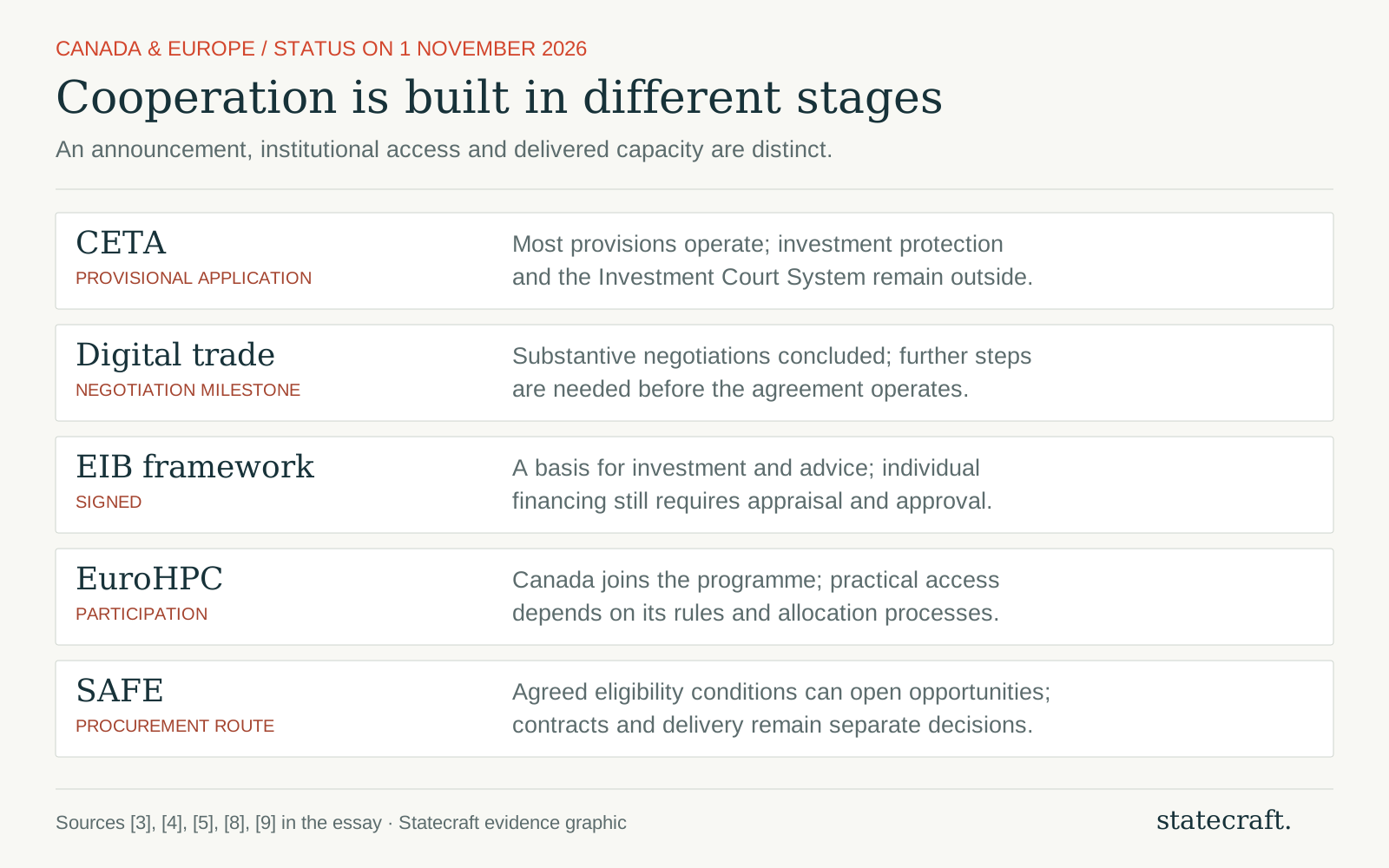
The partnership has an existing institutional foundation. The Comprehensive Economic and Trade Agreement, CETA, has applied provisionally since 21 September 2017. The European Commission explains that most of its provisions already operate, while areas including investment protection and the Investment Court System remain outside provisional application. The relationship consequently combines substantial practical cooperation with unfinished political approval. [3]
That combination is instructive. International agreements are implemented through institutions with different powers and sources of legitimacy. A summit cannot remove every disagreement among governments, legislators or affected industries. Nor does incomplete ratification mean that all economic cooperation has stopped. The mechanisms actually operating need to be examined separately from the wider political narrative surrounding them.
Digital trade illustrates the next layer. The two sides announced the conclusion of substantive negotiations on a Digital Trade Agreement at the October summit. Canada’s subsequent ministerial readout describes it as complementing CETA and modernising the framework for the digital economy. Concluding negotiations is a milestone; its practical consequences still depend on the steps that make the agreement operative and usable. [4]
The strategic value of such arrangements lies partly in predictable treatment. Businesses considering investments need to know how transactions, information and regulatory requirements will be handled. Predictability can make cooperation less dependent on each political meeting producing a fresh reassurance. It also creates obligations. Governments gain a more dependable relationship by accepting limits on how they exercise discretion. Sovereignty is being channelled through agreed procedures, with the expectation that the resulting stability will expand practical choices.
Finance before freedom of action
The European Investment Bank’s announcement provides a particularly clear example of the distance between enabling cooperation and delivering it. The bank says it signed a Framework Agreement with Canada on 30 October, establishing a basis for investment and advisory support. Critical raw materials are an early focus. Individual financing operations remain subject to the bank’s normal appraisal and approval procedures. [5]
This is a meaningful institutional change. It gives potential projects another route through which to seek finance and expertise. It does not establish that particular mines, processing plants or recycling facilities have received funding, become commercially viable or started production. The distinction matters because access to a financing institution is sometimes reported as though the productive capacity it might support already exists.
Political influence emerges further along the chain. Financing can help an otherwise viable project proceed; production can give purchasers an additional source; reliable supply can reduce the costs of disruption. Each transition requires evidence. A project may fail to attract customers, encounter construction difficulties or remain uncompetitive. Conversely, a successful investment may improve a bargaining position before it supplies most of a market, because the possibility of expansion makes an alternative credible.
Europe’s wider raw-materials policy helps explain the demand for such alternatives. The Critical Raw Materials Act sets a 2030 diversification benchmark under which no single third country should supply more than 65 per cent of the EU’s annual needs for a strategic raw material at a relevant processing stage. This is a policy benchmark, not a description of diversification already achieved. [6]
The reference to processing is important. An available mineral deposit is one part of an industrial system. Extraction, refining, manufacturing, transport and recycling can involve different companies and locations. Securing material at one stage may leave exposure elsewhere. The appropriate unit of analysis is the functioning supply chain: where disruption could occur, which alternatives exist and how quickly they could be used. National resource wealth provides opportunities, but its conversion into strategic influence requires investment and durable commercial relationships.
Five instruments, different stages
Energy follows physical routes
Energy cooperation makes the relationship between intention and capability particularly tangible. The European Council’s account of the summit identifies a proposed joint feasibility study on Canadian liquefied natural gas exports to Europe, alongside cooperation on grids, sustainable energy, storage and infrastructure protection. A study establishes a question to investigate. It does not establish the commercial case, finance construction or deliver gas to a European purchaser. [13]
For any prospective route, the strategic assessment must connect supply with transport and demand. Infrastructure can take time to develop, while customers need confidence about availability and producers need confidence about future purchases. Long commitments may help finance a project but become difficult to reconcile with changing consumption or climate objectives. These are choices to be negotiated, rather than technical details that can safely be left until after a political announcement.
An additional route could strengthen bargaining positions even if it never became the cheapest source in normal conditions. Maintaining that option would still have costs. The relevant comparison is between those costs and the consequences of the disruption it might help manage. This is why strategic freedom should be assessed against identifiable pressures. A supply arrangement useful during a temporary interruption might offer less protection against a sustained price shock or a broader failure of infrastructure. Partners need to understand which problem their investment is intended to address.
Whose resilience is being financed?
Resource cooperation raises questions that a language of shared national interests can obscure. Canada’s current critical-minerals approach identifies partnership with Indigenous groups, provinces and territories, industry and other stakeholders as a central theme. This is an official policy commitment. Its value in a particular project must be assessed through the participation, decisions and outcomes experienced by those concerned. [7]
A supply chain can become more secure for an overseas purchaser while imposing environmental risks or uncertain benefits on a producing community. Jobs and investment can be valuable without settling every question about land, water, infrastructure or the distribution of revenue. Indigenous peoples also have distinct rights, institutions and priorities; treating them as another item in a general consultation exercise would miss that political significance.
These considerations belong inside the strategic assessment. A project whose legitimacy is weak may encounter difficulties that financing alone cannot resolve. A partnership that allows communities meaningful influence can produce a more durable basis for development. The point is not to assume that every project will be opposed, or that every assurance of participation establishes consent. It is to ask whose agreement matters and how that agreement shapes the terms of cooperation.
The same scrutiny applies to public expenditure. Supporting additional capacity can involve costs that commercial prices do not fully reflect. Governments should explain which vulnerability they are addressing, why the proposed intervention is appropriate and who bears the risk if demand changes. Resilience has value, but invoking it cannot replace a reasoned account of priorities. An alliance is more likely to endure if its benefits and burdens can be defended to the people expected to support it.
Computing power and the terms of access
Technological cooperation offers another route from shared resources to wider capability. On 30 October, EuroHPC announced that Canada had become its thirty-ninth participating state. The joint undertaking pools resources for supercomputing infrastructure and related research; its announcement describes opportunities for Canadian access and collaboration in high-performance computing, artificial intelligence and quantum technologies. [8]
This is more specific than a general declaration of friendship. Participation connects researchers and institutions to a programme through which capabilities can be developed and used. It also brings the governance of access into the argument. The relevant questions concern eligibility, allocation, continuity and the ability to shape future priorities. Formal participation creates an opportunity; it does not mean that every researcher or business has unlimited computing capacity available on demand.
The relationship with our Taiwan analysis is direct. A digital system depends on hardware, software, skilled people, energy and the organisations that coordinate them. Pooling some resources can expand capability while leaving other dependencies intact. Additional computing infrastructure does not itself establish independence across semiconductor production, cloud services or the full range of AI technologies. It should be assessed for the particular options it provides.
There is also a difference between an alternative existing and an actor being able to move to it. Data arrangements, technical compatibility, contracts and expertise can make switching costly. Cooperation becomes strategically useful when it lowers those barriers or provides continuity during disruption. The most revealing evidence may therefore concern ordinary users’ experience: whether researchers gain workable access, whether firms can build on the infrastructure, and whether the arrangements remain dependable when political attention moves elsewhere.
Defence cooperation has its own machinery
The defence relationship already includes a concrete institutional route. In June 2026, the Council of the EU formally concluded an agreement concerning Canadian companies and Canadian-origin products in procurement under Security Action for Europe, SAFE. The instrument supports EU member states investing in defence industrial production through common procurement. Canada’s participation concerns an agreed route into that cooperation. [9]
Its significance should be described precisely. Supplier eligibility can broaden the set of firms available to purchasers and create opportunities for industrial collaboration. It does not guarantee contracts, production increases or delivery on a military timetable. Those outcomes depend on demand, procurement decisions, industrial capacity and execution. Financing arrangements, commercial orders and operational equipment are different stages of capability development.
A productive partnership could make demand more predictable, support complementary specialisms and reduce some forms of fragmentation. It could also produce disagreements about domestic jobs, technological control and the location of investment. These are distributional questions within a security project. Calling the participants allies does not remove their interest in securing industrial benefits for themselves.
The wider lesson is that military cooperation contains several kinds of commitment. Political consultation, industrial access and the provision of operational assistance answer different needs. A government should understand which it has secured before relying on the relationship in a crisis. Success would mean that institutions and production arrangements help partners meet specific requirements, while providing workable procedures for resolving the disputes that inevitably accompany joint expenditure.
An international society of partners—and outsiders
The English School of international relations helps explain why this project involves more than a bargain over goods. Its concern with international society directs attention to the rules, institutions and shared practices through which political communities manage their relations. Sovereignty, diplomacy and international law shape how material capabilities can be used and what claims participants consider legitimate. [10]
Markets belong in that discussion. Barry Buzan and Robert Falkner’s work treats the market as an institution within international society, connected to political norms and other institutions. Applied to Canada and Europe, this perspective encourages us to examine how access is organised, which expectations sustain it and how governments reconcile economic exchange with security concerns. The application here is an analytical interpretation, rather than a finding supplied by the theoretical framework. [11]
The alliance’s stated commitment to a rules-based international order creates a demanding standard. Its leaders affirm support for international law and institutions alongside closer cooperation between partners sharing political values. [1] A values-based grouping can sustain useful practices, particularly when broader institutions face disagreement. But its participants must still explain how their preferred arrangements relate to obligations owed beyond the grouping.
The central tension concerns the boundary between protection and exclusion. Security screening and trusted partnerships may address real vulnerabilities. They can also limit opportunities for countries and firms outside the preferred network. An assessment should consider whether restrictions are proportionate to the risks identified, how decisions can be challenged and whether cooperation supports wider institutions or progressively displaces them. Shared values do not exempt participants from scrutiny of their conduct.
Order and justice meet here. Predictable supplies and stable commercial rules are important achievements. Their legitimacy also depends on whose interests receive consideration, including workers, communities and societies outside the negotiating room. A partnership that expands its members’ freedom while transferring excessive insecurity to others would have a weaker claim to defend international society as a whole. That judgement requires evidence about actual practices, rather than acceptance or rejection of the alliance’s vocabulary in advance.
Outside participants retain agency too. A resource-producing country might welcome additional buyers while seeking more processing and industrial employment at home. A government considering cooperation on technology might want access without adopting every regulatory preference of its partners. These are legitimate bargaining positions that an inclusive order must accommodate. The alliance’s wider significance will therefore depend partly on whether it can work with governments whose interests overlap without fully coinciding. Flexibility could enlarge the coalition supporting dependable rules. Demanding complete alignment across unrelated issues could instead make cooperation narrower and more brittle.
Britain as a participant, not the template
Britain has a reason to study this cooperation without treating Canada’s relationship as a ready-made model. The UK and EU agreed their own Security and Defence Partnership in May 2025, establishing a framework for dialogue and cooperation across shared security concerns. [12] Canada’s arrangements show that relationships between the EU and outside partners can develop through several instruments. The conditions and opportunities remain specific to each negotiation.
For London, the useful question is what it can contribute reliably. Research institutions, industrial capabilities and diplomatic expertise can all support cooperation when matched to partners’ needs. Influence will also depend on sustained participation in the processes where priorities are decided. A general claim to be strategically important provides less assurance than a record of delivering something others value.
The comparison should sharpen questions rather than produce a league table. Different geography, commercial relationships and political choices create different possibilities. Britain’s task is to assess where cooperation improves its practical freedom and which commitments it can sustain. The Canadian case is useful because it makes visible the work between seeking autonomy and building the relationships through which autonomy can be exercised.
What would count as success?
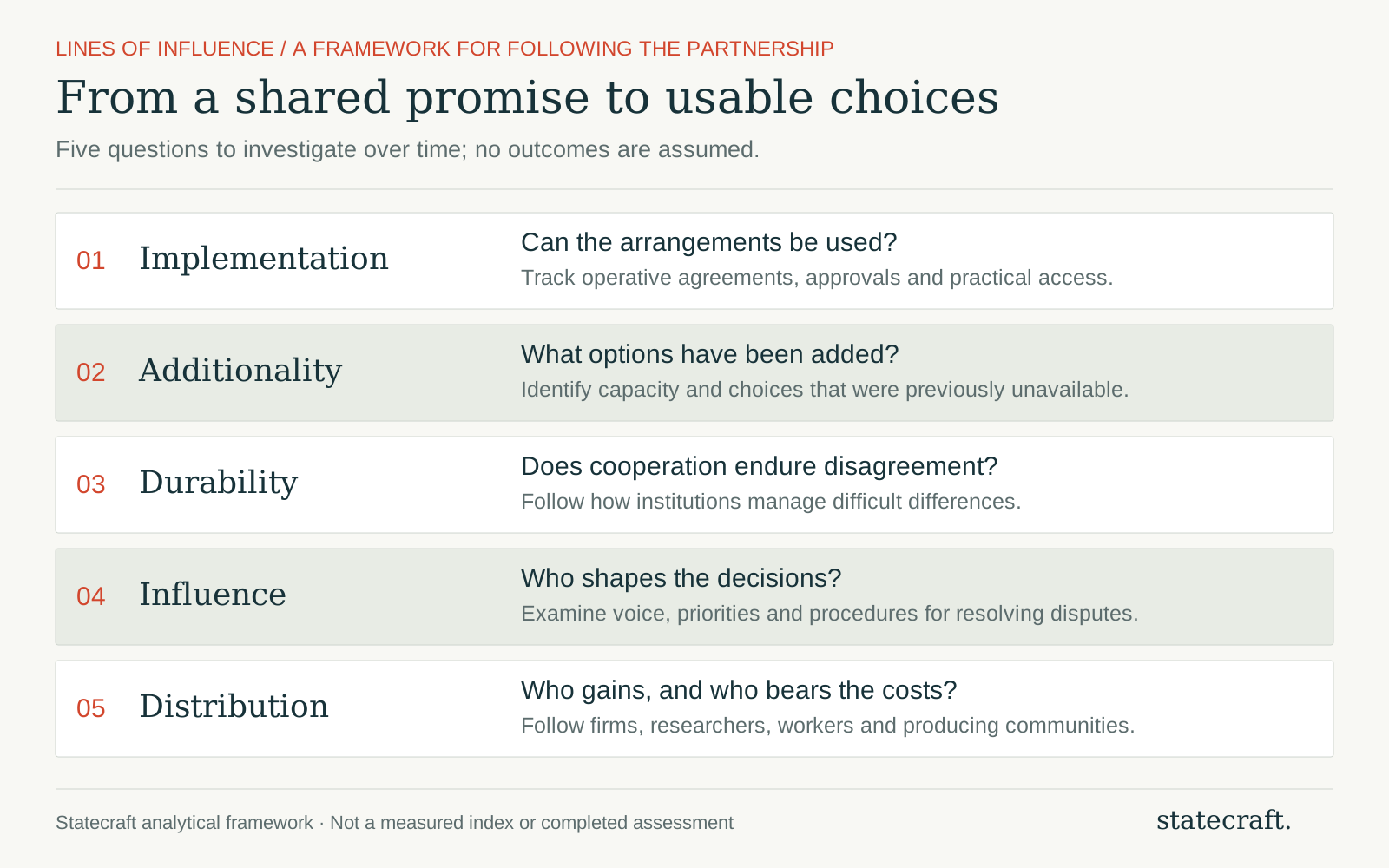
The alliance now needs to be followed through decisions that can be observed. The first test is implementation: which agreements become operative, which projects secure approval, and which forms of access are used? The second is additionality: does cooperation create options that would otherwise have been unavailable, or mainly give a new name to activity already proceeding?
The third concerns durability under disagreement. Partners can share broad objectives while differing over regulation, industrial priorities or external relationships. Procedures that preserve essential cooperation during such disputes would be a meaningful source of security. Dependability is demonstrated when managing a difference becomes difficult, not simply when announcing agreement is convenient.
There is a further question of influence within the partnership. When a participant contributes capital, a market or a scarce capability, does that contribution translate into a voice over the decisions it considers important? Benefits need not be equal in every sector for the relationship to be worthwhile. But a partner expected to accept adjustment costs needs a credible account of its longer-term position. Studying who proposes priorities, who can amend them and how disputes are resolved would reveal more about the alliance’s distribution of power than its ceremonial language alone.
Finally, the distribution of gains matters. Assessments should follow the experience of firms, researchers, workers and producing communities alongside national indicators. Increased trade or investment can coexist with concentrated benefits and unresolved vulnerabilities. Claims of greater sovereignty should identify whose decisions have become less constrained and what obligations or costs accompany that change.
For Lines of Influence, Canada–EU cooperation offers a test of a central proposition: political freedom can be strengthened through relationships that are deliberately structured, sufficiently diverse and answerable to those affected. Its success remains open. The promise is a wider capacity to choose, built through reliable access and the institutions needed to sustain it. Whether that promise is fulfilled will depend on the patient work after Montréal, when aspirations become contracts, rules, investments and decisions that people can actually use.
What would turn cooperation into freedom?
Sources & notes
- Canada–EU, Joint Statement: building together an Alliance for the Future, 30 October 2026 ↗Back to the essay ↑
- Statistics Canada, Canadian international merchandise trade, December 2025, released 19 February 2026 ↗Back to the essay ↑
- European Commission, EU–Canada agreement explained, accessed 1 November 2026 ↗Back to the essay ↑
- Global Affairs Canada, Minister Sidhu and EU Commissioner welcome conclusion of digital trade agreement negotiations, 31 October 2026 ↗Back to the essay ↑
- European Investment Bank, EIB and Canada open new chapter for investment at EU–Canada Summit, 30 October 2026 ↗Back to the essay ↑
- European Commission, European Critical Raw Materials Act, accessed 1 November 2026 ↗Back to the essay ↑
- Government of Canada, Canada’s Critical Minerals Strategy: current approach, updated 11 August 2026 ↗Back to the essay ↑
- EuroHPC Joint Undertaking, Canada becomes the 39th participating state, 30 October 2026 ↗Back to the essay ↑
- Council of the EU, SAFE: Council concludes agreement with Canada, 15 June 2026 ↗Back to the essay ↑
- Cornelia Navari, editor, International Society: The English School, publisher’s overview and contents ↗Back to the essay ↑
- Barry Buzan and Robert Falkner, The Market in Global International Society: An English School Approach to International Political Economy, Oxford University Press, abstract ↗Back to the essay ↑
- UK government, UK–EU Security and Defence Partnership, 19 May 2025 ↗Back to the essay ↑
- European Council, EU–Canada summit, 29–30 October 2026: main results, including energy cooperation ↗Back to the essay ↑
This is an analytical essay, grounded in the dated developments and official positions above. Interpretations and illustrative scenarios are distinguished from reported events. Drafted with AI assistance. Maps and evidence graphics: Statecraft. Documentary photographs are dated and credited individually. Read our editorial approach.