On 26 October, a year after the fall of El Fasher, Britain announced sanctions against fifteen senior commanders from Sudan’s rival forces suspected of atrocities, including conflict-related sexual violence. The measures impose asset freezes and travel bans. Five days earlier, international representatives had gathered in Geneva to coordinate another effort towards peace. These developments show diplomatic activity continuing around a war whose destruction demands far more than another expression of concern. [1] [2]
The difficult question is how that activity changes decisions inside Sudan. A commander may face international condemnation while retaining access to money, weapons and the expectation of further military gains. A government may endorse negotiations while tolerating commercial networks that sustain a belligerent. Pressure becomes consequential when it changes the resources available, the costs of continued violence or the credibility of an alternative. Sudan exposes how unevenly those connections are governed—and how urgently they need to be brought within a coherent political strategy.
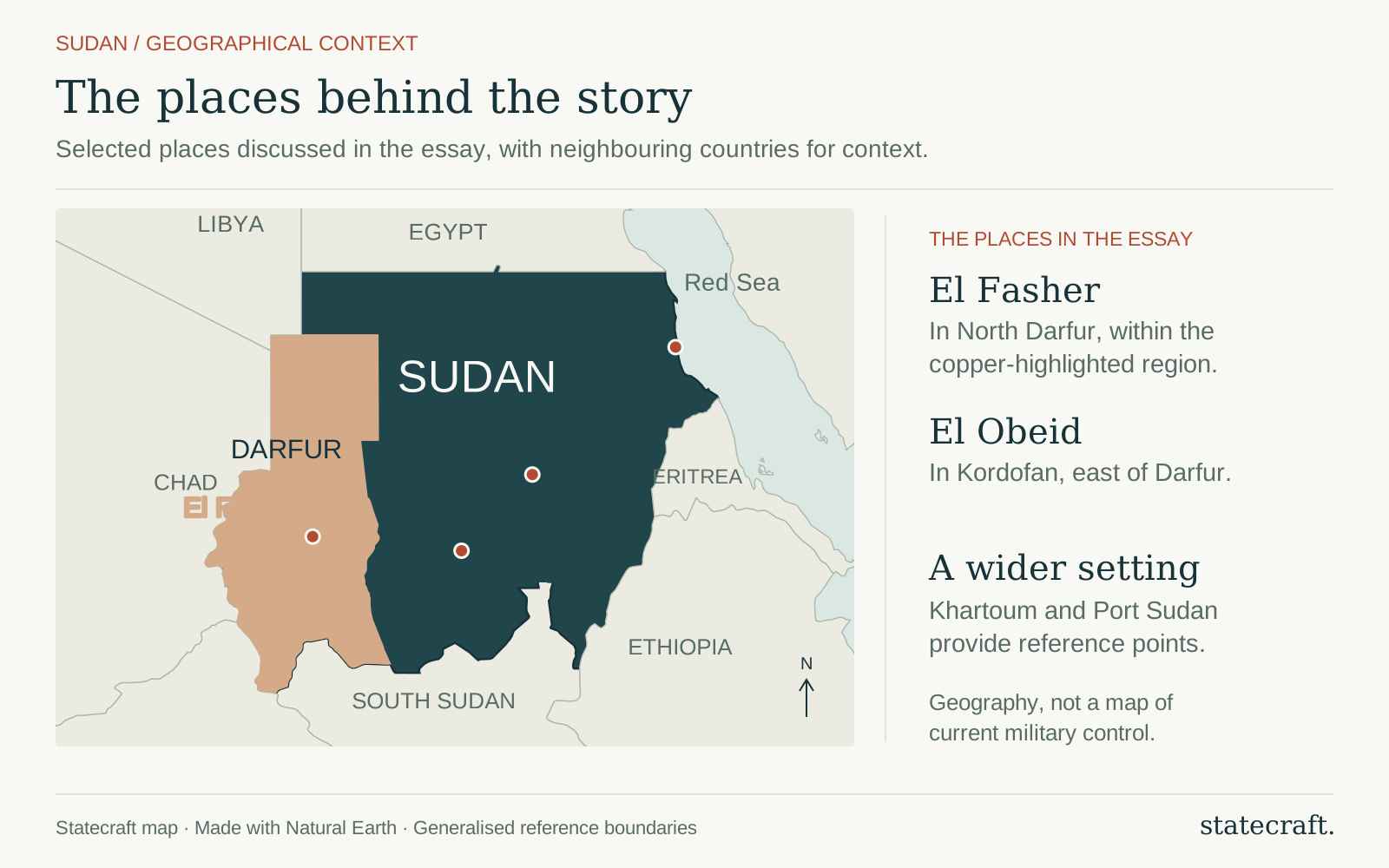
The places behind the story
A war connected to the world
The conflict between the Sudanese Armed Forces, or SAF, and the Rapid Support Forces, the RSF, began in April 2023. Its consequences cannot be understood simply as a contest between two military organisations. In February 2026, the UN Human Rights Office reported more than 6,000 documented killings during the first three days of the RSF’s final offensive on El Fasher the previous October. Its findings described war crimes and possible crimes against humanity. These were documented deaths within a particular period, rather than a complete national death toll. [3]
The means of continuing such violence extend beyond Sudan’s borders. Presenting its September report, the UN’s independent fact-finding mission described evidence linking external weapons, technology, logistics, training and personnel to military operations. It reported reasonable grounds to believe that a transnational network involving individuals and entities in the UAE, Chad, southeastern Libya and Somalia supported the RSF. It also described serious violations involving drone operations by both sides; its investigation of external support to the SAF remained at an earlier stage. [4]
Those distinctions matter. An investigative finding carries a different status from a judicial determination, and evidence concerning one network cannot establish every allegation against every government. The UAE has denied providing arms or military support to either belligerent. Its denial should be recorded alongside the findings against which it must be assessed. [5]
The strategic implication is nevertheless clear: diplomacy has to address the system through which war remains possible. Attention to an airfield, a purchasing company or a financial intermediary can be as consequential as another meeting with a military leader. The relevant relationships connect decisions in foreign jurisdictions with capabilities used against people in Sudan.
The geography of civilian risk also extends beyond the places that have commanded most international attention. In September, the fact-finding mission chair discussed threats to essential infrastructure around El Obeid and the wider reach of drone warfare. [4] A diplomatic response organised around the last atrocity can remain dangerously behind the next risk. Prevention requires following changing capabilities and threats, without claiming certainty about military developments that independent observers cannot fully verify.
From naming commanders to constraining networks
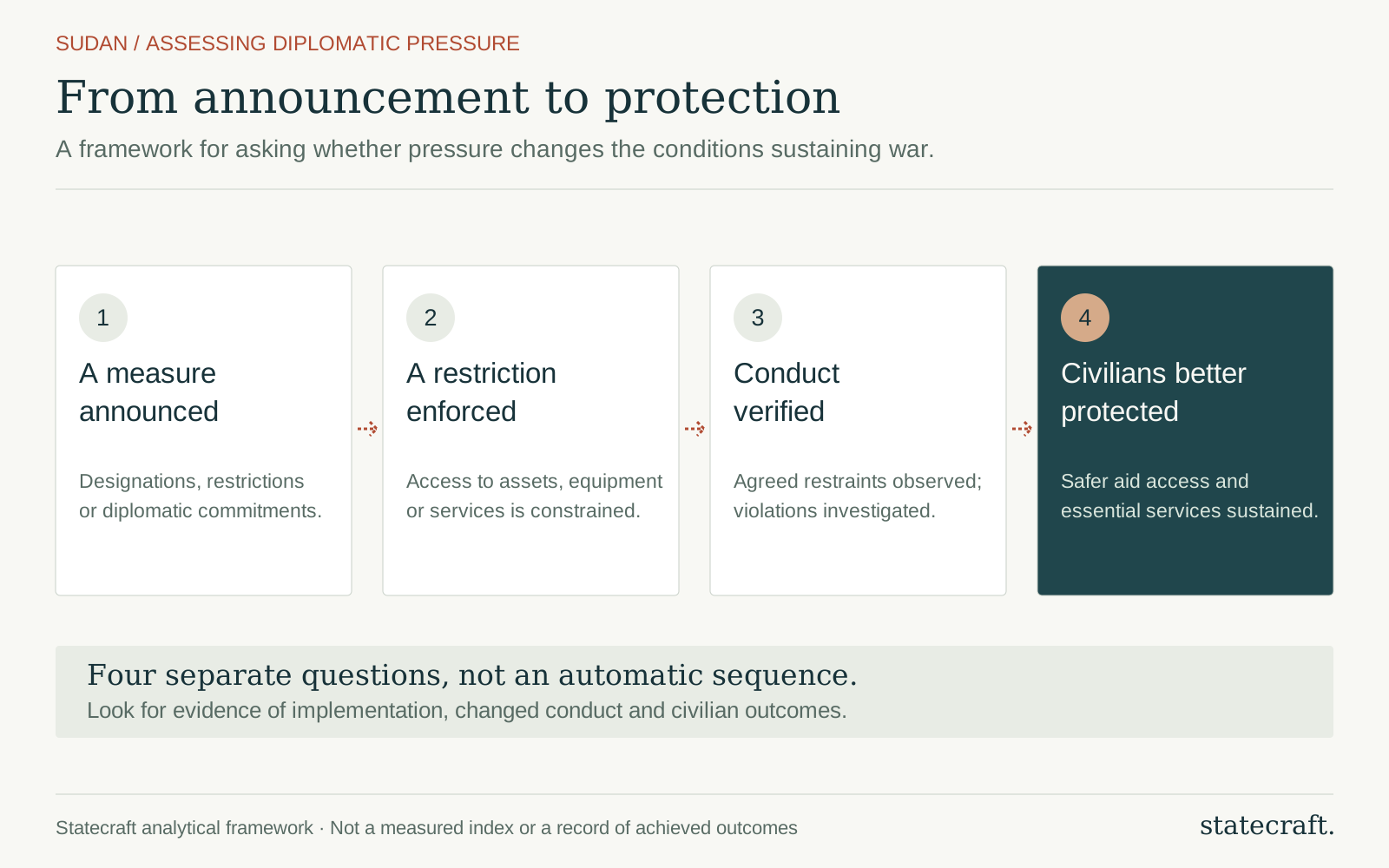
Targeted sanctions can restrict assets within the reach of the sanctioning authorities, limit travel and identify conduct that carries international consequences. Their practical effect depends on exposure. An individual who relies on accessible financial services faces a different constraint from one whose resources sit beyond the enforcing state’s reach. Public designation establishes a measure; its announcement does not reveal how much money has been immobilised or whether military activity has become harder to sustain.
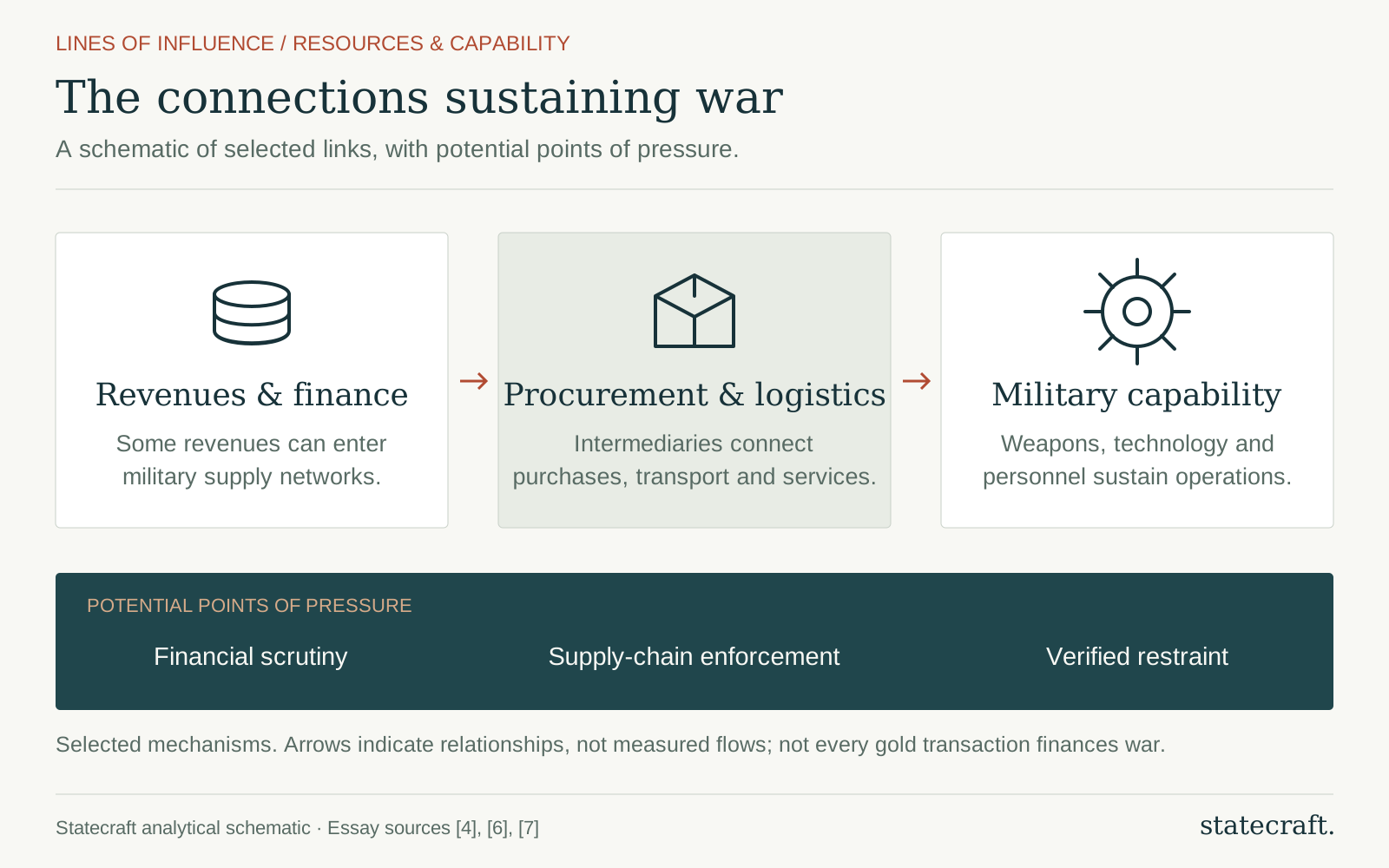
Britain’s July package recognised the importance of intermediaries. It targeted eleven individuals and entities suspected of involvement in financing, procurement and commercial networks supporting the RSF or SAF. The government described links between Sudanese gold revenues and international transactions, including activity in Dubai and Hong Kong. This was an official account of the grounds for sanctions, rather than independent proof that the measures had subsequently disrupted those networks. [6]
Effective implementation requires more than adding names to a list. Authorities need to identify ownership, follow transactions and cooperate across jurisdictions. Banks and trading firms need sufficiently clear information to recognise the relevant risks. Enforcement also has to anticipate adaptation: a sanctioned company might be replaced, a transaction rerouted or an intermediary moved. A policy that counts designations while ignoring those changes can mistake administrative activity for strategic effect.
The objective should be specified. A measure intended to constrain procurement needs evidence about access to equipment and services. One intended to encourage participation in talks needs a credible relationship between compliance and the benefit offered. Measures serving accountability may remain justified even when they do not immediately change behaviour. Governments should explain these purposes separately so that a failure to secure a ceasefire does not obscure other achievements—or excuse ineffective implementation.
Gold and the geography of enforcement
The EU moved further into the war economy in July, announcing restrictions on the purchase, import or transfer of Sudanese gold and on supplying mercury and cyanide to Sudan, alongside related services. Its announcement included specified exceptions, including for certain humanitarian purposes. The Council presented the measures as a means of reducing resources sustaining the conflict. [7]
This creates an important enforcement problem. Restricting trade within participating jurisdictions may make transactions more difficult without eliminating other markets. The effect depends on the routes through which material reaches purchasers, how its origin is established and the willingness of other authorities to cooperate. A prohibition has greater reach when trading, financial and transport services apply compatible standards and credible checks.
There are also consequences for people beyond the intended targets. A strategy aimed at armed groups’ revenues should examine how restrictions affect civilian livelihoods and legitimate commerce. The evidence needed includes prices received by producers, changes in trading routes and the distribution of lost income. Otherwise, hardship could fall on communities while more powerful intermediaries preserve their margins. Monitoring those effects is part of designing pressure responsibly.
For Lines of Influence, gold provides a stark example of dependence running in several directions. Armed organisations need ways to convert resources into purchasing power. Outside businesses seek supplies and profits. Governments have authority over different points in those transactions. Their influence depends on recognising where they can interrupt the connection, then accepting the diplomatic and commercial consequences of doing so. General condemnation leaves that more demanding choice unresolved.
The connections sustaining war
The mediators have interests too
October’s Geneva consultations brought the Quad and Quintet into closer coordination. The Quad comprises the United States, Saudi Arabia, Egypt and the UAE. The Quintet brings together the African Union, IGAD, the Arab League, the European Union and the United Nations. The UN envoy’s account described discussions spanning a humanitarian truce, a possible ceasefire and the political process. The meeting established further engagement; it did not itself establish an implemented settlement. [2]
Different participants possess different kinds of access. Some can speak directly to military leaders; others can mobilise finance, regional institutions or international legitimacy. Combining those capacities could make mediation more effective. It also requires scrutiny of the participants’ preferences. A government’s access to a belligerent does not ensure that it will use every available means to alter that belligerent’s behaviour.
This is a problem of incentives within mediation itself. A participant may value a ceasefire while also seeking influence over the future political order. Another may want regional stability but disagree about which security arrangements would provide it. These are analytical possibilities to investigate, rather than motives established merely by a country’s membership of a diplomatic group. Treating the mediators as a single actor conceals the work necessary to produce a shared policy.
Coordination should therefore identify who will undertake which actions and how their effects will be assessed. Commitments concerning supply networks need follow-up by the authorities able to investigate them. Political undertakings need consistent messages to the parties. A negotiating process becomes more credible when its participants cannot easily promise restraint in one room while enabling contrary activity elsewhere.
A truce needs arrangements that people can trust
Pressure requires an achievable purpose. A humanitarian truce could create space for relief and reduce immediate violence. A permanent ceasefire involves a wider set of obligations. A political settlement raises further questions about authority, security and civilian government. Combining all three in a communiqué does not resolve the different practical problems each presents.
A useful truce would need clarity about the conduct covered, the places affected and the procedures for reporting violations. Arrangements should address how humanitarian organisations obtain reliable access and how civilians learn what protection has actually been agreed. Monitoring needs people, communications and a workable means of assessing contested incidents. These are proposed requirements for a credible arrangement, not capabilities already established by the October consultations.
A further difficulty concerns enforcement. An armed group might accept a pause because it wants relief from pressure, time to reorganise or genuine progress towards an agreement. Observers cannot safely assume a single motive. The arrangement needs to reduce opportunities for military advantage while making compliance more valuable than violation. External actors must be prepared to respond when their partners breach commitments, including when doing so complicates a relationship they otherwise value.
Credibility matters on the other side of the bargain too. Participants need to understand which steps would produce which benefits, and whether the states offering them can deliver. A vague promise of future acceptance may offer little reason to change course. Any proposals for adjusting restrictions should specify lawful conditions, verification and procedures for responding to renewed abuses. Negotiating incentives cannot erase victims’ claims to justice or substitute diplomatic assurances for independent investigation.
The transition from a truce to a wider settlement also needs care. Early humanitarian gains should be protected from becoming hostages to every unresolved political dispute. At the same time, a temporary reduction in fighting must not become an indefinite substitute for addressing the organisation of power. Diplomacy needs sequencing: urgent measures to protect lives, followed through by negotiations capable of changing the conditions that make violence recurrent.
Sovereignty, order and the protection of people
The English School of international relations offers a useful way to examine these tensions. It understands international society through the rules, institutions and practices by which states manage their relations. Within that tradition, debates over pluralism and solidarism concern how an order protecting distinct political communities relates to wider obligations towards human beings. The framework identifies a tension; it does not supply an automatic policy for Sudan. [8]
Respect for sovereignty should prompt scrutiny of outside military involvement as well as caution about externally imposed political arrangements. A peace designed around foreign preferences could reproduce the very dependencies that Sudanese civilians want to escape. Yet protecting a state’s formal independence provides little reassurance to people exposed to organised violence within it. An international society that invokes rules must confront what sustaining those rules requires in practice.
The Security Council’s October action illustrates the distance between institutional continuity and expanded protection. Resolution 2830 renewed the sanctions measures until 11 December and the experts’ mandate until 11 January 2027. The independent Security Council Report described the decision as a technical rollover amid continuing differences over expanding the Darfur-focused UN arms embargo across Sudan. Britain’s own embargo already covers the whole country; the two arrangements should not be confused. [9] [10] [11]
Preserving monitoring and existing restrictions has value. The limitation lies in treating renewal as sufficient evidence that the international response has kept pace with the conflict. The harder assessment concerns which activities remain possible, which violations are investigated and whether states give the institutions they endorse the cooperation needed to function. Order acquires meaning through those decisions.
Civilians must help define the peace
Negotiations with armed actors are necessary because those actors can continue fighting. Their military capacity cannot give them an exclusive claim to decide Sudan’s political future. A settlement organised only around the preferences of those commanding forces risks making violence the most reliable route to political recognition.
Sudanese participants in the civilian and political seminar associated with April’s Berlin conference offered a different starting point. Their joint call sought an inclusive process under Sudanese ownership, civilian leadership, protection of infrastructure, humanitarian access and accountability. It explicitly called for meaningful participation by women, young people, civil society, displaced populations and refugees. This expresses the position of those participants; it should not be presented as proof that Sudan’s diverse civilian constituencies share a single political programme. [12]
Meaningful participation requires influence over the process itself. Who helps set the agenda? How are representatives selected? Can participants challenge a proposed arrangement without losing access or facing reprisals? Consultation after the central bargain has been settled leaves civilians with little authority over decisions made in their name. Practical support should include secure participation, interpretation, information and time for constituencies to deliberate.
Representation must also remain open to challenge. Displacement, insecurity and unequal access to communications can make participation easier for some groups than others. A credible process needs ways to hear from people who cannot travel and to explain how their views affect decisions. No international organiser can eliminate those inequalities through an invitation list. It can make selection procedures more transparent and allow participants to question whose voices remain missing.
Civilian organisation also exists beyond formal talks. Sudan’s Localization Coordination Council describes coordinating Emergency Response Rooms and local organisations involved in communal kitchens, clinics and other essential services. Its account emphasises decisions and accountability rooted in communities. [13] These efforts should inform international policy without being treated as a ready-made national government or exposed through demands for public political alignment. Supporting civilian agency means respecting the different purposes through which people organise to survive and rebuild.
Humanitarian access is an immediate measure of progress
Diplomatic assessments need to begin with conditions experienced by people facing violence and hunger. In October, WHO warned of worsening food insecurity and malnutrition and reported that only 23 per cent of its US$97.7 million humanitarian appeal had been funded. That figure concerns WHO’s appeal, not the funding of the entire Sudan response. The UN humanitarian coordinator separately warned that, without urgent funding, food and nutrition stocks were expected to run out by early 2027. These were dated assessments and warnings, rather than predictions that every location would face an identical outcome. [14] [15]
Access and resources must be considered together. Permission to deliver assistance is of limited use when organisations lack supplies, transport or staff. Funding cannot achieve its purpose when people are prevented from reaching those in need. Diplomatic commitments should be followed through to actual deliveries, continuity of services and the safety of local and international responders.
Pressure must also distinguish armed actors from the population. Civilian assistance should follow humanitarian need. Its availability should not depend on communities demonstrating loyalty to a negotiating faction or becoming instruments of diplomatic bargaining. Sanctions implementation needs workable humanitarian arrangements, alongside practical guidance that helps lawful assistance proceed. Otherwise, institutions seeking to reduce risk may withdraw from activities that civilians urgently need.
Measuring progress this way changes the standard applied to diplomacy. A meeting can be useful even before it delivers a comprehensive settlement if it secures verifiable improvements. Conversely, an ambitious declaration offers weak evidence of progress when communities remain cut off, services collapse or responders face continuing attacks. Immediate protection and a durable political process need to reinforce one another.
When does pressure make a difference?
Britain’s influence includes choices about its partners
Britain is one participant in this wider diplomatic system. Its sanctions, aid, international relationships and role at the Security Council offer opportunities to contribute. The relevant issue is how consistently it connects them. An appeal to stop external support should be accompanied by careful scrutiny of activities within reach of British authorities and by sustained engagement with the governments able to address other parts of the network.
In an October parliamentary answer, the government said it had reviewed more than 3,000 export licences to destinations associated with allegations of diversion or transit to Sudan. It reported finding no evidence of British weapons or ammunition being used there, and no cases requiring suspension or revocation. This is the government’s stated conclusion of its review. It does not independently resolve every allegation concerning equipment, intermediaries or other states’ conduct. [11]
The appropriate response is continued, evidence-led scrutiny. Findings by independent investigators should prompt specific questions about products, recipients, routes and end use. Governments should explain how new information changes their assessment and what action follows where risks are established. Commercial and security relationships deserve examination within that process, rather than operating as implicit reasons to avoid it.
Influence also depends on willingness to incur costs. A state that seeks cooperation from an important partner may have to place Sudan high enough on the bilateral agenda to affect decisions in other areas. Which measures are warranted requires evidence and judgement. The principle is simpler: a relationship’s value cannot establish that every activity conducted through it should escape scrutiny. Diplomatic access is useful when governments are prepared to use it for a defined purpose.
That purpose should survive changes in political attention. Investigations require staff and continuity; financial cooperation needs trusted channels between authorities; commitments made in meetings need officials responsible for following them up. These are ordinary requirements of administration with potentially serious consequences for civilians. A sustained strategy would fund that work and explain its results, while protecting information whose disclosure could endanger witnesses or compromise an investigation.
Making the cost of war harder to transfer
The next phase should be judged through observable changes: sustained access to vulnerable communities; credible implementation of agreed restraints; investigations of supply and finance networks; and civilian influence over the political process. These measures cannot prove that peace is inevitable. They can show whether international activity is beginning to constrain the conduct it condemns.
For Lines of Influence, Sudan reveals a particularly destructive arrangement of dependence. Those sustaining war can draw resources through international connections while transferring much of its cost to people with little control over those relationships. Effective diplomacy would begin to reverse that imbalance: raising the costs borne by enablers and belligerents, protecting the population and widening the choices available to Sudanese civilians. The purpose of pressure is fulfilled when it helps people live beyond the authority of the gun.
Sources & notes
- FCDO, UK sanctions senior commanders implicated in campaign of rape in Sudan and unveils new support for survivors, 26 October 2026 ↗Back to the essay ↑
- UN DPPA, remarks of Personal Envoy Pekka Haavisto following the sixth consultative meeting, 21 October 2026; co-chairs’ summary and UN meeting coverage also checked ↗Back to the essay ↑
- UN Human Rights Office, RSF violations during capture of El Fasher amount to war crimes and possible crimes against humanity, 13 February 2026 ↗Back to the essay ↑
- UN fact-finding mission chair Mohamed Chande Othman, presentation of Fuelling Sudan’s Conflict to the Human Rights Council, 7 September 2026, official transcript ↗Back to the essay ↑
- UAE Ministry of Foreign Affairs, statement denying arms or military support to Sudan’s warring parties, 8 May 2025 ↗Back to the essay ↑
- FCDO, UK sanctions illicit gold networks fuelling Sudan’s war amid crisis around El Obeid, 16 July 2026 ↗Back to the essay ↑
- Council of the EU, Sudan: Council strengthens EU sanctions regime by targeting gold trade, 13 July 2026, updated 14 July ↗Back to the essay ↑
- Cornelia Navari, editor, International Society: The English School, publisher’s overview and contents, including Pluralism and Solidarism ↗Back to the essay ↑
- UN Security Council, Resolution 2830, adopted 8 October 2026, renewal dates ↗Back to the essay ↑
- Security Council Report, Sudan: Briefing and Consultations, October 2026, analysis of the technical rollover and competing positions ↗Back to the essay ↑
- UK Parliament, written question 32707, arms licences and Sudan, answered 16 October 2026 ↗Back to the essay ↑
- Sudanese civilian and political seminar participants, Joint Call to End the War and Advance a Sudanese-Owned Political Process, finalised in Berlin, 15 April 2026, English reference translation ↗Back to the essay ↑
- Localization Coordination Council, account of its work with Sudanese Emergency Response Rooms and local organisations, accessed 1 November 2026 ↗Back to the essay ↑
- WHO, IPC Sudan Food Insecurity and Malnutrition Alert, 12 October 2026 ↗Back to the essay ↑
- UN Resident and Humanitarian Coordinator in Sudan, Severe rainfall deficits in Sudan, statement dated 15 October, published 16 October 2026 ↗Back to the essay ↑
This is an analytical essay, grounded in the dated developments and official positions above. Interpretations and illustrative scenarios are distinguished from reported events. Drafted with AI assistance. Maps and evidence graphics: Statecraft. Documentary photographs are dated and credited individually. Read our editorial approach.