On 16 March 2021, the British government published an Integrated Review promising a more active international role. Within five months, the evacuation from Kabul exposed the limits of British influence over an indispensable ally. Within a year, Russia’s full-scale invasion of Ukraine returned territorial war to the centre of European security. By June 2025, Britain was describing its defence posture as NATO-first. These events did not render international ambition obsolete. They made its price harder to ignore. The central question is whether Britain learned to choose commitments it could sustain, or simply accumulated new promises around old obligations.
2021: a strategy with many centres
The 2021 Integrated Review brought defence, diplomacy, development, technology and trade into one framework. It identified Russia as an acute threat while giving increased attention to the Indo-Pacific, scientific advantage and resilience. It was not a straightforward instruction to abandon Europe. Its difficulty was the breadth of what Britain proposed to achieve simultaneously, across instruments with different budgets and different timescales.[1] A strategy can acknowledge every important problem and still fail to determine what happens when several demand action at once.
From an English School perspective, this breadth had a defensible rationale. Britain benefits from a society of states in which trade, diplomacy and legal commitments constrain arbitrary power. Maintaining that society requires more than military balancing. Scientific cooperation, development relationships and institutions can help sustain consent to shared rules. The weakness comes when the language of international responsibility ceases to distinguish responsibilities Britain can discharge directly from those it can only support through others.
An Indo-Pacific diplomatic presence, for example, does not require a European-sized military commitment. Trade negotiators, technical specialists and a predictable programme of ministerial engagement may achieve useful results at relatively modest cost. A carrier deployment or a submarine programme makes different demands. Treating every instrument as evidence of the same expanding global role risks concealing these differences. The relevant choice is not simply between regions; it is between kinds of contribution within each region.
The test of the review was therefore operational. Which activity would be reduced if the European security environment deteriorated? Which programmes had protected funding, skilled personnel and delivery plans? Which promises depended on American decisions? Public strategy documents cannot disclose every contingency. They should nevertheless make the hierarchy of interests sufficiently clear that citizens and allies can understand a difficult decision when it comes. Otherwise comprehensiveness becomes a way of postponing choice.
The geography of Britain’s choices
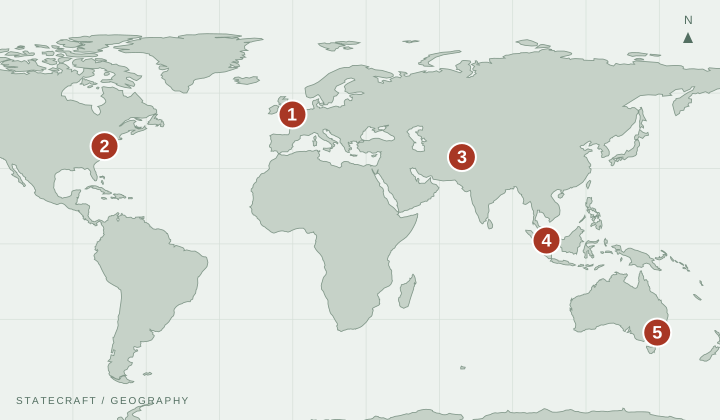
- London
The centre of British decisions about finite diplomatic and military resources.
- Washington
An indispensable ally; Kabul revealed the limits of British autonomy.
- Kabul
The 2021 withdrawal tested promises against dependence on American capabilities.
- Singapore
A focal point for Britain’s wider Indo-Pacific relationships.
- Canberra
AUKUS connects influence to a long industrial and strategic commitment.
Kabul: dependence becomes visible
The Taliban’s takeover in August 2021 supplied an immediate test. The Foreign Affairs Committee’s May 2022 inquiry criticised serious failures of leadership, coordination and preparation around the withdrawal and evacuation. It also questioned Britain’s inability to shape the American decision. These were parliamentary findings, rather than an uncontested account: the government subsequently disputed parts of the committee’s assessment.[2][3] The disagreement does not erase the strategic problem revealed by the episode: British objectives depended on an American operation Britain could not indefinitely reproduce.
Alliance dependence is not inherently a mistake. Cooperation permits states to undertake tasks that would be prohibitively costly alone. The error is to confuse access to an ally’s capabilities with control over the conditions under which they remain available. British participation over many years did not create a veto over Washington’s withdrawal. Diplomatic closeness gave opportunities to argue; it did not guarantee that British preferences would prevail when American priorities changed.
The evacuation also showed that a foreign-policy reversal has consequences beyond government-to-government relations. Afghans who had worked with the British presence had organised their lives around expectations of protection. An English School account concerned only with interstate order would miss these obligations to individuals. The solidarity invoked to justify a long intervention cannot simply disappear when maintaining that intervention becomes politically inconvenient. There is an institutional question about how such obligations are recorded, funded and discharged.
Kabul should not be used to claim that Britain must become capable of every operation independently. That would replace one unrealistic ambition with another. The more useful lesson is to identify dependence in advance and plan for its withdrawal. A credible strategy needs alternatives appropriate to its actual purposes: diplomatic contingency arrangements, evacuation capacity, records of eligible people and clear decision authority. These quieter capabilities may matter more in a crisis than the prestige attached to announcing a distant commitment.
2022–2023: Europe reasserts its priority
Russia’s full-scale invasion changed the ordering of British interests. The Integrated Review Refresh of March 2023 retained global engagement but strengthened deterrence, resilience and Euro-Atlantic security. It announced an additional £5 billion for defence across 2023–24 and 2024–25, including attention to nuclear capabilities and replenishment.[4] The revision is evidence that the government recognised a changed environment. It is not evidence that every resulting capability gap had been closed.
Supporting Ukraine linked a direct security interest with a rule Britain wanted other states to respect: borders should not be changed through conquest. This is where balancing power and defending international society can reinforce each other. Yet the alignment of purpose does not remove the need to prioritise instruments. Weapons transferred to Ukraine, stocks retained for British forces and resources assigned to future programmes all compete for funding, industrial capacity and political attention.
The distinction between immediate usefulness and long-term insurance became especially important. A stockpile is valuable because it can be drawn upon quickly; a replacement contract matters because that stockpile cannot be exhausted indefinitely. Training can increase another army’s capacity but also occupy facilities and personnel needed at home. These are not arguments against assistance. They explain why sustaining assistance requires a wider production and force-generation policy, rather than a succession of exceptional transfers.
The British response was strategically more coherent when it connected these tasks through allies. A government does not need to provide every capability to contribute meaningfully. It does need to know which contribution others are relying upon it to sustain. This is a stronger standard than being described as a leading supporter. Leadership should be measured by whether a British decision makes an allied plan more feasible, predictable or durable.
AUKUS: influence purchased over decades
The AUKUS submarine pathway announced in March 2023 showed that a European priority did not end Britain’s Indo-Pacific commitments. A British design incorporating American technology was selected for SSN-AUKUS, with the first British boats envisaged for the late 2030s and Australian boats in the early 2040s. These are conventionally armed, nuclear-powered submarines, not a transfer of nuclear weapons.[5] The distinction matters both legally and strategically.
AUKUS offers a concrete form of influence. Britain contributes specialised design, industrial knowledge and an established relationship with the United States to a capability Australia wants. The partnership can support skilled employment and tie the participants into repeated cooperation. Unlike a one-off visit, a shared industrial programme creates continuing reasons to consult. In that sense, material interdependence can give diplomatic commitments a more durable institutional basis.
The same arrangement creates dependencies and opportunity costs. Shipyards, nuclear skills, suppliers and public money cannot be expanded simply by announcing a partnership. Long delivery horizons expose a programme to changing governments, inflation and competing military requirements. Its relevance to future deterrence should therefore be distinguished from its contribution to an immediate crisis. A submarine expected decades ahead cannot fill today’s escort, maintenance or ammunition shortfall.
The proper strategic question is whether the programme strengthens capabilities Britain needs anyway while producing benefits for partners, or whether associated commitments stretch scarce resources beyond a sustainable point. That question cannot be settled by celebrating cooperation or invoking overstretch in the abstract. It requires delivery milestones and transparent treatment of the trade-offs. AUKUS demonstrates selective British relevance; its full material return lies beyond the period assessed here.
CPTPP: a diplomatic gain with bounded economic claims
Britain became a member of the Comprehensive and Progressive Agreement for Trans-Pacific Partnership on 15 December 2024. Accession was a completed diplomatic and legal achievement, giving the UK a role in an existing trade institution rather than requiring it to create one.[6] That role has strategic value: it diversifies relationships and allows Britain to participate in discussions about the agreement’s development. It does not mean that geography has ceased to influence trade.
The government’s impact assessment estimated a long-run increase in British GDP of around £2 billion against its projected baseline, expressed in 2021 prices. The modelling compared an economy with accession to an economy without it, rather than claiming that this money had already appeared. It also acknowledged uncertainty and did not treat possible future expansion as part of the central accession scenario.[7] These qualifications belong in an evaluation of the policy, not in small print after a large headline.
Commercial gains and diplomatic access are different outcomes. Firms must use preferences, understand rules of origin and find buyers before formal market access becomes additional trade. Meanwhile, participation in a trade institution can remain useful even if its initial measured GDP effect is modest. The danger is to switch between these rationales whenever one is challenged. A government should say which benefit justifies which cost and provide evidence appropriate to that claim.
For British strategy, CPTPP makes most sense as an addition to a wider network of economic relationships. It is less persuasive when presented as a compensating answer to every difficulty elsewhere. The art of choosing includes accepting limited gains on their own terms. A useful agreement does not have to transform the economy; overstating its significance can make an otherwise defensible achievement appear disappointing when assessed against an inflated promise.
Bletchley: convening as a strategic instrument
The AI Safety Summit at Bletchley Park in November 2023 offered a different test of British influence. The resulting declaration brought governments, including the United States and China, into a shared statement about the opportunities and risks of frontier artificial intelligence. Britain hosted the process and helped establish a subject for continuing international cooperation.[8] This was a concrete diplomatic output. It was neither a binding global regulatory settlement nor evidence that rival governments had resolved their wider technology competition.
The episode matters because it complicates the assumption that Britain must choose between military relevance and international marginality. Technical expertise, research institutions and the ability to organise a useful meeting can create influence in a field where no government has settled answers. The host does not need to dominate the underlying industry to shape a discussion. It does need sufficient knowledge to formulate a problem that other participants recognise as consequential.
The limits are equally instructive. Agreement that a technology presents risks leaves open who evaluates those risks, what information companies disclose, and which restrictions states will accept. A summit can establish a vocabulary without creating the means to enforce it. The diplomatic value should therefore be traced into subsequent scientific exchanges, testing practices and institutional cooperation. Attendance is a starting condition for influence, not its final measure.
For a selective British strategy, the attraction is a contribution whose value depends on expertise and trusted procedure rather than on matching the scale of American or Chinese investment. The danger is attempting to preserve the status of indispensable convenor after the agenda moves elsewhere. Britain should be willing to contribute to a process it no longer hosts. Shared ownership can make a diplomatic initiative more durable, even if it reduces the national visibility attached to it.
Bletchley thus adds a useful criterion to the assessment of global ambition: can Britain establish something that partners continue to find worth using? Where the answer is yes, influence may outlast a summit and survive changes of government. Where the answer is no, repeated invitations risk becoming an expensive substitute for a purpose.
The room becomes an instrument

2025: rediscovering the value of European machinery
The UK–EU summit of 19 May 2025 established a security and defence partnership alongside a broader agenda for cooperation. The common understanding proposed exploring opportunities under the EU’s SAFE defence instrument within the parties’ respective legal frameworks.[9] This was a decision to develop cooperation, not automatic British access to every European procurement programme. The wording itself revealed that shared strategic interests still required negotiation over institutional conditions.
The summit’s strategic significance was that it treated relationships with nearby states as working infrastructure. Regular consultation can identify a problem before it becomes a public dispute. Compatible procedures can make joint action faster. Agreements on standards, procurement and industrial participation can affect whether political commitments generate equipment. These gains are less dramatic than the language of a national return to the world stage, but potentially more consequential.
Re-engagement also required accepting that influence from outside an institution differs from influence as a member. Britain retained significant military, intelligence and diplomatic capabilities. The EU retained its own decision procedures and responsibilities to its members. Neither fact compelled the other side to accept every proposed arrangement. Cooperation had to rest on mutual benefit rather than an assumption that security importance automatically entitled Britain to favourable economic terms.
This is not a choice between autonomy and dependence in the absolute. All workable arrangements distribute discretion. Britain can retain the formal freedom to decide alone while finding that joint procedures improve the choices available to it. Conversely, a poorly designed arrangement can create obligations without useful influence. The 2025 opening should be judged by the agreements and practical activity it enables, rather than by either symbolic reconciliation or suspicion of cooperation as such.
The budget makes the hierarchy explicit
On 25 February 2025, the government announced that defence spending would reach 2.5 per cent of GDP in 2027, financed by reducing official development assistance from 0.5 to 0.3 per cent of gross national income. The two measures use different national-income denominators and should not be treated as a simple transfer of identical percentage points. The announcement nevertheless made the political trade-off explicit.[10] An integrated strategy was choosing to strengthen one instrument partly by reducing another.
The case for additional defence spending was that the security environment required greater capacity. The objection to its financing was that development relationships, conflict prevention and humanitarian assistance also contribute to international influence and security. Both arguments can be true. It is insufficient to describe aid and defence as interchangeable contributions to national strength. Their benefits arise through different mechanisms, reach different constituencies and unfold over different periods.
The inherited affordability problem was substantial. In December 2023, the National Audit Office reported that forecast costs in the Ministry of Defence’s 2023–2033 Equipment Plan exceeded the available budget by £16.9 billion. Inflation and the cost of major priorities contributed to the gap.[11] This was an assessment of that plan, not a current audited deficit for every subsequent budget. It illustrates why a new spending target cannot be assumed to purchase an equivalent amount of additional capability.
The Strategic Defence Review published in June 2025 adopted a NATO-first approach and emphasised warfighting readiness, industrial delivery and transformation.[12] The National Security Strategy later that month placed security at home, strength abroad and sovereign capabilities within a common framework.[13] These documents made priorities more legible. Their success depended on execution: recruitment and retention, industrial output, serviceable equipment, resilience and the quality of relationships through which Britain expected to act.
At The Hague on 25 June 2025, NATO allies committed to a 2035 spending framework comprising at least 3.5 per cent of GDP for core defence and up to 1.5 per cent for wider security and resilience.[14] This further extended the horizon of British commitments. The long timetable created space for planning, but also left difficult decisions to future governments. A target measured in national income is a promise about resources; an alliance ultimately needs deployable forces and functioning infrastructure.
Strategy runs on different clocks
Milestones and announced horizons in the evidence reviewed
Britain joins CPTPP on 15 December: an institutional milestone, with economic effects unfolding later.
The February 2025 announcement set a target of 2.5% of GDP.
The Hague commitment set a 5% framework, combining core defence and wider security spending.
The delivery horizon envisaged in the March 2023 announcement.
A more selective Britain, or a longer list?
Across these episodes, British statecraft performed unevenly. Kabul exposed a gap between commitments and control over their enabling conditions. Ukraine strengthened the rationale for European security cooperation. AUKUS demonstrated the value of specialised capabilities while adding long-term obligations. CPTPP delivered institutional access with bounded modelled economic gains. The European reset recognised that diplomacy depends on procedures and negotiated terms. The 2025 reviews acknowledged that military readiness required a more explicit hierarchy.
The recurring problem was not a shortage of interests. It was the temptation to claim that every interest could be advanced by a new commitment without reducing another. Real strategy should make the marginal decision visible: what additional result does the next pound, diplomatic initiative or deployment plausibly purchase? The answer will vary by instrument. A modest diplomatic investment can be highly valuable where relationships already exist; an expensive military contribution can be indispensable where no substitute is available.
Three principles follow. First, distinguish national obligations from contributions to collective plans, and identify the dependencies in each. Second, protect the institutions that convert decisions into delivery, including civilian expertise and industrial capacity. Third, make the expected outcome sufficiently specific that failure can be recognised. Success should not be defined so broadly that retaining a relationship or issuing a statement always counts as achieving the original objective.
Accountability also needs a timescale. Some commitments should produce visible results within a year: a staffed diplomatic post, a functioning consultation process or a completed procurement decision. Others, such as a submarine programme, require intermediate milestones because the final capability lies much further away. Treating them all as achievements at announcement conceals delay; judging them all by immediate output penalises necessary investment. A disciplined strategy should state what evidence would justify continuing, expanding or revising each commitment.
An English School reading adds a final qualification. Britain’s capacity to shape order depends partly on whether other states regard its conduct as legitimate and useful. Military contribution cannot indefinitely compensate for unreliable agreements or selective principles. Equally, the language of rules requires resources when those rules are challenged. The policy cycle from 2021 to 2025 moved Britain towards recognising this connection. Whether it produced a more effective strategy depends on the choices that follow the documents: which promises are funded, which are revised and which are finally declined.
Sources & notes
- Cabinet Office, The Integrated Review 2021, 16 March 2021. ↗Back to the essay ↑
- Foreign Affairs Committee, Missing in action: UK leadership and the withdrawal from Afghanistan, 24 May 2022, summary. ↗Back to the essay ↑
- Foreign Affairs Committee, publication of the government’s response to the Afghanistan report, 29 July 2022. ↗Back to the essay ↑
- Cabinet Office, Integrated Review Refresh 2023, 13 March 2023. ↗Back to the essay ↑
- UK government, British-led design chosen for AUKUS submarine project, 13 March 2023. Delivery dates are the announced pathway. ↗Back to the essay ↑
- Department for Business and Trade, UK joins CPTPP, 15 December 2024. ↗Back to the essay ↑
- Department for Business and Trade, CPTPP impact assessment, executive summary. Modelled long-run effects against a counterfactual baseline. ↗Back to the essay ↑
- UK government, The Bletchley Declaration, 1 November 2023: shared statement on frontier AI safety. ↗Back to the essay ↑
- UK–EU summit, Common Understanding, 19 May 2025. ↗Back to the essay ↑
- Prime Minister’s statement to the House of Commons, 25 February 2025: defence and development spending decisions. ↗Back to the essay ↑
- National Audit Office, The Equipment Plan 2023 to 2033, 4 December 2023. ↗Back to the essay ↑
- Ministry of Defence, Strategic Defence Review 2025, 2 June 2025. ↗Back to the essay ↑
- Cabinet Office, National Security Strategy 2025, 24 June 2025. ↗Back to the essay ↑
- NATO, The Hague Summit Declaration, 25 June 2025. ↗Back to the essay ↑
This is an analytical essay, grounded in the dated developments and official positions above. Interpretations and illustrative scenarios are distinguished from reported events. Drafted with AI assistance. Maps and evidence graphics: Statecraft. Documentary photographs are dated and credited individually. Read our editorial approach.