On 19 May 2025, Britain and the European Union announced a new security and defence partnership. By December, negotiations on enhanced British participation in the first round of the EU’s SAFE defence-financing instrument had ended without agreement. The contrast is a useful starting point for European security. Governments can agree that a threat is serious while disagreeing over who should pay, whose industry should benefit and who controls the response. Britain has become an active organiser of European defence cooperation. Its success depends on whether the arrangements it helps create supply capabilities partners can actually use when a crisis arrives.
2022: solidarity acquires a geography
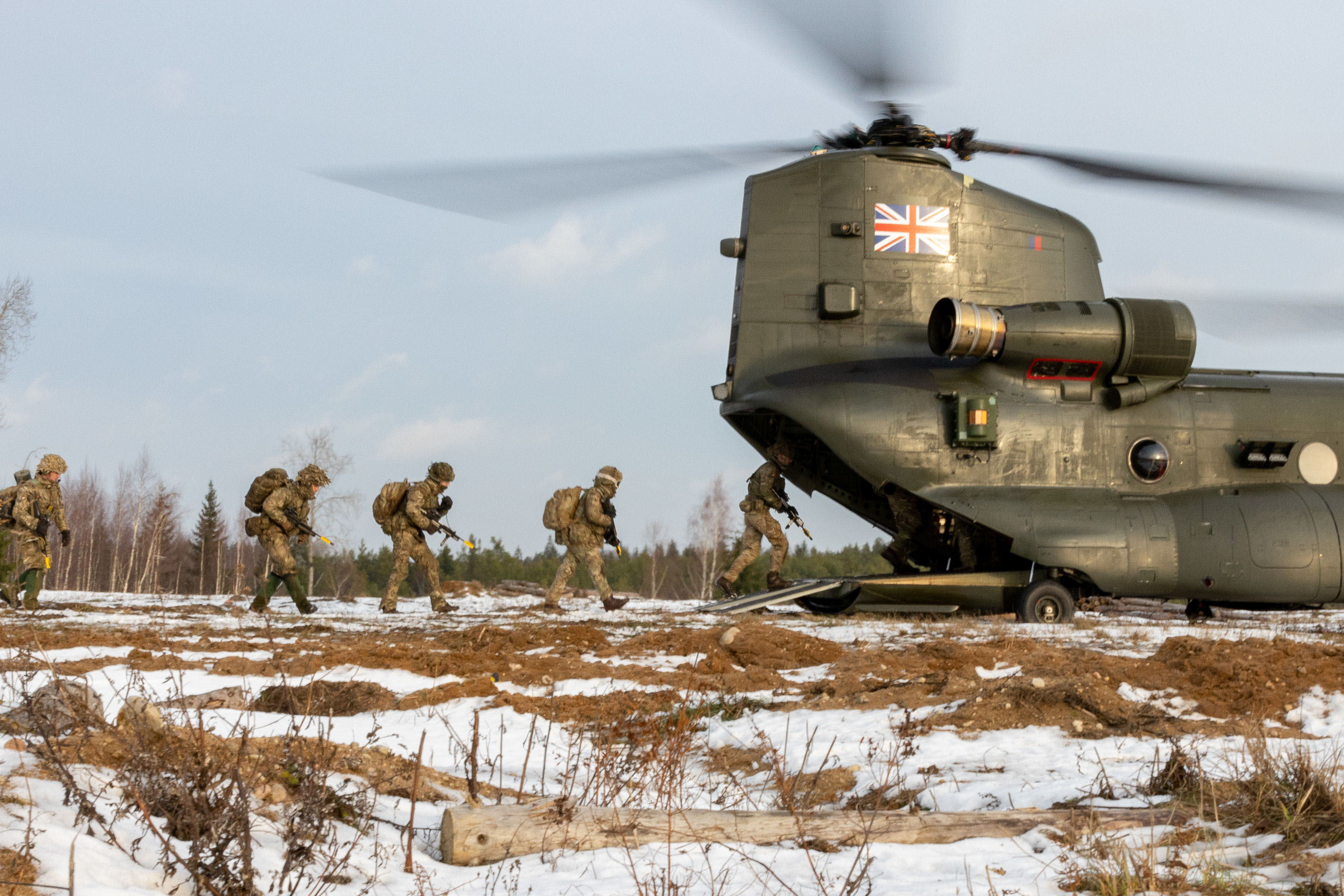
Russia’s invasion of Ukraine made the defence of NATO’s eastern members more urgent. Britain temporarily doubled its deployed presence in Estonia to more than 1,600 personnel and announced additional forces for NATO’s developing force arrangements in June 2022.[1] This was a material response as well as a signal. Soldiers, equipment and command relationships can make a commitment more credible because their presence creates practical connections between national defence plans.
A forward deployment has more than one function. It can reassure the host, complicate an attacker’s calculations and create the basis for reinforcement. It does not necessarily supply all the force needed to defeat a major attack by itself. The distinction between a visible presence and a complete defensive plan is therefore crucial. A small multinational force may be politically consequential while depending on larger formations, air support, logistics and decisions taken elsewhere.
The UK–Estonia roadmap of November 2022 addressed reinforcement and integration with Estonian defence planning, including exercises up to brigade level.[2] Such arrangements matter because a promise to send troops is usable only if the route, equipment, command authority and reception arrangements are prepared. The difficulty is not simply whether London intends to help. It is whether help can arrive in time and operate effectively with the forces already there.
An English School perspective treats this as the institutional side of the balance of power. States preserve their independence partly through shared practices that organise resistance to aggression. But an alliance remains a society of sovereign governments. It cannot assume away national decisions. Credibility comes from repeatedly aligning those decisions with a common plan, while making it more costly politically and materially to abandon partners at the decisive moment.
An assurance made visible
The Nordic enlargement: reassurance before membership
On 11 May 2022, Britain signed security declarations with Finland and Sweden. These built on existing cooperation, including the UK-led Joint Expeditionary Force, and preceded the two countries’ NATO membership.[3] The British contribution was useful precisely because the transition created uncertainty. Political assurances and closer military cooperation could help reassure partners while the formal accession process depended on agreement across the alliance.
Finland joined NATO on 4 April 2023; Sweden followed on 7 March 2024.[4] These were decisions by the countries themselves, accepted through NATO’s procedures. They should not be narrated as British diplomatic acquisitions. London supported a change that Finnish and Swedish governments judged necessary in response to their security environment. Respecting their agency is part of explaining why the resulting arrangements possess greater legitimacy than a great-power bargain imposed over their heads.
The material effect of enlargement is also more complicated than adding flags to a map. New members bring capabilities, territory, experience and obligations. Defence plans must connect these assets to existing arrangements. Geography can make cooperation more coherent, but it also changes the infrastructure and forces that require protection. The appropriate assessment asks what the alliance can now plan or sustain that it could not previously do as reliably.
Britain’s role was strongest where it supported this integration through an existing regional network. The Joint Expeditionary Force offered relationships and habits of cooperation that could complement NATO. Its value would be diminished if it became a competing structure or a substitute for capabilities members had already promised elsewhere. European defence benefits from overlapping institutions when their tasks are clear; overlap becomes wasteful when several organisations count the same scarce forces as available simultaneously.
Trinity House: cooperation becomes a programme
The UK and Germany signed the Trinity House Agreement on 23 October 2024. The associated programme included maritime cooperation, industrial projects and joint work on military capabilities. Planned episodic German P-8 deployments to Britain were intended to support interoperability and anti-submarine activity after those aircraft entered service.[5] The details made this more than a general declaration of friendship, while the conditions and future tense made clear that much remained to be implemented.
The partnership addressed a practical problem: European states often need similar capabilities but buy, support and upgrade them through separate systems. Common requirements and shared facilities can spread costs and increase the usefulness of equipment in joint operations. Yet cooperation is not automatically cheaper. Governments may insist on national modifications or industrial shares that increase complexity. The diplomatic task includes deciding which preferences can be surrendered in exchange for a more useful collective result.
A concrete procurement step followed in December 2025, when the UK announced a £52 million agreement for RCH 155 early capability demonstrators, with one platform for Britain and two for Germany for joint testing.[6] A demonstrator contract is evidence of progress beyond a communiqué. It is not the delivery of a fully equipped operational artillery fleet. Presenting the stages accurately allows readers to recognise achievement without confusing development with readiness.
The proposed sharing of test data and facilities illustrates a plausible mechanism for improvement. Partners can learn from the same trials rather than duplicating every task, while aligning decisions about the eventual system. Whether that produces faster or less costly delivery must be established through the programme’s results. The broad strategic benefit is that repeated work gives officials and industry a continuing reason to solve problems together after ministerial attention moves elsewhere.
Britain’s European security relationships
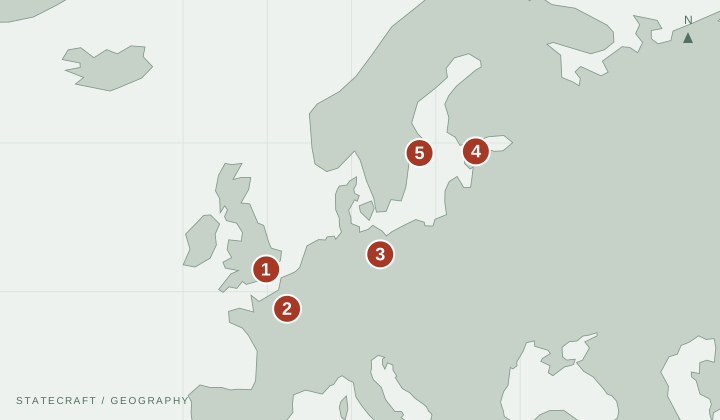
- London
British planning increasingly framed around NATO readiness.
- Paris
Anglo-French cooperation, including coordination of independent nuclear forces.
- Berlin
Trinity House: equipment and industrial cooperation with Germany.
- Tallinn
Britain’s forward defence relationship with Estonia.
- Stockholm
Nordic reassurance and Sweden’s subsequent NATO accession.
SAFE: collective security meets industrial politics
The Council of the EU adopted SAFE in May 2025 as an instrument providing up to €150 billion in loans for defence investment. Its procurement rules included limits on components originating outside the EU, EEA–EFTA states and Ukraine, alongside possibilities for additional agreements with partner countries.[7] The money was a financing mechanism for eligible purchases, not a €150 billion grant already spent or a completed stock of weapons.
SAFE exposed two objectives that can reinforce or obstruct each other. European governments want more military capability quickly. They also want stronger domestic industrial capacity and less dependence on suppliers outside their political control. Buying an available system elsewhere may address an immediate gap but do less to sustain European production. Restricting procurement to favoured suppliers may support industry while delaying the equipment a military needs. These trade-offs cannot be resolved by the word European alone.
The May 2025 UK–EU security partnership created a framework for closer consultation and cooperation.[8] Britain’s military and industrial contribution made it a consequential prospective partner. Its position outside the EU also meant that access was subject to negotiation. The EU had to consider the interests of participating members; Britain had to assess the financial and industrial terms. Strategic alignment did not remove the bargaining problem.
On 1 December 2025, the British government told Parliament that discussions on enhanced participation in SAFE’s first round had not been successfully concluded. It stated that UK industry still had access under standard third-country terms.[9] This was a diplomatic limitation, not the collapse of all defence cooperation. It demonstrates why a partnership announcement should be assessed separately from the commercial and legal arrangements needed to make particular programmes work.
For Britain, the lesson is to negotiate industrial participation as part of strategy, rather than treating it as a technical consequence that follows automatically from military importance. For the EU, there is a corresponding question about whether restrictions serve capability goals or merely protect incumbents. The sensible measure is the additional security generated by the final arrangement, including future production resilience, not simply which side can claim to have secured the tougher bargain.
2025: more money, but on whose timetable?
The Hague NATO summit in June 2025 adopted a 2035 commitment of at least 3.5 per cent of GDP for core defence and up to 1.5 per cent for broader security and resilience, with national plans and a review in 2029.[10] This was a significant collective statement of intended effort. Its long horizon also meant that the forces required in an earlier crisis could not be assumed to exist because the target had been agreed.
Spending shares are useful for political accountability, but imperfect measures of military output. Countries face different labour costs, industrial structures and existing obligations. A larger budget can finance pensions, infrastructure, replacement equipment or genuinely additional capability. Some of these are necessary foundations; none should be confused with every other category. The alliance needs a connection between national spending plans and the capabilities its defence plans require.
Britain’s Strategic Defence Review of June 2025 proposed embedding NATO in how its forces plan, organise, equip and train.[11] This is a more demanding interpretation of alliance commitment than announcing a deployment after a crisis begins. It asks whether national force development starts from what the alliance needs. The test is whether training, support and procurement decisions follow that principle when competing national priorities arise.
The Defence Committee had already warned in February 2024 that operational demands were damaging the armed forces’ readiness for high-intensity conflict. Its report identified shortages of capabilities and stocks, alongside the difficulty of retaining personnel.[12] This was a parliamentary assessment of British preparedness, rather than proof that every unit was unready. It nevertheless challenged the assumption that repeatedly completing current tasks demonstrated sufficient capacity for a larger war.
The difficult issue is political endurance. Defence production needs predictable orders, but democratic governments must remain able to reassess programmes that fail or threats that change. A credible commitment cannot mean protecting every contract from scrutiny. It means making the purpose and delivery milestones sufficiently clear that changes are understood as informed adaptation rather than abandonment. Allies should know which contribution Britain is organising itself to provide and what risks could interrupt it.
Personnel are central to this distinction. Equipment that exists on an inventory may still lack trained crews, maintainers or the support needed for prolonged use. A formation repeatedly assigned to urgent tasks may have less time to train collectively for its primary warfighting role. These costs are difficult to convey in a summit declaration, but they determine whether an ally receives a usable capability or a nominal commitment.
Inside NATO’s 5% commitment
Annual share of GDP targeted for 2035 · The Hague, June 2025
Military requirements and NATO capability targets.
Infrastructure, networks, civil resilience, innovation and the defence industrial base.
Anglo-French deterrence: coordination without merger
The Northwood Declaration of 10 July 2025 stated that British and French nuclear forces remained independent but could be coordinated. It established a steering arrangement for closer work on policy, capabilities and operations.[13] The declaration was significant because nuclear decisions involve the most sensitive elements of sovereignty. It should not be described as the creation of a single European nuclear command or an automatic new guarantee covering every conceivable contingency.
Coordination can increase the uncertainty an adversary faces about the response to extreme aggression. It may also improve communication between partners and reduce the risk that their separate policies work at cross-purposes. Yet public wording cannot demonstrate how an opponent will interpret the commitment. Deterrence is a relationship involving the other side’s expectations, not an effect produced merely by making a declaration more emphatic.
Britain’s June 2025 announcement that it intended to buy twelve F-35A aircraft and join NATO’s dual-capable aircraft nuclear mission added a different dimension.[14] That was an announced procurement and participation decision, not an already operational British capability. It connected additional British activity to NATO’s shared nuclear arrangements, showing that greater European responsibility could coexist with continued transatlantic dependence.
The English School tension is especially clear here. Great-power management seeks to prevent catastrophic conflict, while the balance of power aims to make aggression unattractive. Nuclear signalling can serve both purposes, but can also heighten insecurity if poorly communicated. Britain must therefore connect resolve with restraint: explain the defensive purpose of cooperation, maintain channels for reducing misunderstanding and avoid treating escalation as evidence of seriousness in itself.
Below the threshold: cables, information and attribution
Not every security challenge takes the form of an overt armed attack. In January 2025, the Joint Expeditionary Force activated the UK-led Nordic Warden system to monitor potential threats to undersea infrastructure and suspicious maritime activity after reported cable damage in the Baltic.[15] This was a practical example of cooperation built around a particular problem and a shared informational capability.
Monitoring is valuable because governments need to distinguish accident, negligence and deliberate interference before choosing a response. A suspicious movement or damaged cable does not by itself establish responsibility. Hasty attribution can undermine credibility; excessive delay can make repeated interference easier. Britain’s useful contribution lies partly in helping partners gather and share evidence while preserving the legal and political distinctions on which an appropriate response depends.
The capability also reveals why defence cannot be confined to conventional military formations. Telecommunications companies, energy operators, coastguards, police and regulators may possess different parts of the relevant information. A system that detects an anomaly is useful only if responsible institutions can investigate and act. Coordination must therefore cross the boundary between civilian and military organisations, with clear rules governing authority and information sharing.
Such arrangements can produce meaningful security benefits without a dramatic deployment. They can also be overstated. The activation of a monitoring system does not establish that a threat has been deterred or that infrastructure is now secure. Appropriate evidence would include faster identification, clearer attribution, more effective protection and recovery, and cooperation that persists through a real incident. These outcomes are less visible than the announcement, but more important to the user of the damaged service.
2026: the promise still requires a route to delivery
A new UK–Estonia roadmap announced in July 2026 proposed a transition to a mobile anti-armour force from April 2027 and the pre-positioning of equipment and ammunition for reinforcement.[16] The proposal connected changes in force design to lessons about contemporary warfare. Its value should be assessed against mobility, survivability, integration with Estonian plans and the speed with which additional forces could arrive, rather than by comparing unit labels alone.
The future dates matter. Announcing that equipment will be positioned is not confirmation that the stocks are present, maintained and available. Increasing a nominal troop total does not settle questions about readiness or supporting capabilities. Conversely, changing a force’s composition need not indicate reduced commitment if the new arrangement is better suited to the task. A serious assessment asks what the force is expected to accomplish and whether its resources match that purpose.
The same discipline applies to proposed forces that might support a future peace in Ukraine. British and French coalition planning can be diplomatically important while questions about composition, authority, American support and response to violations remain unresolved.[17] It would be premature to credit a proposed force with having secured a peace that it has not yet been asked to defend. Planning is an achievement at the planning stage; operational protection requires further decisions.
Across these initiatives, the key problem is connecting timescales. A deterrent message is immediate, a readiness decision may take months, and a major industrial programme can take years. Britain should identify which measures address the intervening risk. Otherwise long-term promises can become politically convenient answers to short-term gaps. The most persuasive assurance is a sequence of actions that partners can observe, with responsibility for each stage clearly assigned.
What Britain has achieved—and what remains unproven
Britain has helped strengthen European security through forward presence, Nordic reassurance, bilateral industrial cooperation, renewed engagement with the EU and closer work with France. These are distinct contributions with different kinds of evidence behind them. Some involve deployed forces or signed contracts; others remain institutional frameworks, spending intentions or proposals. A balanced verdict recognises the progress without combining every category into a single claim of increased readiness.
The diplomatic record is strongest where Britain offers a specific contribution others need. It is weaker where a broad statement of common purpose is expected to overcome unresolved distributional questions, as SAFE demonstrated. The material record should be judged through the availability of trained forces, ammunition, support, infrastructure and functioning command arrangements. Those are the means by which an ally can use a British promise, rather than merely welcome it.
Three questions should guide the next assessment. Can commitments be exercised under realistic conditions? Are industrial programmes delivering to an agreed timetable? And do political arrangements specify how governments respond when their preferences diverge? The point is not to demand certainty in an uncertain world. It is to make uncertainty manageable before an emergency turns an unresolved question into a military constraint.
There is also a burden-sharing question within Britain. Defence cooperation can generate industrial benefits, but those benefits do not arrive in every community or at the same time as public costs. Governments need an honest account of why maintaining security merits sustained expenditure, including the less visible spending on people and maintenance. Presenting defence chiefly as an employment programme risks prioritising contracts by their domestic political appeal instead of their contribution to the common plan.
The strongest form of leadership would make such scrutiny easier. Britain could explain delivery milestones, identify where partners provide indispensable support and report slippage without treating every admission as a diplomatic defeat. Reliability does not require pretending that programmes never encounter difficulties. It requires giving allies enough truthful information to adapt their own plans before those difficulties become a shared vulnerability.
From an English School perspective, European defence cooperation is an effort to preserve a regional order in which states retain meaningful independence. It succeeds when solidarity becomes a reliable practice, supported by legitimate procedures and material capacity. Britain’s role is substantial, but its influence is not measured by how many partnerships it announces. It is measured by whether partners can organise their own security around the contributions Britain has promised to provide.
Sources & notes
- Ministry of Defence, additional UK forces for NATO, June 2022. ↗Back to the essay ↑
- UK and Estonian defence ministries, joint statement and defence roadmap, 8 November 2022. ↗Back to the essay ↑
- UK government, security declarations with Finland and Sweden, 11 May 2022. ↗Back to the essay ↑
- NATO, enlargement and Article 10: Finnish and Swedish accession dates. ↗Back to the essay ↑
- UK–Germany Trinity House Agreement, joint communiqué, 23 October 2024. ↗Back to the essay ↑
- Ministry of Defence, RCH 155 early capability demonstrator contract, 28 December 2025. ↗Back to the essay ↑
- Council of the EU, adoption of SAFE, 27 May 2025: loans and procurement eligibility. ↗Back to the essay ↑
- UK–EU Security and Defence Partnership, 19 May 2025. ↗Back to the essay ↑
- UK Parliament, written statement HLWS1112, 1 December 2025: first-round SAFE negotiations. ↗Back to the essay ↑
- NATO, The Hague Summit Declaration, 25 June 2025. Targets, rather than spending already achieved. ↗Back to the essay ↑
- Strategic Defence Review 2025: NATO-first planning, organisation and capability development. ↗Back to the essay ↑
- House of Commons Defence Committee, Ready for War? findings, 4 February 2024. ↗Back to the essay ↑
- Northwood Declaration, UK–France joint nuclear statement, 10 July 2025. ↗Back to the essay ↑
- UK government, intended purchase of F-35As and participation in NATO’s nuclear mission, 24 June 2025. ↗Back to the essay ↑
- Ministry of Defence, activation of Nordic Warden, 6 January 2025. ↗Back to the essay ↑
- Ministry of Defence, UK–Estonia defence roadmap, 16 July 2026. Force changes are planned for 2027. ↗Back to the essay ↑
- Commons Library, Coalition of the Willing proposals, 11 August 2026. ↗Back to the essay ↑
This is an analytical essay, grounded in the dated developments and official positions above. Interpretations and illustrative scenarios are distinguished from reported events. Drafted with AI assistance. Maps and evidence graphics: Statecraft. Documentary photographs are dated and credited individually. Read our editorial approach.