A fighter intercepting a drone and a tanker refuelling an aircraft bound for a strike can both contribute to a government’s defensive purpose. They do different things, create different responsibilities and require different evidence of success. Britain’s expanding support for Saudi Arabia makes that distinction consequential. On 20 October, the Ministry of Defence announced RAF Typhoon missions to protect Saudi cities and critical infrastructure, alongside transport, advisers and extended refuelling support. Its statement excluded offensive strikes by the British fighters while including Saudi operations against Houthi military targets within the activities supported by refuelling. The task is to understand this division of labour before judging whether it protects civilians, strengthens diplomacy or draws Britain further into Yemen’s war. [1]
September to October: the commitment expands
The starting point was a Saudi request for assistance. On 22 September, the Ministry of Defence said Britain would provide an RAF Voyager tanker to support Saudi defensive activity connected to Yemen’s recognised government. It presented this as additional help alongside existing British air-defence equipment and personnel. The announcement connected regional stability to British trade, energy supplies and household costs. These were the government’s reasons for acting, rather than measurements of benefits already secured. [2]
October’s package added a direct British fighter role, an A400M for movement of defence equipment within Saudi Arabia and advisers supporting Saudi staff officers. These are separate contributions: intercepting threats, sustaining another air force, moving resources and assisting an organisation. Treating them as a single undifferentiated deployment obscures which decisions remain British and which belong to the partner receiving support. [1]
The 20 October written ministerial statement specified a further 90 days of refuelling support. In the Commons two days later, minister Calvin Bailey reiterated the restriction on RAF offensive strikes. MPs questioned the policy’s boundaries, political direction and parliamentary scrutiny. The minister defended the distinction between defensive counter-air operations and strikes. This establishes the public terms of the commitment; it does not provide an independently verified account of sorties, interceptions or the effects of particular Saudi missions. [15][3]
The distinction between commitment and performance is particularly important this early. A deployment can be justified by an urgent threat before its effectiveness is measurable. That does not relieve ministers of explaining what later evidence would support continuation. The public record reviewed here permits an assessment of the policy’s design and risks. It cannot yet establish that British assistance has reduced attacks or changed Houthi decision-making.
One package, different responsibilities
Publicly announced roles · September–October 2026
British defensive counter-air missions; RAF offensive strikes excluded from the announced task.
Refuelling support includes Saudi operations against Houthi military targets in Yemen.
Transport of defence equipment; advisers are a further, separate contribution.
The tanker is part of the policy
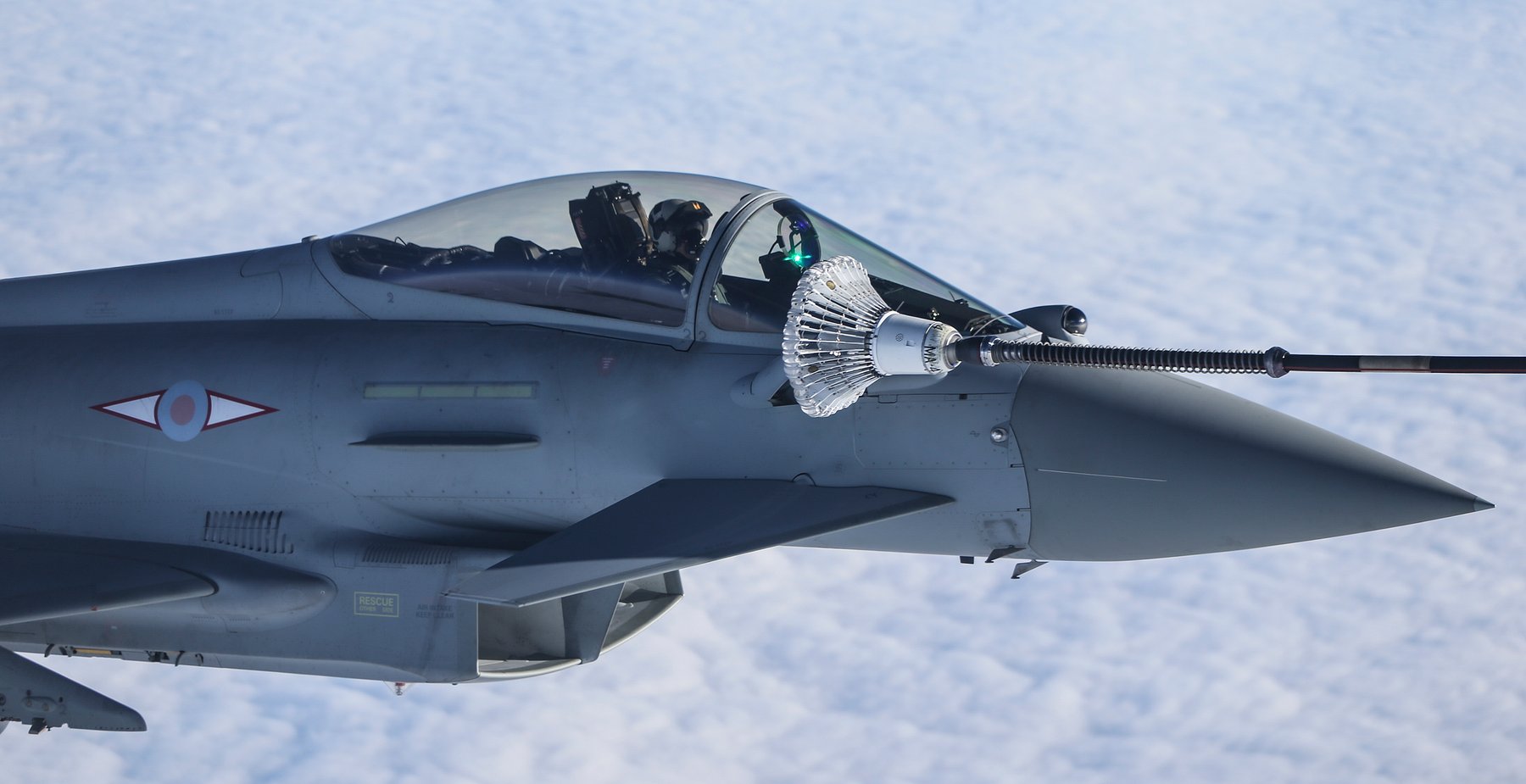
Air-to-air refuelling changes what an aircraft can do by extending its range and time on task. The RAF’s account of the capability explains its use across exercises and operations; a tanker is an enabling element of combat air power, even though it does not itself release a weapon. The physical transfer of fuel therefore has a political meaning determined partly by the missions it sustains. [4]
One possible use is prolonged defensive patrol: more time available to respond to an incoming threat and fewer interruptions while fighters return to base. Another is support for an aircraft attacking a military objective. The practical contribution differs in each case. Knowing the aircraft type establishes a capability. Knowing whom it refuels still leaves questions about the authorised task, the information available to British personnel and the conditions attached to assistance.
There is a useful, explicitly separate precedent. In May 2026 the RAF reported that Voyager support had enabled Typhoon and F-35B patrols covering HMS Dragon in the Red Sea. That account demonstrates how the RAF describes an endurance requirement in another operation. It is not evidence about the number, duration or effectiveness of the Saudi missions announced in October. The connection is the enabling mechanism, rather than an assumption that the operations are interchangeable. [13]
A restriction on British fighters conducting strikes can consequently be real while the wider support package still assists a partner’s use of force. Recognising that relationship is more precise than calling every form of assistance equivalent to a British attack. It also avoids making the tanker politically invisible. An evaluation should follow the supported activity far enough to understand what the contribution enables, while acknowledging where the public evidence ends.
Fuel extends the mission
A right to protection, with limits on its exercise
The threat to Saudi civilians is not established solely by British ministerial language. On 11 October, the United Nations reported the Secretary-General’s condemnation of a Houthi missile attack on Riyadh’s main airport. Saudi authorities reported twelve deaths and more than 300 wounded. The UN account attributes those figures to Saudi reporting; they should not become a British estimate or a claim about every recent attack. The incident gives the protection argument a concrete human subject: passengers, airport workers and others exposed to aerial violence. [6]
An English School reading begins with two connected concerns. International society depends on states being able to defend their populations and on force remaining subject to common rules. Assistance requested by a government can support sovereign agency. It does not remove questions about what the assistance enables beyond that government’s territory. The right to protection and the restraints on its exercise belong in the same argument.
The UN Charter recognises individual and collective self-defence in Article 51 and requires measures taken under that provision to be reported to the Security Council. Its wider framework also prohibits force against states’ territorial integrity or political independence. These provisions supply relevant public standards. They do not make a general political description sufficient to determine the legality of every operation, and this essay does not reach a legal verdict on particular sorties from announcements alone. [7]
The conduct of hostilities raises a further set of questions. The ICRC explains the requirements to distinguish civilians and civilian objects from military objectives, to avoid indiscriminate attacks and to take precautions to protect civilians. Its account of proportionality prohibits attacks expected to cause civilian harm excessive in relation to the concrete and direct military advantage anticipated. These obligations apply to the conduct under examination, whatever a government calls its overall purpose. [8][9]
Protecting a Saudi airport and protecting Yemeni civilians are therefore compatible standards. Condemning Houthi attacks does not establish that every response is lawful. Scrutinising Saudi operations does not make the people threatened in Saudi Arabia less deserving of protection. Consistency is an operational test: whose safety appears in planning, how risks are assessed and what would make assistance change.
From the geography of dependence to a policy of protection
The earlier Statecraft essay, The geography of dependence, examined Britain’s exposure to routes and markets it cannot independently control. This episode carries that argument into a particular relationship. The government links a contribution to Saudi defence with the wider conditions on which British prosperity depends. The plausible mechanism is that a more secure region reduces opportunities for coercion and disruption. Whether this package produces that effect is a separate empirical question.
The consequences of maritime insecurity are demonstrable without inventing a new forecast. In March 2024, the IMF estimated that trade volume through Suez had fallen by 50 per cent year on year during January and February, while traffic around the Cape of Good Hope increased substantially. Those figures describe the 2024 disruption. They are historical evidence of exposure, rather than a measurement of the October 2026 situation or of the economic return from deploying Typhoons. [10]
Geography also demands precision. Bab el-Mandeb connects the Red Sea to the Gulf of Aden; Hormuz is a different passage. In September 2026, UN official Khaled Khiari discussed the increasingly volatile situation around Bab el-Mandeb alongside continuing disruption at Hormuz. The fact that crises interact does not make the routes interchangeable. Nor does protecting Saudi airspace automatically restore confidence among ships using nearby waters. [12]
Commercial decisions respond to expectations as well as intercepted threats. Owners, crews and insurers need confidence about future exposure, the reliability of protection and the consequences of another attack. A contribution that prevents damage in one area could still leave another route commercially unattractive. Conversely, incomplete restoration of shipping would not prove that air defence had protected nobody. The policy has several possible benefits, and each needs an appropriate measure.
This is why promises about British household costs should remain carefully bounded. A patrol can affect one source of insecurity; prices reflect many additional influences. Without evidence linking a change in attacks to a change in commercial behaviour, an assertion that the deployment has lowered living costs would run ahead of the record. The economic argument supports attention to the region. It does not settle the scale or duration of the military response.
Protection, conflict and the maritime connection
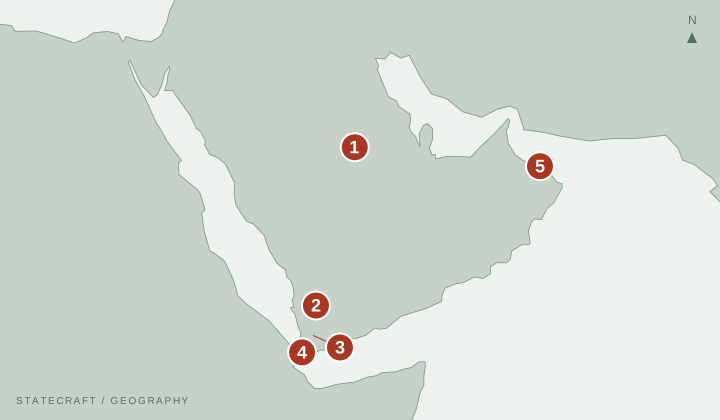
- Riyadh
Saudi capital: King Khalid International Airport was attacked in October.
- Sana’a
Yemen’s capital; shown for geographic orientation, not as a target marker.
- Taiz
A focus of civilian suffering and constraints on humanitarian access.
- Bab el-Mandeb
The passage between the Red Sea and the Gulf of Aden; distinct from Hormuz.
- Muscat
Oman’s capital: one location of the UN envoy’s diplomatic engagement.
Yemen cannot be the background to somebody else’s security
On 19 October, the UN’s daily briefing described intensified fighting, displacement and deteriorating conditions in Taiz. It reported that more than a quarter of a million people had been displaced since the beginning of August and that restrictions on movement were obstructing relief. These are dated humanitarian reporting figures, not a final count or an estimate of harm caused by British assistance. They nevertheless show why the effects inside Yemen must form part of the assessment. [11]
The risks are also specific to children. The Secretary-General’s representative for children and armed conflict warned on 15 October that renewed hostilities threatened gains made since the 2022 truce, including through recruitment, killing and injury. Civilian protection cannot be assessed only where the aircraft providing assistance are based. It must follow the conflict’s consequences for people who have little control over the choices made in their name. [14]
A government may reasonably argue that reducing Houthi freedom to attack can create safer conditions for aid and negotiation. That is a proposed causal chain: assistance improves protection, protection changes incentives, and changed incentives make a political opening possible. Each link may fail. Fighting may intensify, access may remain blocked, or the actors may prefer continued coercion. A humanitarian justification becomes persuasive through evidence about access and civilian safety, rather than through proximity to a humanitarian emergency.
The reverse argument also needs discipline. The presence of a British tanker does not by itself establish responsibility for a particular civilian death. Such an allegation would require evidence about the operation, contribution and relevant decisions. The immediate analytical requirement is to make those relationships examinable. Affected Yemenis belong within the account of success, even when available information cannot support a confident attribution of individual outcomes.
Where limited assistance can become a larger obligation
Defensive support can reduce pressure for escalation by helping a partner absorb attacks without immediately widening its own campaign. It can also make additional operations easier by increasing the endurance of the supported air force or allowing resources to be reassigned. These are competing possibilities, rather than findings about what Saudi commanders have actually done with the British contribution. Their relative importance depends on decisions that an aircraft inventory cannot reveal.
There is a corresponding dilemma for the attacker. Better protection could raise the cost of coercion and encourage restraint. It could also encourage more attacks, different targets or attempts to threaten the forces providing assistance. Calling the mission defensive does not determine how the Houthis will perceive it. Neither does that uncertainty establish that escalation is inevitable. The policy needs a way to recognise adaptation before an enlarged response becomes the default.
The British commitment can grow through repeated decisions that each appear limited. An extension may be justified by a continuing threat, and another asset by a gap in protection. Over time, the aggregate obligation may become larger than the original public explanation suggested. This is an institutional risk: temporary support can acquire the political character of an assurance even when no unlimited guarantee was intended.
Clarity has value in both directions. A partner benefits from understanding what assistance it can rely upon, while Britain benefits from stating which circumstances would trigger review. Publishing precise operational details may expose personnel to danger. Explaining the political objective, the categories of supported activity and the basis for continuation does not require disclosing flight schedules or tactics. Secrecy about methods should not leave the purpose of the commitment undefined.
Diplomacy has to connect protection to a settlement
The government’s parliamentary explanation acknowledged that military action cannot provide an enduring solution by itself. That makes diplomacy part of the policy’s mechanism. It raises the question of how a period of greater protection is supposed to improve the possibility of negotiation, and what action would preserve that opportunity. A safer partner is not automatically a more willing negotiator. [3]
The UN Special Envoy’s 9 October briefing described renewed full-scale war and engagement with the Yemeni parties and regional stakeholders, including in Riyadh, Muscat and Cairo. His account also connected domestic fighting with the wider regional confrontation. This establishes an active diplomatic effort and a conflict with several interacting arenas. It does not demonstrate that negotiations have produced restraint or that any external capital can deliver the agreement of all Yemeni actors. [5]
From an English School perspective, diplomacy is the practice through which adversaries preserve the possibility of coexistence. It need not wait for an agreed account of blame. British assistance could support that practice if it helps sustain contact, encourages limits on violence and gives partners reasons to accept arrangements they expect others to observe. The stronger the military relationship becomes, the more consequential Britain’s willingness to discuss limits with its partner may be.
Influence should still be demonstrated. Providing useful support creates access and an opportunity to argue; it does not establish that British preferences prevail in Saudi decisions. A claim that assistance has purchased moderation would need examples of choices altered, commitments implemented or access improved. Public acknowledgement of a close relationship measures none of those things.
Yemeni agency also matters to the durability of any settlement. An arrangement that reduces cross-border attacks while leaving civilians trapped and local political disputes unaddressed may protect one interest without resolving the conflict. Diplomacy must connect regional security to a process Yemenis can shape. External partners can help make an agreement feasible, but treating the country only as the location of threats leaves much of the problem unexplained.
A balance sheet for the next review
The next assessment should begin by separating resources from results. Aircraft made available, missions flown and hours sustained are inputs and activities. Successful interceptions or reduced damage are closer to protective effects. Fewer attempted attacks, safer civilian life and an improved political environment are wider outcomes. Movement at one stage does not automatically establish progress at the next.
First, the protective record should distinguish attempted attacks from attacks that cause harm. A fall in casualties could reflect better interception, fewer launches, changes in targets or several factors together. A serious account would compare these possibilities and acknowledge reporting gaps. Absolute claims about preventing attacks are especially difficult because the event that did not happen cannot be directly observed.
Second, refuelling should be assessed through the activity it supports. At an appropriate level of disclosure, Parliament needs to understand the scope of authorised assistance, how partner compliance is assessed and what would cause support to be withheld. The requirement is meaningful scrutiny of British choices. It does not depend on publishing information that would enable an attack on British personnel.
Third, the humanitarian and diplomatic record should be tracked alongside military performance. Access for relief, the ability of civilians to move safely, credible engagement with a political process and implementation of any restraint would give substance to claims that protection is creating space for diplomacy. A calm period caused by fear, deprivation or blocked information would require a different judgement.
Finally, a commitment needs a sustainable British contribution and a defined review. The capacity to provide additional sorties for a short period differs from the capacity to maintain them alongside other obligations. Ending an operation simply because a deadline arrives may abandon a legitimate protective purpose; extending it solely because the threat persists can evade the question of strategy. A review should explain which results justify the next decision and which developments would change it.
Protection as a bounded claim
Britain’s Saudi air support presents a defensible protective purpose and an incomplete account of strategic effect. The threat to civilians is real, and assistance can make protection more effective. The separation between British defensive patrols and Saudi strikes supported by refuelling is also meaningful. It distributes tasks and decisions; it does not end the need to examine their relationship.
The policy’s strongest case is that a limited, accountable contribution can protect people while helping preserve conditions for a political settlement. Its most serious risk is that useful military assistance becomes a continuing obligation whose humanitarian consequences and diplomatic return are asserted more often than demonstrated. The evidence available so far supports scrutiny of those possibilities, rather than a verdict that either has already prevailed.
The geography of dependence explains why Britain has an interest in events beyond its shores. It cannot specify every action that interest requires. The next test of statecraft is whether Britain can connect the protection it offers, the force it enables and the diplomatic outcomes it seeks within a commitment whose limits are intelligible. Success will mean a more secure political environment for the people affected, alongside a credible explanation of Britain’s contribution to it.
Sources & notes
- Ministry of Defence, operational update, 20 October 2026: Typhoons, A400M, advisers and extended support to Saudi air operations. ↗Back to the essay ↑
- Ministry of Defence, 22 September 2026: the Saudi request and the initial Voyager commitment. ↗Back to the essay ↑
- House of Commons, Saudi Arabia: RAF Support, 22 October 2026: ministerial explanation, 90-day refuelling extension and parliamentary questions. ↗Back to the essay ↑
- Royal Air Force, 100 Years of Air-to-Air Refueling, 20 July 2023: the general range and endurance role of refuelling. ↗Back to the essay ↑
- UN Special Envoy for Yemen, Security Council briefing, 9 October 2026: renewed war and diplomatic engagement. ↗Back to the essay ↑
- United Nations, 11 October 2026: condemnation of the Riyadh airport attack; casualties attributed to Saudi authorities. ↗Back to the essay ↑
- United Nations Charter, especially Articles 2 and 51: the prohibition of force and individual or collective self-defence. ↗Back to the essay ↑
- ICRC, FAQ: Rules of war: distinction, precautions and limits on the conduct of hostilities. ↗Back to the essay ↑
- ICRC Customary IHL Database, Rule 14: proportionality in attack. ↗Back to the essay ↑
- IMF, Red Sea Attacks Disrupt Global Trade, 7 March 2024: historical PortWatch transit-trade estimates, not October 2026 conditions. ↗Back to the essay ↑
- United Nations daily press briefing, 19 October 2026: Yemen displacement, Taiz and constraints on relief. ↗Back to the essay ↑
- UN Assistant Secretary-General Khaled Khiari, 15 September 2026: developments around Bab el-Mandeb and their wider regional context. ↗Back to the essay ↑
- Royal Air Force, Sustained at Range, 15 May 2026: an earlier, separate refuelling-supported Red Sea patrol operation. ↗Back to the essay ↑
- UN Special Representative for Children and Armed Conflict, 15 October 2026: renewed risks to children in Yemen. ↗Back to the essay ↑
- Defence Secretary, written ministerial statement HCWS394, 20 October 2026: refuelling extended for a further 90 days. ↗Back to the essay ↑
This is an analytical essay, grounded in the dated developments and official positions above. Interpretations and illustrative scenarios are distinguished from reported events. Drafted with AI assistance. Maps and evidence graphics: Statecraft. Documentary photographs are dated and credited individually. Read our editorial approach.