On 24 February 2022, Russia’s full-scale invasion of Ukraine turned a longstanding British security concern into a test of statecraft. Could a state with substantial diplomatic reach but limited military mass help preserve another state’s independence, impose costs on aggression and hold an international coalition together? Four years later, Britain’s strongest claim is to have helped Ukraine continue resisting. Its weaker claim is to have converted that resistance into an enforceable peace. The distinction matters: preserving the possibility of a satisfactory outcome is an achievement, but it is not the outcome itself.
The English School’s uncomfortable question
The English School begins from a proposition associated with Hedley Bull: states inhabit an international society as well as a competitive system. They recognise rules and sustain practices—diplomacy, international law, the balance of power and great-power management—without a government above them. Britain’s Ukraine policy is therefore more than balancing Russian power. It is an attempt to defend the conditions under which states can remain politically independent. Yet those same institutions can conflict. Great powers may stabilise their relationships by bargaining over smaller states whose equality international law ostensibly protects.[1]
The pluralist–solidarist debate sharpens the dilemma. Pluralism emphasises coexistence among sovereign states; solidarism asks how far shared purposes justify collective enforcement and obligations beyond coexistence. These are competing tendencies within a broad tradition, not instructions to appease or intervene. In Ukraine, resisting conquest can serve a pluralist commitment to sovereign equality. Coordinating costly action to uphold that commitment adds a solidarist element. Calling the entire policy a crusade for democracy would obscure this overlap and unnecessarily narrow its potential international constituency.[2]
The Charter provides the relevant public standard: Article 2 prohibits force against states’ territorial integrity or political independence; Article 51 recognises self-defence following armed attack. Ukraine’s request for assistance situates British support within that framework.[3] My assessment applies three tests: whether Britain strengthened Ukraine’s practical capacity to resist; whether it sustained cooperation around a legitimate objective; and whether it brought a durable settlement closer. Diplomatic activity, money announced and Russian costs are intermediate measures. None, alone, establishes success against all three tests.
A war sustained through relationships
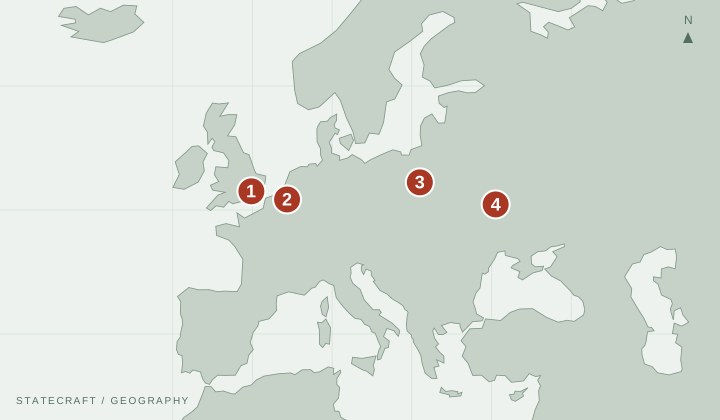
- London
British decisions on military assistance, sanctions and coalition diplomacy.
- Brussels
NATO and EU institutions; overlapping coalitions with different powers.
- Warsaw
A major allied capital on NATO’s eastern flank.
- Kyiv
Ukraine’s government: the partner whose sovereignty assistance is intended to sustain.
2015–2022: preparation, warning and survival
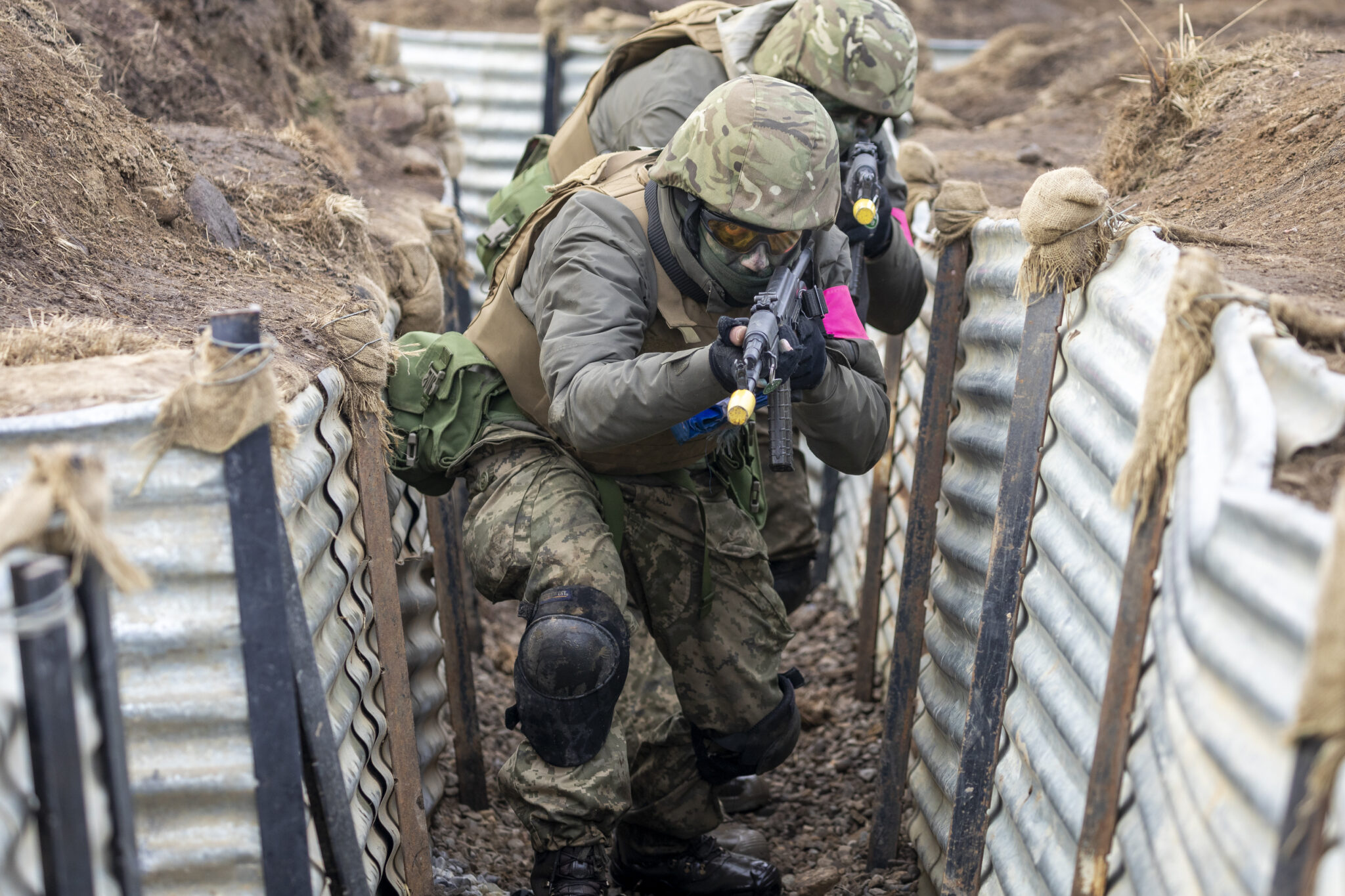
Britain did not begin from zero in February 2022. Operation Orbital had trained more than 22,000 Ukrainian personnel from 2015 to the full-scale invasion, according to the government’s June 2022 account.[4] On 17 January 2022, Defence Secretary Ben Wallace announced the provision of light anti-armour defensive weapons.[5] The sequence matters: training relationships and supplies preceded the immediate emergency. Their potential value lay in improving an existing Ukrainian force, while signalling that Moscow could not assume an uncontested intervention.
Nevertheless, deterrence failed: Russia invaded. This does not demonstrate that assistance was useless. A policy can fail to prevent an attack while improving the defender’s subsequent position. British support’s significance changed from raising the anticipated cost of invasion to helping impose actual costs. It would be equally mistaken to retrospectively call every pre-war measure a success because Kyiv survived. The analytical question is which capabilities arrived in time, how Ukrainian forces used them, and what would plausibly have happened without them.
NLAW anti-tank weapons became a recognisable symbol of British assistance. They should not become a substitute for explaining the battle. RUSI’s November 2022 study, drawing on Ukrainian operational evidence, emphasised the importance of Ukrainian artillery in blunting Russia’s attempt to seize Kyiv. Its authors also cautioned that inaccessible underlying material made their account necessarily incomplete testimony.[6] Britain supplied useful capabilities within a defence conducted by Ukrainians and supported by multiple partners. Public evidence does not isolate a British share of the victory around the capital.
The diplomatic counterpart was the General Assembly vote of 2 March 2022: 141 states backed a resolution reaffirming Ukraine’s sovereignty and demanding Russian withdrawal.[7] This was evidence of a broad constituency against aggression, not proof that Britain had assembled a worldwide sanctions coalition. For an English School analyst, its importance was that a common rule survived a powerful member’s breach. Its limitation was that declaratory agreement could not itself enforce the rule.
Cooperation also involved a deliberate limit. On 4 March 2022, NATO explained its rejection of a no-fly zone: enforcing one would require confronting Russian aircraft and could expand the war. The Commons Library recorded the same British position.[8] This was great-power management in practice, balancing assistance against the risk of direct conflict. The moral cost was that restraint left Ukrainians exposed to attacks that allies would not themselves stop. The strongest defence of British policy is that avoiding a wider war preserved a sustainable basis for support. The strongest objection is that excessive caution could make that support insufficient. Neither proposition licenses treating escalation as impossible or inevitable.
Training turns an assurance into a capability
2023: opening doors, meeting material limits
On 14 January 2023, Britain announced a squadron of fourteen Challenger 2 tanks, explicitly presenting the decision as part of an effort to accelerate allied support.[9] On 11 May, Wallace confirmed the donation of Storm Shadow cruise missiles.[10] These were different instruments with a common diplomatic purpose: make additional forms of assistance politically practicable. A relatively small British contribution could matter beyond its numerical size if it helped other governments revise what they were willing to supply.
That is a plausible mechanism of influence, rather than a proven account of every subsequent allied decision. German, American and other governments had their own negotiations, stock constraints and assessments of escalation. Britain’s announcements show initiative; they do not establish that London caused the wider coalition’s choices. The sounder judgement is that Britain acted as an early mover in selected capability debates, accepting political exposure that could make collective movement easier.
The 2023 offensive exposed the distance between opening a diplomatic door and creating battlefield advantage. RUSI’s contemporaneous Stormbreak study described dense Russian minefields, costly breakthrough attempts and shortages in Ukrainian staff capacity. It argued that allied training needed to fit the forces and tools Ukraine actually employed.[11] Tanks and long-range missiles could not independently solve the combined problems of engineering, reconnaissance, ammunition, coordination and sustained combat. Counting prestigious platforms overstated what a donation list could tell an analyst.
British training illustrates both contribution and constraint. The National Audit Office reported in September 2024 that 89 per cent of one Interflex training tranche felt better prepared to survive combat. That is evidence of perceived preparedness, not measured survival. The NAO also recorded unmet Ukrainian training requests, limitations on drone training, and pressure on Britain’s own training estate. It found that stockpile donations had been sharply reduced from mid-2023 because further transfers threatened UK readiness.[12] The diplomatic promise to sustain Ukraine was already encountering the physical limits of the British state.
Sanctions: constraining a war without stopping it
Britain’s financial role also carried an uncomfortable inheritance. In May 2018, the Commons Foreign Affairs Committee’s Moscow’s Gold report criticised the handling of corrupt Russian wealth in the UK and the gap between security rhetoric and financial practice.[13] The 2022 response therefore needs to be read partly as a correction to earlier failures of statecraft. A financial centre cannot persuasively present itself as a defender of international rules while neglecting how its own institutions may shelter power accumulated through their abuse. This does not make subsequent sanctions insincere. It raises the standard by which enforcement should be judged, including Britain’s willingness to bear costs at home.
Sanctions combined several ambitions: signal disapproval, restrict access to finance and technology, reduce resources available for war, and change Moscow’s calculations. These should be assessed separately. OFSI’s 2024–25 review recorded notifications of £28.7 billion in assets frozen under the Russia regime since February 2022, as of May 2025.[14] That establishes an implementation result. Frozen assets are not automatically confiscated assets, compensation transferred to Ukraine, or an equivalent reduction in Russia’s military budget.
The oil-price cap made the coalition’s balancing act explicit. Announced on 2 December 2022 and applied to crude from 5 December, the initial $60 cap linked access to coalition maritime services, including insurance, to purchases below the threshold. Britain acted with the G7, EU and Australia. The intention was to reduce Russian earnings while keeping oil available to third-country buyers.[15] This was economic statecraft shaped by concern for the wider international economy: a maximal interruption of exports could raise prices and burden states whose cooperation the coalition needed.
The material record resists a simple verdict. KSE Institute’s oil-market analysis published on 2 September 2026 estimated Russian oil-export revenues at $13.8 billion in July, down $2 billion from June. But it linked disrupted product shipments to Ukrainian attacks and a Russian export ban, alongside price changes. It also identified continuing shadow-fleet activity and sanctioned vessels still carrying exports.[16] This Ukrainian research institution advocates stronger sanctions; its estimates are valuable evidence, not a neutral experiment identifying Britain’s independent effect.
The implication is constraint without demonstrated decisive coercion. Lower receipts may reflect sanctions, market prices, physical disruption or some combination. Revenue forgone is not synonymous with expenditure prevented: a government can reprioritise spending. Conversely, continuing exports do not prove zero effect; substitution may involve discounts, delays and additional costs. A defensible assessment asks how much harder and more expensive Russia’s choices became, while acknowledging that the available evidence cannot give a clean British contribution to that counterfactual.
Enforcement also evolved. On 14 June 2026, the government announced the first UK-led interception of a sanctioned Russian shadow-fleet tanker, with French coordination.[17] Moving from designation to physical enforcement demonstrated additional resolve. One interception, however, cannot establish a sustained reduction in war finance. Its wider effectiveness depends on repeated lawful implementation, cooperation with other jurisdictions and the scope for replacement vessels. Sanctions remain an adaptive contest between restrictions and evasion, not a list whose growing length guarantees increasing leverage.
2024–2025: making tomorrow’s support credible
On 12 January 2024, Britain and Ukraine signed a security-cooperation agreement. Its provisions envisaged consultation within twenty-four hours after a future Russian armed attack and sustained assistance, subject to British legal and constitutional requirements.[18] This created a procedure and an expectation. It did not automatically commit British forces to fight. The distinction is central to credibility: a written promise helps organise decisions, but its deterrent value depends on the resources and political willingness behind it.
The Hundred Year Partnership signed on 16 January 2025 broadened the relationship across security, economic and other fields.[19] Its extended horizon sought to frustrate the expectation that foreign attention would fade. Yet a century is a diplomatic statement of intended durability, not a funded military programme. The useful test is whether institutions, industrial cooperation and recurring decisions make withdrawal of support more difficult. Longevity in a title cannot substitute for durability in budgets.
A more concrete link between sanctions and assistance emerged with the £2.26 billion UK loan agreement of 1 March 2025, part of the G7 Extraordinary Revenue Acceleration initiative. Repayment was structured around profits generated on immobilised Russian sovereign assets.[20] This converted an allied financial arrangement into present resources for Ukraine while avoiding a straightforward transfer of the underlying Russian principal. It was consequently a compromise between urgency and the coalition’s concerns about legal and financial precedent.
The Commons Library’s August 2026 military-assistance timeline records the final British loan instalment as paid in April 2026.[21] Here the evidence advances beyond a pledge to disbursement. Even then, money transferred is one stage before equipment delivered and effective capability generated. The English School significance is that rules constrained as well as enabled British action. Coalition agreement depended partly on finding an instrument partners could defend as institutionally sustainable, rather than treating every legal reservation as mere reluctance to help.
2025–2026: managing disagreement among allies
The Security Council vote of 24 February 2025 made the tension between peace-making and the terms of peace unusually visible. Resolution 2774, proposed by the United States, passed with ten votes in favour and five abstentions, including Britain and France. London objected to language that did not distinguish aggressor from victim and sought reference to Ukraine’s sovereignty and territorial integrity.[22] Britain could register a principled disagreement with Washington; it could not make the Council adopt its preferred account of the war.
An English School reading sees two conceptions of order competing here. One prioritises an agreement among great powers capable of stopping the fighting. The other insists that an agreement which rewards territorial conquest may weaken the rules needed for longer-term coexistence. Neither dismisses peace. They disagree over which settlement would deserve that name and how immediate stability relates to future insecurity. Britain’s position defended sovereign equality, while exposing its limited ability to determine American diplomacy.
The London leaders’ meeting on 2 March 2025 sought to preserve coordinated action. Its statement supported continued assistance and economic pressure, affirmed Ukraine’s place in decisions about its future, and envisaged work with the United States on a peace plan.[23] Convening mattered because it could turn disagreement into a shared agenda. But the meeting should be credited with coordination, not with having secured an American guarantee or a Russian concession that its statement did not contain.
The subsequent UK–French-led Coalition of the Willing attempted to give a prospective settlement a security component. The Commons Library’s 11 August 2026 briefing records a January 2026 declaration of intent for forces in the event of a peace deal. It also identifies unresolved questions about force size, capabilities, duration, rules of engagement and American support.[24] These are the substance of deterrence. The coalition represents substantial diplomatic preparation; it cannot yet be counted as a deployed force successfully defending an agreed peace.
Britain’s comparative strength was thus organising partners around practical commitments. Its constraint remained dependence on capabilities it could not independently replace. Kiel’s August 2026 update, covering allocations through June, found increased European aid alongside continued reliance on American weapons.[25] Financing more assistance and producing the required equipment are separate capacities. A European coalition may reduce political dependence over time, but an announcement of greater responsibility does not instantly create industrial autonomy.
What the material balance sheet can tell us
The government’s factsheet of 24 July 2026 put total British commitments at approximately £25 billion, including £16 billion in military support, with the ERA loan included in that military figure. It also reported more than 63,000 personnel trained under Interflex. Its announcement of 150,000 drones and 350 air-defence missiles specified delivery by the end of 2026; it did not certify that all had arrived. The overall package mixes military commitments, non-military support and export-finance cover, rather than documenting £25 billion of completed deliveries.[26]
These distinctions prevent two opposite mistakes. Dismissing assistance because it has not ended the war ignores the value of keeping a sovereign state able to fight, govern and negotiate. Treating commitments as accomplished effects obscures procurement delays and battlefield adaptation. Britain’s contribution should be followed through a sequence: authorised resources, contracts, delivery, usable capability and strategic consequences. Public reporting is much stronger at the beginning of that sequence than at its end.
The counterfactual remains difficult. Ukraine’s continued resistance is consistent with British assistance having mattered, but does not show how much worse the outcome would have been without Britain specifically. Other donors might have substituted for some supplies; some British contributions may have arrived when substitutes were unavailable. Diplomatic influence is similarly relational. The most credible claim is a consequential contribution to an allied effort, with particularly visible roles in training, selected weapons decisions and coalition organisation.
This yields a qualified material verdict. Britain has generated real inputs and helped sustain resistance, but the evidence reviewed here does not establish that its instruments have compelled Russian withdrawal or produced durable security. Nor can the value of sustaining resistance be judged entirely from London. Ukrainians bear the war’s immediate human costs. An assessment that measures only allied reputation or Russian losses would leave out the people whose sovereignty the policy is intended to defend.
Three figures, three different claims
A guide to reading Britain’s material balance sheet
Challenger 2 commitment, 14 January 2023. A weapons decision, not a measure of battlefield success.
Cumulative Russia-regime notifications since February 2022, recorded as of May 2025. Freezing is not confiscation.
Final tranche paid in April 2026. Repayment draws on profits from immobilised Russian sovereign assets.
Statecraft after the promise
Britain’s diplomatic record is strongest in maintaining a working circle of supporters and giving commitments institutional form. Its limits appear where that circle must influence actors outside it, reconcile American and European preferences, or turn a proposed security presence into enforceable protection. A coalition of substantial capability can still be a partial international society: agreement among its members does not mean that the rest of the world accepts its priorities or every instrument it uses.
Three practical priorities follow from this assessment. First, align military commitments with production and Ukrainian requirements, including replenishment and training adapted to battlefield conditions. Second, judge sanctions by enforcement, substitution costs and their contribution to a stated objective, rather than by designation totals. Third, connect negotiations to arrangements that specify who responds to violations, with what capabilities and on what authority. These are recommendations arising from the evidence, not claims that the missing arrangements already exist.
A serious settlement strategy must also preserve Ukraine’s agency when allied priorities change. Consultation is insufficient if the decisive bargain is presented to Kyiv as a finished condition of receiving assistance. Equally, respect for Ukrainian consent cannot relieve British ministers of explaining the resources and risks they are prepared to accept. The task is to make these limits negotiable and explicit, so that solidarity does not become an unlimited promise followed by an abrupt withdrawal.
There is also a diplomatic obligation to explain the rule consistently. The case for Ukraine is strongest when grounded in the security of states against conquest, a principle intelligible beyond Britain’s alliances. That requires listening to the economic and security concerns of governments asked to cooperate. It also requires willingness to apply comparable standards elsewhere. The credibility of international society cannot rest entirely on the identity of the aggressor in one war.
From an English School perspective, Britain has helped prevent a breach of international order from becoming an uncontested new rule. That is a meaningful, incomplete success. It has been more effective at sustaining Ukraine’s capacity and assembling commitments than at enforcing a settlement. The next test is whether British diplomacy can join sovereign consent, material endurance and great-power restraint in the same arrangement. Statecraft will be judged by the security that arrangement delivers, not by the length of the promise.
Sources & notes
- Hedley Bull, The Anarchical Society (1977; Columbia fourth edition, 2012): international society and its institutions. ↗Back to the essay ↑
- Barry Buzan, From International to World Society? (2004), chapter 5: the pluralist–solidarist debate. ↗Back to the essay ↑
- United Nations Charter, Articles 2 and 51: territorial integrity, political independence and self-defence. ↗Back to the essay ↑
- UK government, 17 June 2022: proposed training programme and the Operation Orbital record. ↗Back to the essay ↑
- UK Parliament, written answer 113269: confirmation of the 17 January 2022 anti-armour announcement. ↗Back to the essay ↑
- Zabrodskyi, Watling, Danylyuk and Reynolds, RUSI, 30 November 2022: Preliminary Lessons in Conventional Warfighting, February–July 2022. ↗Back to the essay ↑
- United Nations, 2 March 2022: General Assembly resolution demanding an end to the Russian offensive. ↗Back to the essay ↑
- House of Commons Library, No-fly zones and Ukraine, 7 March 2022: British and NATO policy, and escalation concerns. ↗Back to the essay ↑
- UK government, 14 January 2023: Challenger 2 announcement and effort to accelerate international support. ↗Back to the essay ↑
- Ben Wallace, parliamentary statement, 11 May 2023: confirmation of Storm Shadow donation. ↗Back to the essay ↑
- Jack Watling and Nick Reynolds, RUSI, 4 September 2023: Stormbreak, fieldwork on the 2023 offensive. ↗Back to the essay ↑
- National Audit Office, 11 September 2024: training feedback, stockpile transfers and UK readiness constraints. ↗Back to the essay ↑
- House of Commons Foreign Affairs Committee, Moscow’s Gold: Russian Corruption in the UK, 21 May 2018. ↗Back to the essay ↑
- OFSI Annual Review 2024–25: cumulative asset-freeze notifications as of May 2025. The in-year figure differs from the annual frozen-assets snapshot. ↗Back to the essay ↑
- HM Treasury, 2 December 2022: original oil-price-cap announcement. The $60 figure describes the initial cap, not the current level. ↗Back to the essay ↑
- KSE Institute, 2 September 2026: August Russian Oil Tracker analysis of July shipments, revenues and sanctions evasion. Figures are research estimates. ↗Back to the essay ↑
- UK government, 14 June 2026: first UK-led interception of a Russian shadow-fleet vessel. ↗Back to the essay ↑
- UK–Ukraine Agreement on Security Co-operation, 12 January 2024, especially Part VIII: response to future armed attack. ↗Back to the essay ↑
- UK government, 16 January 2025: Hundred Year Partnership announcement. ↗Back to the essay ↑
- HM Treasury, 1 March 2025: £2.26 billion ERA loan agreement and repayment from profits on immobilised assets. ↗Back to the essay ↑
- House of Commons Library, Timeline of British military assistance to Ukraine, updated 11 August 2026: ERA loan disbursements. ↗Back to the essay ↑
- UN Security Council meeting coverage, 24 February 2025: resolution 2774 and British explanations of position. ↗Back to the essay ↑
- Chair’s statement, London leaders’ meeting on Ukraine, 2 March 2025. ↗Back to the essay ↑
- House of Commons Library, 11 August 2026: Coalition of the Willing proposals and outstanding questions. ↗Back to the essay ↑
- Kiel Institute, Ukraine Support Tracker, 13 August 2026 update: allocations through June 2026 and continued dependence on US weapons. ↗Back to the essay ↑
- UK support to Ukraine factsheet, updated 24 July 2026: government commitment totals, training and scheduled deliveries. Commitments are not a delivery audit. ↗Back to the essay ↑
This is an analytical essay, grounded in the dated developments and official positions above. Interpretations and illustrative scenarios are distinguished from reported events. Drafted with AI assistance. Maps and evidence graphics: Statecraft. Documentary photographs are dated and credited individually. Read our editorial approach.