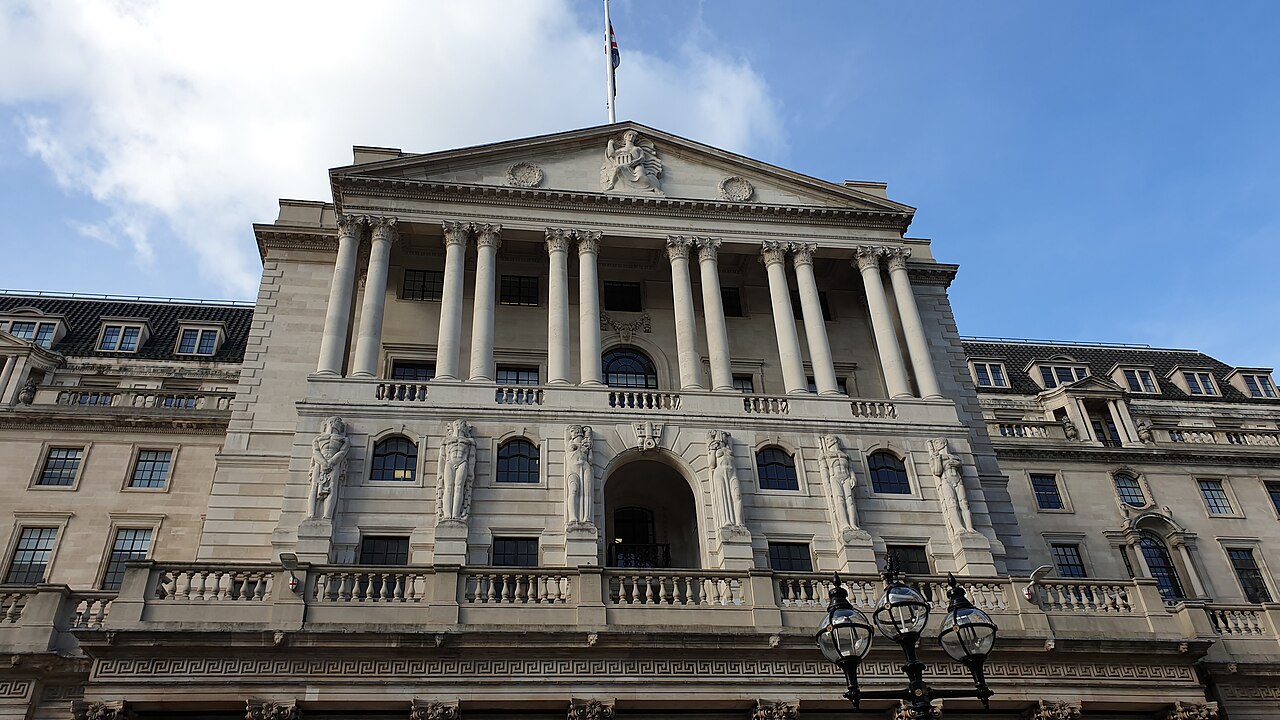
The Bank of England is scheduled to publish its next monetary policy decision, meeting minutes and Monetary Policy Report at noon on Thursday, 5 November. The announcement will be a domestic decision about pressures that do not respect national borders. For Statecraft, the question is how an institution with a clear national mandate responds when the origin and duration of an important shock lie partly beyond its control. [1]
The development
At its September meeting, the Monetary Policy Committee voted six to three to hold Bank Rate at 3.75%. Its account linked higher and volatile energy prices to conflict in the Middle East and distinguished the immediate price shock from the risk of more persistent effects on wage and price setting. Those were the Committee’s September judgements, rather than an advance account of its November decision. [2]
The subsequent inflation release supplies another dated observation. The Office for National Statistics reported that annual CPI inflation rose from 3.1% in August to 3.5% in September. Transport, particularly motor fuels, made the largest upward contribution to the change in the annual rate. These figures describe observed consumer prices; they do not establish the future path of inflation. [3]
Why it matters
The Bank’s primary monetary policy objective is price stability, expressed through the government’s 2% inflation target over the medium term. Its principal instrument is Bank Rate. Changes in monetary conditions influence borrowing costs and the economy’s adjustment, but their full effects take time: the Bank describes a period of around 18–24 months. Policy must therefore respond to an assessment of future pressures as well as the latest data. [4]
This creates a difficult distinction. UK monetary policy cannot materially determine global energy prices. It can influence how their consequences spread through domestic demand, wages, expectations and prices. The Bank’s April report explained that offsetting an energy shock’s direct inflation effect would require weaker domestic core and wage inflation. A response can therefore carry costs for activity while leaving the original supply disruption unresolved. [5]
From an overseas shock to a domestic decision
International conditions
Energy supply and prices change the pressures facing the UK.
UK transmission
Fuel prices and business costs can affect consumer prices and demand.
The persistence test
The MPC assesses wages, price setting, expectations and domestic conditions.
The policy response
Bank Rate influences borrowing conditions and demand, with effects over time.
What to watch
First, read the November decision alongside its reasoning. Has the Committee changed its assessment of the shock’s duration, domestic demand or the risk that higher costs become persistent inflation? A rate move and an unchanged rate can each reflect different judgements about those relationships. The explanation is essential to understanding the instrument.
Second, distinguish observations from assumptions in the new report. Dates, energy-price paths and the treatment of uncertainty will matter. A projection is conditional on its inputs; it should not become a claim that a geopolitical development is settled. Comparing the new assessment with September’s account will show where the Committee’s interpretation has changed.
Third, follow the distribution of adjustment. Higher financing costs and higher energy costs do not reach every household or business in the same way. The useful questions are whose choices narrow, which pressures ease, and what requires other forms of policy. A central-bank decision should be assessed against its mandate without treating it as the complete response to an international disruption.
The wider argument
An English School reading brings sovereignty into contact with international markets and responsibilities for human welfare. Britain retains authority over a national policy instrument while facing pressures generated through relationships it cannot control alone. The costs of preserving economic stability are also distributed unevenly within society. For Lines of Influence, the question is how domestic authority and international cooperation can widen the capacity to respond. The SDG discussion of energy and prosperity becomes concrete when access, affordability and the people bearing the costs of adjustment are examined together.
Sources & notes
- Bank of England, Upcoming events: weeks beginning 2 and 9 November 2026, updated 30 October 2026; decision and report listed for 5 November at noon, accessed 2 November 2026. ↗Back to the briefing ↑
- Bank of England, September 2026 Monetary Policy Summary and minutes, published 17 September 2026; meeting ended 16 September. ↗Back to the briefing ↑
- Office for National Statistics, Consumer price inflation, UK: September 2026, published 21 October 2026. ↗Back to the briefing ↑
- Bank of England, Monetary policy, mandate, instruments and transmission lag, accessed 2 November 2026. ↗Back to the briefing ↑
- Bank of England, Monetary Policy Report — April 2026, energy supply shocks and domestic policy trade-offs, accessed 2 November 2026. ↗Back to the briefing ↑
This briefing separates reported developments and official positions from interpretation and questions to watch. Prepared with AI assistance. Read our editorial approach.