Britain’s announcement on 8 September marks a substantial change in its approach to Israel and the occupied Palestinian territory. The government set out plans to prohibit imports from Israeli settlements, restrict the promotion of settlement property and create broader powers against those financing or facilitating settlement activity. It also explicitly concluded that Israel’s continued occupation of Palestinian territory is unlawful. The intended distinction is territorial and political: restrictions on the settlement economy, while preserving wider relations with Israel. The government’s announcement presents these measures as an attempt to protect a viable two-state solution. [1]
8 September: a change of instruments
The central question is whether Britain can turn a longstanding diplomatic position into practical influence. Condemning settlements has not prevented their expansion. Yet imposing restrictions does not itself establish that expansion will slow, Palestinian communities will become safer or negotiations will resume. The policy deserves assessment against those outcomes, rather than against either the force of its language or the anger it has provoked.
There is also an immediate distinction between announcement and implementation. Foreign Secretary Ed Miliband told Parliament that the new comprehensive sanctions legislation would be in place within six to nine months. Additional individual sanctions were immediate; other measures require further legal and administrative work. He also announced that Britain would refuse export licence applications for arms and other goods materially contributing to the occupation. It would therefore be premature to describe the entire package as an already operational trade embargo. His parliamentary statement sets out both the timetable and the intended scope. [2]
Britain’s historical inheritance
Britain’s historical involvement gives the decision unusual resonance. In 1917, the Balfour Declaration supported a Jewish national home in Palestine while promising protection for the civil and religious rights of its existing non-Jewish communities. Its wording recognised one people’s national aspiration without explicitly recognising the other’s equivalent political claim. That asymmetry remains central to Palestinian criticism of Britain’s role. For Zionism, the declaration represented important international recognition of Jewish national aspirations. Both readings begin with the same document, but emphasise different promises and omissions. The original declaration makes that tension visible. [3]
The subsequent Mandate, the persecution of European Jews, the Holocaust, the failed partition settlement and the 1948 war cannot be reduced to a single causal story. Jewish statehood answered an urgent demand for national security and refuge; Palestinians experienced dispossession, displacement and the failure to secure their own state. The UN’s historical account records the transition from British administration to partition proposals, war and an unresolved Palestinian national question. Its historical overview provides the essential sequence, although the meaning assigned to those events remains contested. [4]
Historical responsibility should inform British policy without becoming a claim to contemporary authority over either people. Britain cannot repair its imperial record through a dramatic announcement, and neither Israelis nor Palestinians require British permission to possess national rights. The relevant lesson is institutional: arrangements that recognise one community’s political future while indefinitely postponing the other’s create enduring instability. A credible British approach must take both peoples’ security and self-determination seriously.
From differentiation to economic restrictions
The settlement question has a more specific legal history. The territories occupied by Israel in 1967 are distinguishable from Israel itself. Security Council Resolution 2334, adopted in December 2016, reaffirmed that settlements in the occupied Palestinian territory, including East Jerusalem, have no legal validity. It called on states to distinguish between Israel’s territory and the territories occupied since 1967, while allowing for changes to the pre-war lines agreed through negotiations. The resolution therefore combines opposition to unilateral territorial change with support for an agreed settlement. [5]
This makes the September announcement partly a change of instruments rather than an entirely new destination. Successive British governments opposed settlements, and settlement goods were already excluded from preferential treatment under the UK–Israel trade agreement. Britain also recognised Palestine in September 2025. The Commons Library’s account of policy before the latest announcement shows a substantial body of diplomatic differentiation already in place. What remained contested was whether Britain should prevent particular economic relationships rather than merely withhold advantages or advise caution. The parliamentary briefing documents that earlier position. [6]
The escalation was gradual. In May 2025, Britain suspended negotiations to upgrade its trade agreement with Israel and imposed further sanctions connected with West Bank settlement activity. In June, it joined Australia, Canada, New Zealand and Norway in sanctioning ministers Itamar Ben-Gvir and Bezalel Smotrich for inciting violence against Palestinian communities. Those actions challenged the assumption that close relations insulated senior Israeli political figures from targeted British measures. The May parliamentary debate and June sanctions announcement establish the progression. [7][8]
September’s proposed approach reaches further into the economic activity sustaining settlements. The analytical distinction matters. Sanctioning a violent individual seeks to alter that person’s behaviour and restrict their resources. Restricting settlement-linked commerce addresses the incentives and organisations through which construction and consolidation proceed. The latter approach can potentially influence decisions before another settlement is built. It also demands more difficult judgments about which activities contribute materially to an unlawful situation.
E1 in its wider geography
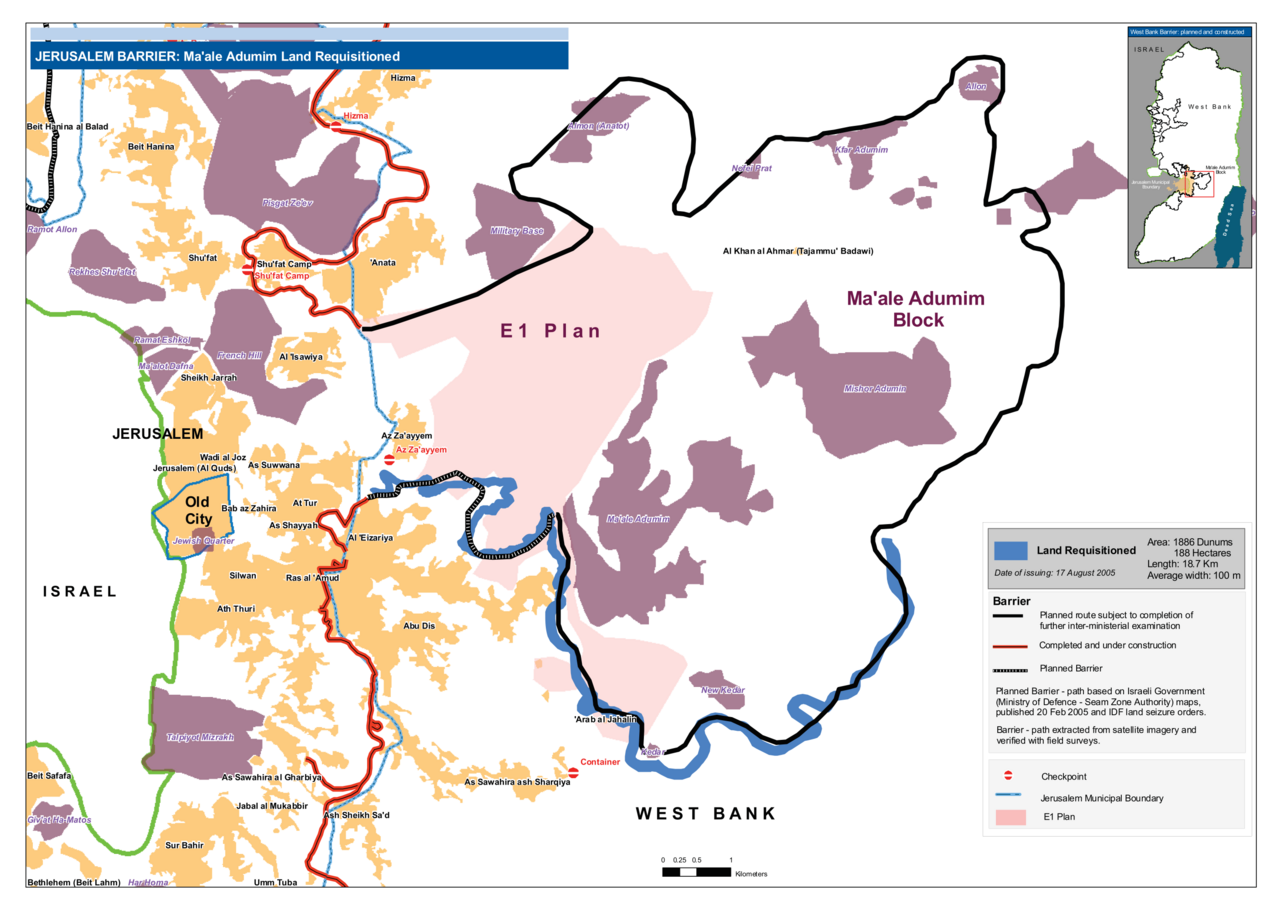
E1: why the geography matters
The immediate diplomatic confrontation concerns E1, the area between East Jerusalem and Ma’ale Adumim. Its importance exceeds its physical size. Settlement construction and associated infrastructure there threaten Palestinian territorial connections and access to East Jerusalem. The twelve-country statement issued on 8 September identified the publication of E1 tenders as a particular concern. Its signatories supported, intended or were considering trade restrictions through different national or European processes; they did not announce twelve identical bans already in force. The joint statement is explicit about those differences. [9]
Israeli civil society supplies an important perspective on this geography. Peace Now’s reporting describes E1 as an interconnected programme involving housing, commercial development, roads and changes affecting Bedouin communities. It argues that the combined effect would obstruct Palestinian territorial continuity and undermine a functioning Palestinian economy. Peace Now is an organisation campaigning against settlements, rather than a neutral governmental authority, but its analysis links its claims to planning documents and tenders. Its account of E1 shows why examining housing numbers alone can miss the wider consequences. [10]
A road can preserve the ability to travel between two places while leaving travellers dependent on another authority’s permission. A future state requires more than a route through someone else’s infrastructure: it needs workable jurisdiction, access to land and services, and the capacity to govern. Conversely, a map showing fragmentation cannot by itself establish that every conceivable negotiated arrangement is impossible. The practical question is whether current development leaves meaningful choices available to future negotiators.
Law, security and the unfinished Oslo framework
The International Court of Justice’s July 2024 advisory opinion strengthened the legal basis for challenging continued occupation. The Court concluded that Israel’s continued presence in the occupied Palestinian territory was unlawful and identified obligations for other states not to recognise or assist the resulting situation. Its reasoning connected settlement policy, annexation and obstruction of Palestinian self-determination. An advisory opinion is not a binding judgment between litigating states; nevertheless, the legal obligations it identifies cannot simply be dismissed as optional because the procedure is advisory. The Court’s opinion is the principal reference point. [11]
There was significant judicial disagreement about parts of that reasoning. Judges Tomka, Abraham and Aurescu criticised the majority’s treatment of the relationship between occupation, security and the negotiated framework. Their joint opinion emphasised the continuing relevance of the Oslo agreements and the connection between Palestinian self-determination and Israeli security. This was not a blanket endorsement of settlement expansion. It was a disagreement about the legal characterisation of the occupation and the conditions governing its termination. Their joint opinion deserves attention precisely because serious legal analysis includes the strongest objections to its preferred conclusion. [12]
Oslo itself embodied both diplomatic achievement and deferred difficulty. The 1993 Declaration of Principles envisaged transitional Palestinian self-government and negotiations over permanent-status questions, including Jerusalem, refugees, settlements, security and borders. It created a process for addressing mutually incompatible demands without resolving them immediately. The agreement helps explain two contemporary arguments: that outsiders should preserve negotiation, and that an interim process cannot justify postponing political rights indefinitely. [13]
An Israeli government-hosted legal overview has stressed agreed divisions of authority and argued that unilateral Palestinian moves undermine the negotiating framework. That position should be understood as an Israeli legal argument, not accepted as an uncontested account of international law. The overview illustrates the central objection to international pressure: that it may pre-empt matters assigned to bilateral agreement. The counterargument is that settlement expansion also changes the conditions under which such agreement could be reached. [14]
A settlement in its landscape
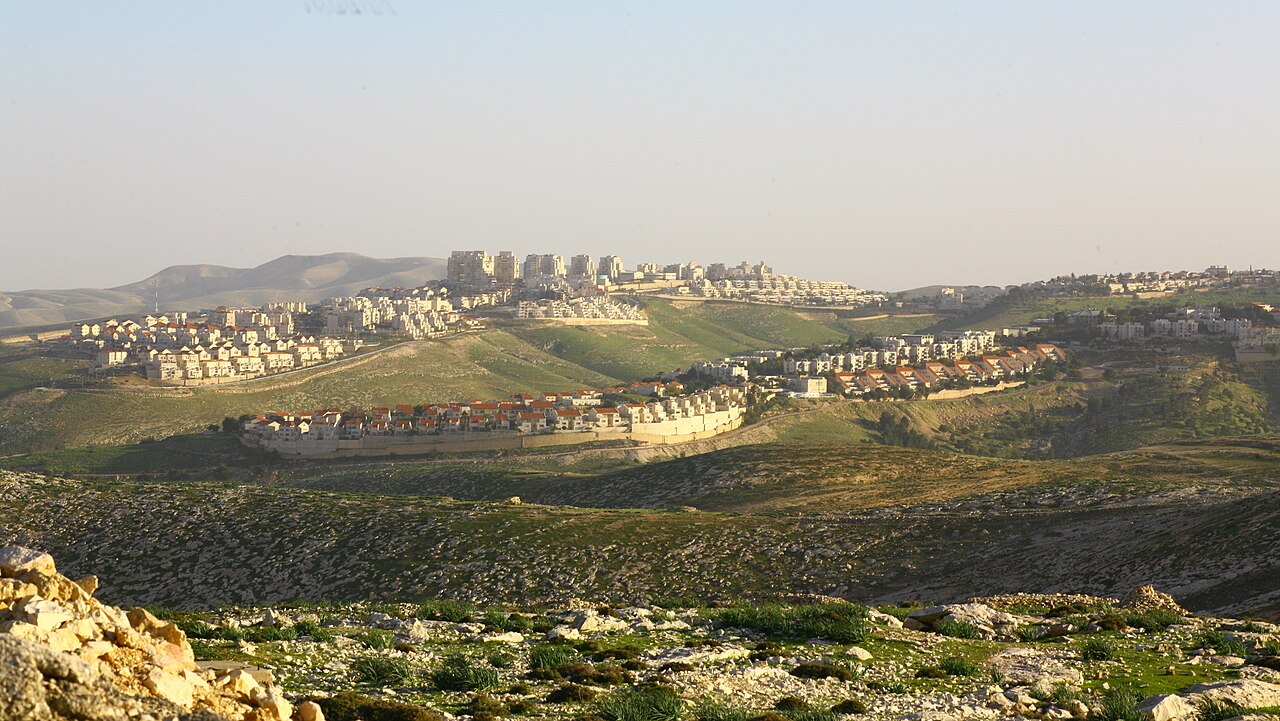
Israeli and Palestinian perspectives
Israeli security concerns require substantive treatment. Hamas’s attacks on 7 October 2023 demonstrated the catastrophic consequences of failed protection. No durable arrangement can rest on asking Israelis to regard armed threats as merely rhetorical. Equally, a security argument must explain how a particular settlement, road or land policy improves protection, rather than assuming every assertion of territorial control serves the same purpose. The September coalition statement explicitly recognises Israel’s legitimate security interests while opposing settlement expansion. These positions are compatible if security is treated as a concrete requirement rather than an unlimited territorial entitlement.
Israeli opinion is not uniform. Earlier sanctions against Ben-Gvir and Smotrich were criticised by centrist politician Benny Gantz, despite his disagreements with those ministers, while Israeli human-rights lawyer Eitay Mack welcomed them. Contemporary reporting on the June 2025 measures captures that division. Opposition to a government’s settlement policy does not automatically imply support for foreign sanctions; support for Israel does not necessarily imply support for settlements. British diplomacy loses precision when it treats either camp as speaking for all Israelis. [15]
Palestinian responses likewise contain more than a demand for symbolic recognition. The Palestinian Presidency welcomed September’s announcement as a step against settlement expansion, land seizure and forced displacement. Earlier, the Palestinian foreign ministry had urged international partners to move beyond individual sanctions towards the wider settlement enterprise. These statements show why the new economic focus matters to Palestinian diplomacy: it seeks changes in the conditions sustaining occupation, rather than another declaration of support for eventual statehood. The Presidency’s response and the ministry’s June position record that argument. [16][17]
For a Palestinian family facing displacement, however, the relevant timetable is immediate. A future legislative regime cannot protect a home today. There is consequently a serious test of sequencing: can interim diplomatic pressure and existing powers constrain damaging decisions while the wider regime is prepared? If construction, financing and displacement advance during the implementation period, Britain may establish a stronger legal framework after the developments it intended to deter have become harder to reverse.
The government’s language has also changed. Miliband said Britain judged that settler terrorists were carrying out ethnic cleansing in areas of the West Bank. This is a grave governmental assessment and should be attributed as such. It should not be conflated with a final judicial finding about an individual’s criminal responsibility, or with a determination of genocide. The value of precise terminology is practical as well as legal: a serious accusation requires evidence, clearly identified conduct and consequences proportionate to the responsibility established.
International society and the costs of pressure
An English School interpretation places the controversy within the institutions of international society. States coexist through more than a balance of military capabilities. They also depend on diplomacy, legal rules, recognition and shared restraints on territorial acquisition. Britain’s argument is that settlement expansion is eroding those restraints. On this reading, the policy seeks to defend the conditions under which negotiated coexistence remains possible, rather than treating the dispute solely as a competition between national preferences.
The same perspective reveals a difficulty. International society is sustained by accommodation as well as enforcement. Measures that defend a rule can reduce access to a government whose cooperation remains necessary. Israel’s announced retaliation included closing the British consulate in Jerusalem and restricting British participation in other activities. Reporting on those countermeasures shows the potential price of confrontation. Whether every announced step is implemented, and with what operational effect, requires continued verification. [18]
Losing diplomatic access would not automatically prove that sanctions were mistaken. Otherwise, a government could neutralise any external criticism by threatening to end cooperation. But access is a real resource, particularly when it supports civilian protection or contact with Palestinian institutions. British policymakers must assess whether the expected benefits of pressure outweigh these costs, and whether partners can preserve essential channels. Moral clarity does not remove the need for that calculation.
Working with allies and influencing commerce
Working with allies improves the prospects of influence, but coalition size alone is an inadequate measure. A shared statement can conceal substantial differences in legal powers, implementation dates and political resolve. Effective coordination requires compatible definitions of settlement goods, information-sharing and attention to indirect trade. Otherwise, restricted commerce may shift to alternative routes while the political announcement remains impressive. The diplomatic achievement is therefore provisional until participating states translate common language into comparable practice.
The American position also requires careful interpretation. Axios reported that the Trump administration did not oppose the British initiative, citing US officials and Western diplomats. That is evidence about Washington’s response, rather than proof of American participation in the restrictions or a permanent change of policy. The report suggests room for British action, but non-opposition and active support are different resources. Britain should avoid building its strategy on the assumption that the former guarantees the latter. [19]
Material effectiveness will depend heavily on commercial decisions. Import restrictions can close a market, but financing and service restrictions may affect projects earlier in their development. A firm deciding whether to fund or construct infrastructure weighs expected returns against legal exposure and compliance costs. If those costs rise, some activity may be delayed or abandoned. That is a plausible mechanism, not an observed outcome of a package announced three days ago.
The opposite mechanisms are plausible too. Trade can be redirected, ownership obscured and financial support replaced. Poorly designed rules may encourage firms to withdraw from lawful Palestinian commerce because distinguishing permitted activity appears difficult. Palestinian workers could bear costs without gaining greater freedom or security. Clear guidance, proportionate licensing and assistance to Palestinian economic institutions would therefore be integral to effectiveness. Measuring only the number of sanctions imposed would miss both evasion and unintended harm.
From announcement to implementation
The UK’s September 2026 policy shift
Import ban, service and advertising restrictions, wider sanctions powers and an unlawful-occupation position.
Further extremist settlers designated under existing human-rights powers.
The government’s stated timetable for the comprehensive settlement-related sanctions regime.
Whether settlement expansion, displacement and commercial facilitation measurably change.
What would success look like?
Britain must also distinguish political neutrality from moral indifference. Objective assessment does not require equal weight for every claim, or silence when evidence establishes wrongdoing. It requires consistent standards, including protection for Israeli and Palestinian civilians and rejection of collective responsibility. Jewish people in Britain are not accountable for Israeli government decisions; Palestinians are not collectively accountable for Hamas. A policy directed at identified conduct is more defensible, and more intelligible, when its public language maintains those distinctions.
The strongest challenge to the new approach is whether preserving two states remains a sufficiently concrete objective. Restrictions on settlements cannot alone produce legitimate Palestinian governance, settle Jerusalem and refugee questions, guarantee Israeli security or establish agreed borders. Some readers will favour alternative constitutional arrangements. Any alternative, however, must explain how it would secure equal rights, physical protection and legitimate political authority. Rejecting the existing diplomatic formula does not remove those requirements.
Success should therefore be assessed at several levels. Britain can achieve greater consistency between its legal position and economic conduct even if Israeli policy does not immediately change. It may also influence corporate behaviour and strengthen coordination among partners. The more demanding tests concern settlement expansion, displacement, civilian security and the preservation of negotiable territory. Those outcomes require evidence over time, with attention to other forces shaping events.
The September shift is consequently significant but unproven. It acknowledges that diplomacy loses credibility when repeated objections have no discernible consequences. It also exposes Britain to the costs of acting on those objections. Its ultimate value will depend on disciplined implementation and a political strategy that joins Palestinian self-determination to Israeli security. Stronger language has clarified Britain’s position. The task of statecraft is to make that position contribute to a more viable peace.
Sources & notes
- FCDO, new measures on settlement activity and the UK legal position, 8 September 2026 ↗Back to the essay ↑
- Ed Miliband, oral statement on Israel–Palestine, 8 September 2026: timetable, export licensing and governmental assessments ↗Back to the essay ↑
- Balfour Declaration, 2 November 1917 — original text, Yale Avalon Project ↗Back to the essay ↑
- United Nations, History of the Question of Palestine ↗Back to the essay ↑
- UN Security Council Resolution 2334, 23 December 2016 ↗Back to the essay ↑
- House of Commons Library, UK trade with Israeli settlements: government statements and guidance in 2026, 8 July 2026 ↗Back to the essay ↑
- Hansard, Commons debate on Israel and the Occupied Palestinian Territories, 20 May 2025 ↗Back to the essay ↑
- FCDO, UK and partners sanction ministers inciting West Bank violence, 10 June 2025 ↗Back to the essay ↑
- Joint Foreign Ministers’ Statement on the Two-State Solution, 8 September 2026 ↗Back to the essay ↑
- Peace Now, Another Tender in E1, 15 May 2026, updated 30 June 2026 — advocacy organisation’s analysis with planning references ↗Back to the essay ↑
- International Court of Justice, advisory opinion on the occupied Palestinian territory, 19 July 2024 ↗Back to the essay ↑
- ICJ, joint opinion of Judges Tomka, Abraham and Aurescu, 19 July 2024 ↗Back to the essay ↑
- Israel–PLO Declaration of Principles, 1993 — Yale Avalon Project ↗Back to the essay ↑
- Israeli government-hosted legal overview, Palestinian Compliance with the Oslo Accords, 6 August 2023 — an attributed legal position ↗Back to the essay ↑
- Associated Press, UK and partners sanction two Israeli cabinet ministers, 10 June 2025 — contrasting Israeli responses ↗Back to the essay ↑
- WAFA, Palestinian Presidency welcomes UK settlement import announcement, 8 September 2026 — official Palestinian response ↗Back to the essay ↑
- Palestinian Ministry of Foreign Affairs, response to coordinated settler-violence sanctions, 9 June 2026 ↗Back to the essay ↑
- Le Monde, Israel targets UK in retaliation for West Bank sanctions, 9 September 2026 ↗Back to the essay ↑
- Axios, Trump did not oppose UK settlement sanctions, 9 September 2026 — reporting based on officials and diplomats ↗Back to the essay ↑
This is an analytical essay, grounded in the dated developments and official positions above. Interpretations and illustrative scenarios are distinguished from reported events. Drafted with AI assistance. Maps and evidence graphics: Statecraft. Documentary photographs are dated and credited individually. Read our editorial approach.